
Frederick Douglass and Mayflower Descendant Helen Pitts Douglass
Advocates for Freedom, Equality, and Women’s Rights
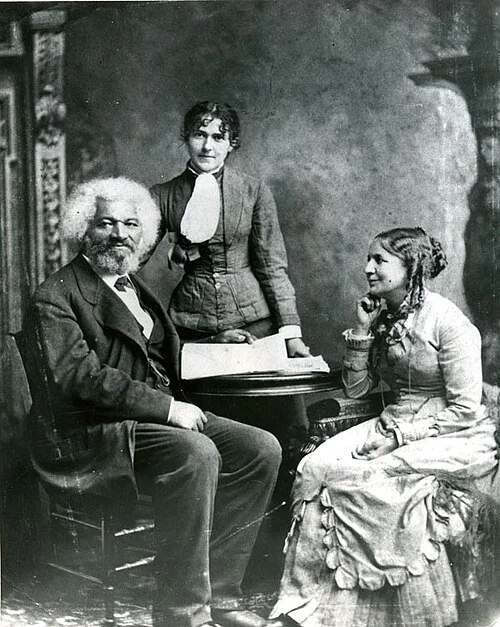
This photo presents a modern print reproduced from a historic public-domain photograph of Frederick Douglass (1818–1895), his second wife, Helen Pitts Douglass (1838–1903), seated to his right, and Helen’s sister, Eva Pitts, seated in the center, circa 1880. Helen Pitts Douglass was a ninth- or tenth-generation descendant of six Mayflower passengers: John Alden, Priscilla Mullins, William Mullins, Alice Mullins, Thomas Rogers, and Richard Warren. American Ancestors specifically identifies all six in its genealogical profile of Helen Pitts Douglass.
https://www.americanancestors.org/gary-boyd-roberts/kipling
Their marriage in 1884 joined one of the most prominent Black abolitionists and civil-rights advocates of the nineteenth century with a white abolitionist and women’s-rights activist whose ancestry extended directly to the Mayflower generation.
Frederick Douglass: From Enslavement to National Advocate
Frederick Douglass was born into slavery in Maryland in 1818. After escaping in 1838, he became one of the most influential abolitionists, writers, orators, publishers, and political thinkers in American history.
The National Park Service describes Douglass as a formerly enslaved man who became America’s foremost abolitionist as well as a suffragist, publisher, and author. Through speeches, newspapers, autobiographies, political activism, and public service, he spent decades challenging slavery and advocating for racial equality and expanded civil rights.
Douglass also became an important supporter of women’s suffrage. He attended the 1848 women’s-rights convention at Seneca Falls and publicly supported women’s right to vote at a time when the position remained controversial even among reformers.
After the Civil War, Douglass continued his advocacy while also serving in prominent federal positions, including Recorder of Deeds for the District of Columbia and U.S. Minister Resident and Consul General to Haiti. His public life continued to center on questions of citizenship, racial justice, political participation, and equality.
Helen Pitts Douglass: Mayflower Descendant and Advocate in Her Own Right
Helen Pitts was born in Honeoye, New York, into an abolitionist family.
Her connection to the Mayflower was substantial. The Mount Holyoke Alumnae Association describes Helen as a descendant of six Mayflower passengers, placing her firmly within the history of later generations descended from the Plymouth settlers.
Helen graduated from Mount Holyoke Female Seminary in 1859. During the Civil War era, she traveled to Virginia and taught African American students in a school established for formerly enslaved people. Later, in Washington, D.C., she became involved with the women’s-rights newspaper The Alpha and worked on issues including women’s suffrage and social reform.
The National Park Service describes her as an activist who worked for both racial equality and women’s rights. By the early 1880s she was employed as a clerk in the office of the Recorder of Deeds, where Frederick Douglass was serving as Recorder.
Helen therefore should not be understood simply as “Frederick Douglass’s wife.” She had already developed her own commitments to abolition, education, racial equality, and women’s rights before their marriage.
A Marriage That Challenged the Color Line
Frederick Douglass’s first wife, Anna Murray Douglass, died in 1882 after approximately four decades of marriage. Anna had played a crucial role in Douglass’s escape from slavery and participated in antislavery work throughout their marriage.
In January 1884, Frederick Douglass and Helen Pitts married.
Their interracial marriage generated intense public controversy. Douglass was Black and Helen was white, and opposition came from portions of both the white and Black communities as well as from members of their own families. Contemporary newspapers treated the marriage as sensational news, while Helen’s father—despite his own history as an abolitionist—broke with his daughter over the marriage.
Helen defended the marriage as a matter of personal equality and individual choice. Douglass likewise rejected the idea that race should determine whom a person could love or marry.
Their union therefore became, intentionally or not, another public challenge to nineteenth-century racial boundaries.
The couple remained married until Douglass’s death in 1895.
Partners in Advocacy
The Douglasses shared interests extending well beyond their marriage.
Helen participated in Frederick’s intellectual and professional life, managing correspondence and assisting with his work while he continued to lecture and write on racial justice and women’s rights. Mount Holyoke’s historical account notes that some of Douglass’s lengthy speeches survive in Helen’s handwriting and describes her as an important sounding board for his ideas.
Their household at Cedar Hill also became part of a wider reform community. Advocates including journalist and anti-lynching activist Ida B. Wells visited them, and the couple continued to engage with issues involving racial discrimination, women’s equality, political rights, and social reform.
This makes the pair especially appropriate for the Museum’s Advocates Collection: they were connected not merely through marriage, but through overlapping commitments to expanding the meaning of American freedom and equality.
Helen Pitts Douglass and the Preservation of Cedar Hill
Helen’s work did not end with Frederick Douglass’s death.
When Douglass died suddenly at Cedar Hill in 1895, problems with his will threatened Helen’s ability to retain the property. She took out a large mortgage and purchased the interests of other heirs because she was determined to preserve the house as a memorial to his life.
Her efforts ultimately led to the creation of the Frederick Douglass Memorial and Historical Association, chartered by Congress in 1900 for the purpose of preserving Douglass’s life and legacy. Helen left Cedar Hill and most of its contents to the organization when she died in 1903.
The preservation effort continued through the work of Black women and organizations including the National Association of Colored Women’s Clubs. Cedar Hill ultimately entered the National Park System and is preserved today as the Frederick Douglass National Historic Site.
Helen’s decision to save the house is therefore part of the reason visitors today can enter Douglass’s home, view his possessions, and study his life in the place where he spent his final years.
Helen Pitts Douglass creates a particularly meaningful bridge between Mayflower-descendant history and the struggle to broaden American freedom centuries later.
She inherited ancestry reaching back to Mayflower passengers, but the significance of her story does not lie merely in genealogy. She grew up in an abolitionist household, taught African American students during the Civil War era, advocated for women’s rights, entered an interracial marriage despite extraordinary social opposition, and devoted her later life to preserving the legacy of one of America’s most important Black abolitionists.
Her life demonstrates something central to the Museum’s approach to descendant history: ancestry alone does not tell the whole story. What later generations chose to believe, defend, challenge, preserve, and change is equally important.
Frederick Douglass was not a Mayflower descendant. His connection to this collection comes through Helen Pitts Douglass—and through the extraordinary intersection of their lives.
Together, their story connects the Mayflower generation with nineteenth-century movements for abolition, racial equality, women’s suffrage, interracial freedom, and historic preservation.
About the Museum Object
Modern interpretive photographic print
Subjects: Frederick Douglass (1818–1895) and Helen Pitts Douglass (1838–1903)
Historic image reproduced from a public-domain photographic source
Frederick Douglass: abolitionist, author, publisher, orator, suffragist, and public official
Helen Pitts Douglass: abolitionist, women’s-rights advocate, preservationist, and Mayflower descendant
Married: 1884–1895
Holdings of the Mayflower Descendants Museum
Sources & Further Reading
U.S. National Park Service, Frederick Douglass National Historic Site, “Frederick Douglass.”
Provides an overview of Douglass’s birth into slavery, escape, abolitionist career, writing, support for women’s suffrage, and later public service.
https://www.nps.gov/people/frederick-douglass.htm
U.S. National Park Service, Frederick Douglass National Historic Site, “People.”
Provides biographical information on Frederick Douglass, Anna Murray Douglass, and Helen Pitts Douglass and identifies Helen’s work for racial equality and women’s rights.
https://www.nps.gov/frdo/learn/historyculture/people.htm
Mount Holyoke Alumnae Association, “Right is of No Sex. Truth is of No Color.”
Provides an extensive biography of Helen Pitts Douglass, including her descent from six Mayflower passengers, Mount Holyoke education, antislavery family background, teaching of African American students, work in the women’s-rights movement, marriage to Douglass, and later preservation work.
https://alumnae.mtholyoke.edu/blog/right-is-of-no-sex-truth-is-of-no-color/
U.S. National Park Service, “The Saviors of Cedar Hill.”
Documents Helen Pitts Douglass’s efforts after Frederick Douglass’s death to purchase and preserve Cedar Hill and establish the Frederick Douglass Memorial and Historical Association.
https://www.nps.gov/frdo/learn/historyculture/the-saviors-of-cedar-hill.htm
U.S. National Park Service, “Frederick Douglass and the Power of Photography.”
Discusses Douglass’s understanding of photography as a powerful tool for representation and includes historic photographs associated with Douglass and the Pitts family.
https://www.nps.gov/articles/000/frederick-douglass-and-the-power-of-photography.htm