
Mayflower Descendant Helen Keller: Author and International Advocate for Disability Rights, Women’s Suffrage, and Social Justice
Mayflower Descendant Helen Keller: Author and International Advocate for Disability Rights, Women’s Suffrage, and Social Justice
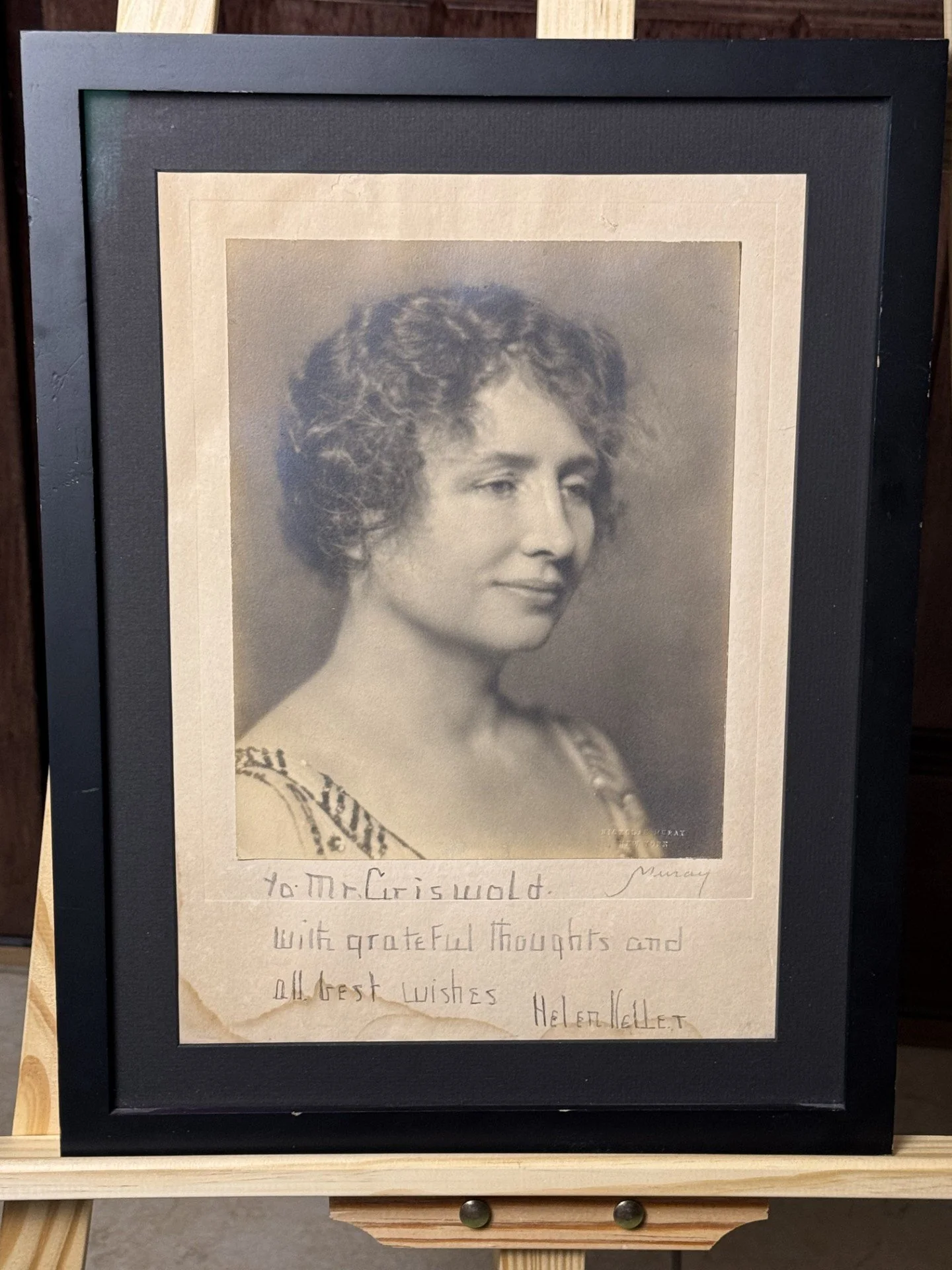
This is an original photographic portrait of Helen Keller (1880–1968) by noted photographer Nickolas Muray (1892–1965). The photograph bears Muray’s name and is personally inscribed by Keller:
“To Mr. Griswold — With grateful thoughts and all best wishes — Helen Keller.”
But who was Mr. Griswold?
That question had already become a public mystery by the 1990s.
On March 13, 1995, the Liverpool Echo in Liverpool, England, published a reader inquiry concerning an autographed photograph of Helen Keller bearing the same inscription. A reader identified as Mrs. R. Garner of Kirkby asked the newspaper for information about Keller and, specifically, whether it could determine who “Mr Griswold” was.
The newspaper provided a brief account of Keller’s life but acknowledged that it had been unable to identify him, concluding:
“We have drawn a blank with Mr Griswold, though. Can any reader help?”
Liverpool Echo, March 13, 1995, p. 13.
The clipping provides no answer, and in the Museum’s research so far, we have not located a published follow-up from the newspaper identifying Mr. Griswold.
The wording of Keller’s inscription makes the mystery particularly intriguing. Her phrase “with grateful thoughts” suggests a meaningful reason for the gift, although the inscription alone cannot tell us what that reason was. Was Griswold someone who assisted Keller personally? Someone who supported her work? Or someone connected to the extensive network of individuals and organizations surrounding her advocacy?
Research by the Mayflower Descendants Museum may now have uncovered a possible answer. The Museum plans to share its findings, the evidence behind the possible identification, and the questions that remain in an upcoming social-media story as part of our “Erased, Forgotten, Lost to Time, and Hidden” collection.
A Mayflower Descendant
Helen Keller was also a Mayflower descendant.
Published genealogical research traces her ancestry to three passengers aboard the Mayflower in 1620: Isaac Allerton, Governor William Bradford, and Richard Warren, with two separate lines of descent from Warren. (FamousKin — Helen Keller)
Although Keller is often remembered through the extraordinary story of her childhood and her education with Anne Sullivan (1866–1936)—her teacher and longtime companion, who taught Keller to communicate by spelling words into her hand—her adult life became an equally remarkable story of authorship, public speaking, travel, and advocacy.
Keller entered Radcliffe College in 1900 and graduated in 1904, becoming the first deafblind person to earn a Bachelor of Arts degree. She subsequently built an international career as an author, lecturer, activist, and advocate. (American Foundation for the Blind — Helen Keller Chronology)
Her work extended well beyond blindness and disability. Keller supported women’s suffrage, workers’ rights, civil liberties, and pacifism, while devoting much of her public career to expanding education, rehabilitation, employment, and opportunity for people who were blind, deafblind, and otherwise disabled. (American Foundation for the Blind — Helen Keller Biography)
From National Advocacy to a Worldwide Mission
In 1924, Keller began working with the American Foundation for the Blind, beginning a relationship that would last for more than forty years.
She traveled throughout the United States speaking and advocating for improved education, rehabilitation, services, employment opportunities, and legal protections for people with vision loss. (American Foundation for the Blind — Helen Keller Biography)
Her work helped draw national attention to the lives and needs of blind Americans. The American Foundation for the Blind records that Keller traveled extensively, addressed legislatures, helped promote the establishment of services for blind people, and became one of the organization’s most visible representatives. (American Foundation for the Blind — AFB History)
Keller’s advocacy eventually became international in scale.
In 1946, when the American Braille Press became the American Foundation for Overseas Blind, Keller was appointed counselor on international relations. During seven major international journeys between 1946 and 1957, she visited 35 countries on five continents. Across her broader travels, the American Foundation for the Blind records Keller as having visited 39 countries. (American Foundation for the Blind — Helen Keller Biography)
She met national leaders, diplomats, educators, disability advocates, and communities around the world, using her international prominence to focus attention on opportunities and services for blind and disabled people.
An Early Presidential Connection
Keller’s encounters with national leaders began remarkably early.
In May 1888, seven-year-old Helen traveled to Washington, D.C., with Anne Sullivan and her mother, Kate Keller. During the trip, they visited the White House and met President Grover Cleveland. (American Foundation for the Blind — Early Fame)
Grover Cleveland (1837–1908) served as the 22nd president of the United States from 1885 to 1889 and the 24th president from 1893 to 1897, becoming the first U.S. president to serve two nonconsecutive terms. (Library of Congress — Grover Cleveland: A Resource Guide)
Keller would go on to know, meet, or correspond with generations of American presidents and other national leaders during her lifetime. The American Foundation for the Blind documents presidential encounters extending through the administration of John F. Kennedy. (American Foundation for the Blind — Helen Keller Biography)
The Helen Keller World Crusade for the Blind
Keller’s international advocacy was further advanced through the Helen Keller World Crusade for the Blind, associated with the American Foundation for Overseas Blind.
Surviving campaign material preserved in the Helen Keller Archive of the American Foundation for the Blind reveals the extraordinary range of prominent Americans connected with efforts carried out in Keller’s name.
Among them was Walt Disney (1901–1966).
An archival fundraising appeal for the Helen Keller World Crusade for the Blind lists Walt Disney as a member of its National Committee, placing him among prominent individuals who lent their names and support to the campaign’s work on behalf of blind people internationally. (Helen Keller Archive, American Foundation for the Blind — World Crusade document)
Disney was also a Mayflower descendant.
Published genealogical research identifies Mayflower passenger John Billington as Walt Disney’s eighth-great-grandfather and traces the family through John’s son Francis Billington, who also traveled aboard the Mayflower in 1620. The source trail includes published Mayflower-family research, including volumes of the General Society of Mayflower Descendants’ Mayflower Families Through Five Generations. (FamousKin — John Billington and Walt Disney)
Disney therefore provides one documented example of a Mayflower descendant supporting another Mayflower descendant centuries after the 1620 voyage.
The Mayflower Descendants Museum is continuing to research Keller’s extraordinarily broad network to determine what other Mayflower descendants may have supported her life, work, and advocacy.
A Remarkably Broad Network
By the middle decades of the twentieth century, Keller’s professional world extended across government, philanthropy, publishing, business, education, entertainment, disability organizations, and international affairs.
That wider network is particularly important when considering the mystery of “Mr. Griswold.”
Identifying the recipient of Keller’s photograph from a surname alone is difficult precisely because so many individuals passed through the enormous network surrounding her life and advocacy—but that network also provides a path through which the Museum can search.
The Photographer: Nickolas Muray
The photographer behind the portrait adds another significant layer to the object’s history.
Nickolas Muray (1892–1965) was a Hungarian-born American photographer known for portraiture, fashion photography, advertising, and pioneering work in color photography. He immigrated to the United States in 1913 and opened his own New York photography studio in 1920.
Muray received regular commissions from major publications including Harper’s Bazaar and Vanity Fair, photographing actors, artists, musicians, dancers, models, and other prominent cultural figures.
During the 1930s, he became a master of the carbro color-printing process and established one of the early commercial color laboratories in the United States. (Smithsonian Archives of American Art — Nickolas Muray Papers)
His sitters included many of the best-known personalities of his era. He is especially remembered today for his celebrated photographs of Mexican artist Frida Kahlo, with whom he also had a longstanding personal relationship. (Smithsonian Archives of American Art — Nickolas Muray Papers)
Muray’s authorship means the Museum’s portrait brings together two important twentieth-century figures: Keller as the sitter and Muray as the photographer.
The personal inscription adds a third individual to that story.
Who Was Mr. Griswold?
The identity of the “Mr. Griswold” to whom Helen Keller inscribed this portrait remains an intriguing part of the object’s history.
The Mayflower Descendants Museum’s research has uncovered a possible identification: an individual named Griswold whose documented history may connect him to the broader network surrounding Keller and her advocacy.
For now, the Museum is treating that identification as a research hypothesis rather than a final conclusion.
The photograph therefore fits naturally within the Museum’s “Erased, Forgotten, Lost to Time, and Hidden” collection—stories in which identities, relationships, or meanings once known have become obscured or separated from their original context and may be recoverable through research.
The Museum will share the possible identification, the evidence supporting it, and the questions that remain in an upcoming social-media story.
Holdings of the Mayflower Descendants Museum.
Sources and Further Reading
American Foundation for the Blind — Helen Keller: Biography and Chronology
Overview of Keller’s education, advocacy, international travel, work with the American Foundation for the Blind, and relationships with national leaders.
Helen Keller Biography
Chronology of Helen Keller’s Life
American Foundation for the Blind — “Early Fame”
Documents Keller’s May 1888 trip to Washington, D.C., and her meeting with President Grover Cleveland at the White House.
Read “Early Fame”
Library of Congress — Grover Cleveland: A Resource Guide
Identifies Cleveland as the 22nd and 24th president of the United States and documents his two nonconsecutive presidential terms.
Grover Cleveland: A Resource Guide
Helen Keller Archive, American Foundation for the Blind — Helen Keller World Crusade for the Blind
Archival campaign material listing Walt Disney as a member of the National Committee supporting the Helen Keller World Crusade for the Blind.
View the World Crusade document
FamousKin — John Billington and Walt Disney
Identifies Mayflower passenger John Billington as Walt Disney’s eighth-great-grandfather and traces the family through Francis Billington.
John Billington — Walt Disney Genealogy
FamousKin — Helen Keller Genealogy
Published genealogical research tracing Keller to Mayflower passengers Isaac Allerton, William Bradford, and Richard Warren.
Helen Keller — Mayflower Ancestry
Smithsonian Archives of American Art — Nickolas Muray Papers
Biographical information concerning Muray’s career, photographic work, color processes, major commissions, and relationship with Frida Kahlo.
Nickolas Muray Papers — Biographical Note
American Foundation for the Blind — History of AFB
Background on the organization with which Keller worked for more than four decades and its development of services and advocacy for blind and low-vision people.
American Foundation for the Blind — History
Liverpool Echo, March 13, 1995, p. 13
Reader inquiry concerning an inscribed Helen Keller photograph and the unresolved identity of “Mr Griswold.”