
Charlotte Cushman—Mayflower Descendant, Actress, Patron, and Advocate for Women Artists
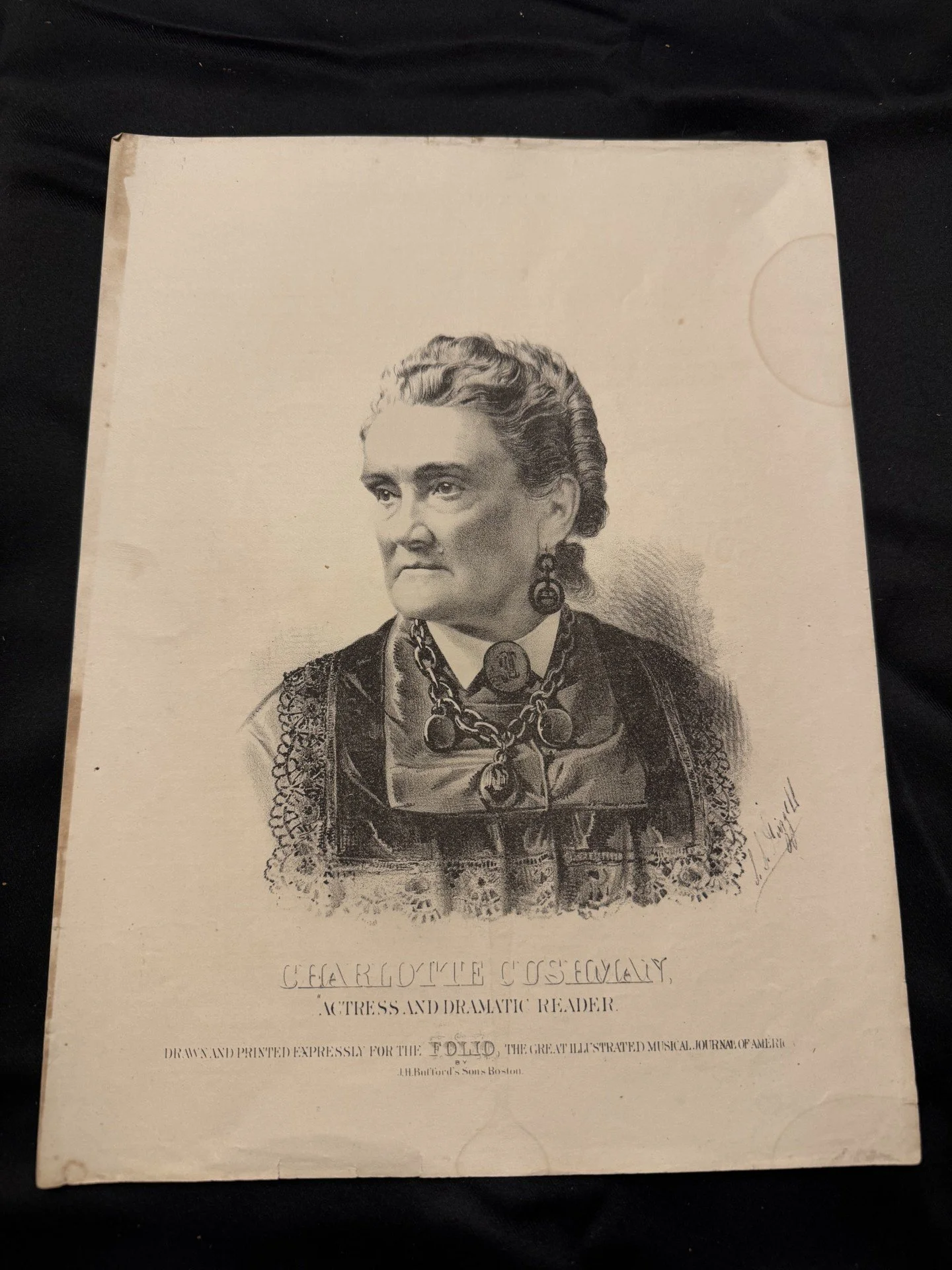
This preview features a nineteenth-century lithographic portrait of Charlotte Cushman (1816–1876), drawn by Samuel S. Frizzell and printed in Boston by J. H. Bufford’s Sons expressly for The Folio: The Great Illustrated Musical Journal of America. The portrait identifies Cushman as both an “Actress, and Dramatic Reader,” reflecting the celebrated performer’s later career, when public dramatic readings became an important part of her work. Cushman achieved international fame performing both female and male roles, including Lady Macbeth, Hamlet, and Romeo. Her career, personal independence, support of other women, and willingness to challenge the social and professional expectations of her era make her an important figure in the history of women in the arts.
A Mayflower Descendant
Cushman was a Mayflower descendant through Mary Allerton, who crossed the Atlantic aboard the Mayflower in 1620 as a young child with her parents, Isaac Allerton and Mary Norris Allerton. Mary later married Thomas Cushman, and historical genealogical accounts trace Charlotte Cushman’s family directly through their descendants. Mary Allerton, who died in 1699, is remembered as the last surviving passenger of the Mayflower.
https://www.gutenberg.org/cache/epub/70031/pg70031-images.html
Cushman’s story therefore connects one of the most prominent American performers of the nineteenth century directly to the generation that arrived at Plymouth in 1620.
Challenging the Limits Placed on Women
Cushman built her career during a period when women faced substantial restrictions in professional and public life. Rather than allowing male managers to control her career, she managed her own professional affairs and demanded pay equal to that of male actors. The Smithsonian’s National Portrait Gallery notes both her insistence on equal pay and the ways she challenged conventional gender expectations onstage and off.
https://npg.si.edu/object/npg_NPG.72.15
Her performances themselves also challenged convention. Cushman became famous not only for powerful female characters such as Lady Macbeth but for taking on major male Shakespearean roles, including Hamlet and Romeo. Her performances helped make her an international theatrical celebrity at a time when a woman exercising this degree of professional and financial independence was unusual.
Creating Opportunities for Other Women
Cushman did not limit that independence to her own career. By the 1850s she had become a central figure in a community of American women artists and writers living in Rome. The Smithsonian’s National Museum of American History describes women in Cushman’s circle as independent women who produced art, challenged expectations about women’s appearance and behavior, and advocated for working women.
https://www.americanhistory.si.edu/explore/stories/woman-who-would-be-cardinal
Cushman used her fame, wealth, social connections, and home to support other women attempting to establish professional artistic careers. Her circle included sculptors Harriet Hosmer, Emma Stebbins, and Edmonia Lewis. Smithsonian research notes that Cushman sought to strengthen the careers of younger women artists in Rome, including Lewis, who faced additional barriers as a woman of Black and Native American ancestry.
In this way, Cushman’s advocacy was not simply theoretical. She created networks, opened doors, introduced artists to potential supporters, and used the influence she had earned through her own career to help other women pursue theirs.
Charlotte Cushman and Emma Stebbins
Her relationship with sculptor Emma Stebbins (1815–1882) is especially significant.
The Smithsonian’s National Portrait Gallery states directly that Cushman “lived as a lesbian” and had a long romantic relationship with Stebbins. The two women met in Rome in the 1850s and shared much of their lives thereafter.
Smithsonian Institution, National Portrait Gallery, “Charlotte Cushman.”
https://www.si.edu/object/charlotte-cushman%3Anpg_NPG.2017.118
Living such a relationship in the nineteenth century required navigating very different social expectations from those of today. Smithsonian Libraries and Archives notes that contemporary newspapers could celebrate the closeness between Cushman and Stebbins while avoiding describing their relationship as romantic because such a relationship between women would have been considered taboo. At the same time, close female partnerships could sometimes exist publicly under the socially acceptable language of friendship.
Cushman and Stebbins nevertheless lived together, traveled together, and worked alongside one another for years. Cushman even wrote in 1858 of being “already married” and wearing a ring on the third finger of her left hand in reference to her relationship with Stebbins. Their partnership endured through years of artistic work and illness, and Stebbins cared for Cushman during her declining health and later became her biographer.
Smithsonian Libraries and Archives, “Abiding Attachments: Artist Emma Stebbins and Actor Charlotte Cushman.”
https://blog.library.si.edu/blog/2020/06/17/abiding-attachments-artist-emma-stebbins-and-actor-charlotte-cushman/
Their story adds another dimension to Cushman’s challenge to nineteenth-century convention. She created an independent professional life, achieved financial success on her own terms, helped build a community in which women could pursue careers in the arts, and formed enduring relationships with women during an era in which those relationships could not be discussed publicly in the same terms available today.
A Connection to Emma Stebbins and Bethesda Fountain
Stebbins became an important American sculptor in her own right and is best remembered for Angel of the Waters, the monumental bronze figure at Bethesda Fountain in New York’s Central Park.
The connection is particularly meaningful within the Museum’s broader research and holdings because Cushman was not merely acquainted with Stebbins. Their lives and artistic worlds were deeply intertwined. Understanding Stebbins’s career therefore also means recognizing the community of women artists in Rome and the support network in which Cushman played such an important role.
Supporting the Union Cause
Cushman also used her prominence during the Civil War in support of the Union cause. Her papers and contemporary records document her participation in benefit performances associated with the United States Sanitary Commission, which provided assistance to Union soldiers during the war.
Her public influence therefore extended beyond the theater. Cushman used the celebrity and financial independence she had acquired as a performer to support causes and people she valued.
An Advocate Through Action
Charlotte Cushman represents a different form of advocacy from Frederick Douglass, Helen Pitts Douglass, or Helen Keller.
Much of Cushman’s advocacy can be seen in what she did: demanding professional equality for herself, achieving extraordinary financial and artistic independence, challenging expectations surrounding women and gender, supporting working women and women artists, using her celebrity to advance the careers of others, and living a personal life that did not conform to many of the expectations placed on nineteenth-century women.
Her story also creates remarkable connections across the Museum’s developing collection and research—from her Mayflower ancestor Mary Allerton to Emma Stebbins and Edmonia Lewis. Through Cushman, Mayflower history intersects with American theater, women’s professional advancement, nineteenth-century art, and the history of same-sex relationships in America.
Holdings of the Mayflower Descendants Museum.