Ruth Payne Burgess — Mayflower Descendant, Watercolorist, and Advocate for Women Artists
Ruth Payne Jewett Burgess (1865–1934) was an American painter whose career encompassed portraiture, still life, landscape, oil painting, and watercolor. Born in Montpelier, Vermont, she studied at the Art Students League of New York and continued her artistic development in Europe, painting in Germany and Italy. Her subjects ranged from landscapes to prominent sitters; while living in Germany, she painted Prince August Wilhelm of Prussia, the second son of Kaiser Wilhelm II. The Smithsonian American Art Museum today holds her 1924 painting Green Chinese Jar. (Smithsonian American Art Museum)
Burgess was also a Mayflower descendant through the family of passenger Stephen Hopkins and his daughter Constance Hopkins. Hopkins traveled aboard the Mayflower in 1620 with members of his family, including Constance, who later married Nicholas Snow and left numerous descendants. (The Mayflower Society)
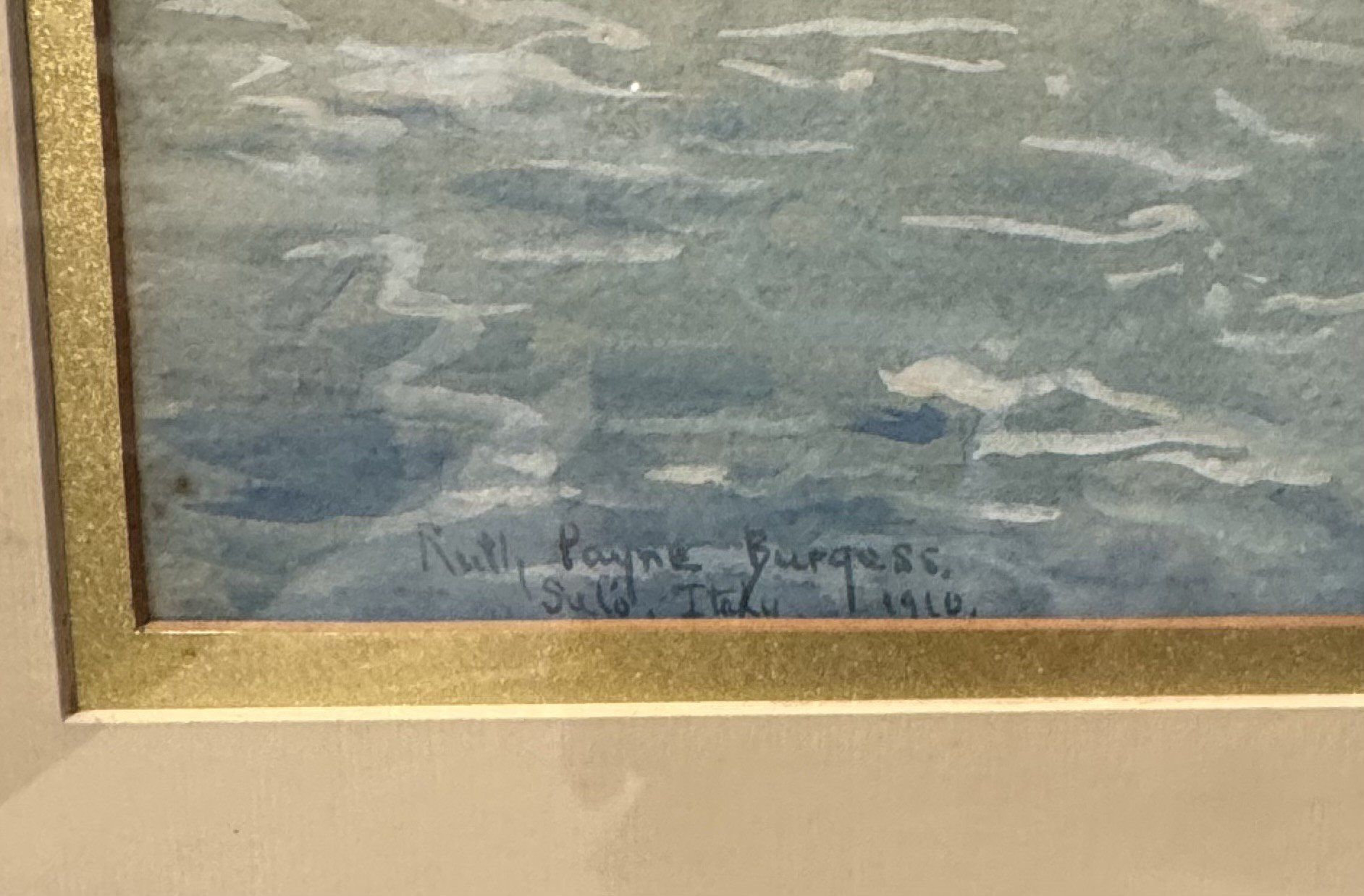
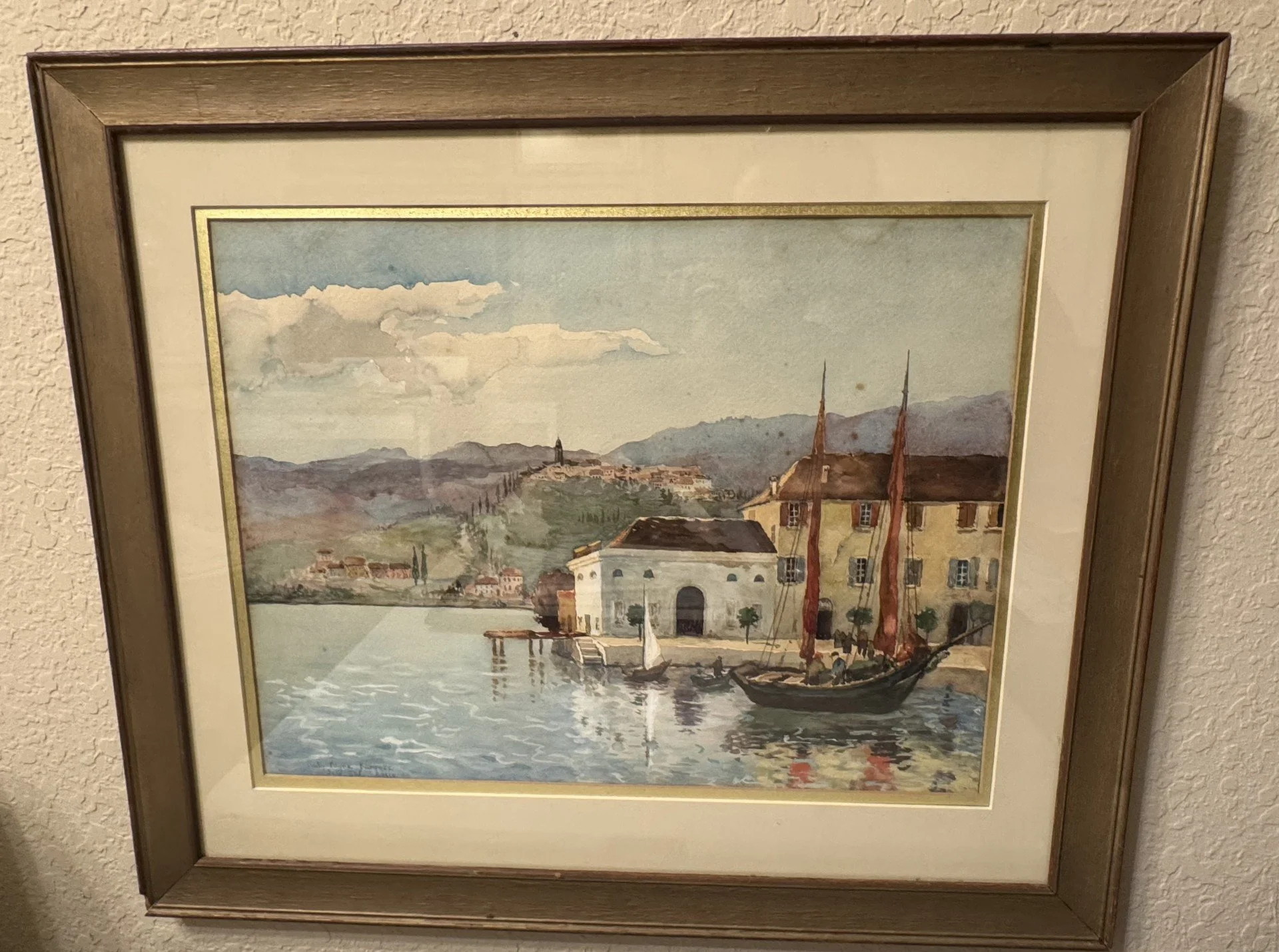
Shown here is one of two watercolors by Burgess in the holdings of the Mayflower Descendants Museum. The inscription at lower right reads “Salò, Italy 1910.” Salò lies on the western shore of Lake Garda in northern Italy. The identification corresponds closely with the scene Burgess painted: buildings gathered along the water, boats near shore, reflections across the lake, and mountains rising beyond. Her presence in Italy also corresponds with the European travels documented in her Smithsonian biography. (Smithsonian American Art Museum)
An American Artist in Italy
The Salò watercolor provides a particularly direct record of Burgess’s European experience. Watercolor remained an important part of her artistic practice, and the extensive John and Ruth Burgess Collection at the Jones Library in Amherst preserves a substantial body of her artwork, sketches, correspondence, photographs, and exhibition material. The archive also preserves National Academy of Design correspondence and an exhibition ticket among her papers. (Jones Library)
The Museum’s watercolor therefore records more than a picturesque stop on an American artist’s European travels. Dated and located by Burgess herself, it preserves a particular moment in her career and connects her directly to the Italian landscapes that became part of her body of work.
Nine National Academy Exhibitions — But Not an Academician
Burgess built her career during a period when women were increasingly entering professional art schools, organizations, and major exhibitions while still remaining significantly underrepresented within some of the institutions that conferred professional recognition.
Her relationship with the National Academy of Design is particularly revealing. Exhibition at the National Academy and election to the Academy were different achievements. Artists could submit work for consideration in the Academy’s annual exhibitions without receiving the elected designation of Associate National Academician, or ANA, and ultimately National Academician, or NA. Membership involved a separate process of nomination and election. Smithsonian Archives of American Art — National Academy of Design Records
Burgess exhibited at the National Academy repeatedly, yet she was never elected to either rank.
Gender provides important historical context for understanding that distinction, although the surviving evidence does not establish that Burgess’s sex was the reason she was not elected.
Women had been permitted membership in the National Academy since its early years, but they represented only a small fraction of its elected membership. Art historian Diana Seave Greenwald’s analysis of National Academy records found that from 1825 through 1900 only eleven women were elected Associate members, while Ann Hall was the only woman elected a full National Academician during that period. No other woman was elected to full Academician status until Mary Cassatt in 1909. Across the longer period from 1825 to 1953, women represented less than six percent of artists elected to the Academy. Diana Seave Greenwald, Painting by Numbers: Data-Driven Histories of Nineteenth-Century Art — JSTOR
Women’s presence in the Academy’s exhibitions was considerably greater than their representation among elected members. Greenwald’s analysis found that women produced approximately 12 percent of the works exhibited at the National Academy between 1826 and 1900; after the Civil War, works by women routinely represented approximately 15 to 20 percent of those displayed. Diana Seave Greenwald, Painting by Numbers — JSTOR
Women also did not initially receive equal access to all of the Academy’s educational opportunities. The Smithsonian Archives of American Art notes that when the National Academy introduced life classes in 1837, they were restricted to advanced male students. A life class for women was not established until 1857. Smithsonian Archives of American Art — National Academy of Design Records
That context is particularly relevant to Burgess. She succeeded repeatedly in having her work accepted for National Academy exhibitions, while elected Academy membership remained beyond her reach. Her experience therefore occurred within an institution in which women were increasingly visible as exhibiting artists while remaining a small minority among those receiving the additional professional distinction of elected membership.
Creating Opportunities for Women Artists
Burgess did not confine her professional ambitions to established institutions. She became deeply involved with the Woman’s Art Club of New York, an organization created to provide women with opportunities to exhibit and develop professional careers. She served as its president from 1905 to 1910. The organization survives today as the National Association of Women Artists and continues to list Burgess among its past presidents. (NAWA)
Under Burgess’s direction, the Woman’s Art Club became a firmly established organization with approximately one hundred members. The organization’s own history places her leadership within a period when women artists were beginning to gain greater visibility, prizes, and professional opportunities. (NAWA)
Burgess also supported those opportunities with substantial personal resources. The Smithsonian American Art Museum records that she donated more than $1,000 to support prizes and exhibitions sponsored by the organization. (Smithsonian American Art Museum)
The scale of that commitment is easier to understand in modern terms. Using the Federal Reserve Bank of Minneapolis historical consumer-price estimates, $1,000 during Burgess’s 1905–1910 presidency represents approximately $36,000–$37,000 in 2026 purchasing power. Because the Smithsonian specifies that she contributed more than $1,000, her actual support exceeded that modern equivalent. The Federal Reserve notes that CPI figures before 1913 are historical estimates rather than modern federal CPI measurements. (Federal Reserve Bank of Minneapolis)
Her contribution was therefore not symbolic. Burgess was committing substantial personal money to exhibitions and prizes that could help other women gain the visibility and professional recognition they needed to build careers.
A Career Beyond Her Own Paintings
Burgess’s story consequently reaches beyond the works she produced herself. She exhibited within the established American art world, traveled and painted internationally, and at the same time helped strengthen an organization designed to expand opportunities for women artists.
The contrast is particularly meaningful: an artist whose work appeared repeatedly in National Academy exhibitions, yet who does not appear in the records consulted as an elected ANA or NA, became president of a women’s art organization and invested the modern equivalent of tens of thousands of dollars in helping other artists exhibit and compete for prizes.
The two Burgess watercolors held by the Mayflower Descendants Museum preserve the quieter, observational side of that career. The 1910 Salò watercolor captures the architecture, boats, water, mountains, and changing atmosphere of Lake Garda through the immediacy of watercolor.
Seen within her larger history, the work connects several parts of Burgess’s life: a Mayflower-descendant artist from Vermont, professionally active in New York, traveling and painting in Europe, exhibiting before major American art audiences, and helping create stronger professional opportunities for women artists.
Holdings of the Mayflower Descendants Museum
Sources and Further Reading
Smithsonian American Art Museum — Ruth Payne Burgess. Biography documenting Burgess’s training, European travels, painting in Italy and Germany, portraiture, presidency of the Woman’s Art Club, and donation of more than $1,000 for prizes and exhibitions.
Read the Smithsonian biography (Smithsonian American Art Museum)
Smithsonian American Art Museum — Green Chinese Jar, 1924. Collection record for Burgess’s oil painting in the Smithsonian collection.
View Green Chinese Jar (Smithsonian American Art Museum)
Jones Library, Amherst — John and Ruth Burgess Collection. Extensive archive containing Ruth Payne Burgess’s artwork, correspondence, sketches, photographs, exhibition material, and National Academy documentation.
Explore the Burgess Collection (Jones Library)
National Association of Women Artists — Leadership. Records Ruth Payne Burgess as president from 1905 to 1910.
View NAWA's leadership history (NAWA)
National Association of Women Artists — The Early Years. Discusses Burgess’s leadership and the growth of the Woman’s Art Club to approximately one hundred members.
Read about the organization's early history (NAWA)
Federal Reserve Bank of Minneapolis — Consumer Price Index, 1800–. Historical purchasing-power data used to place Burgess’s more-than-$1,000 contribution in modern context; the Federal Reserve identifies pre-1913 values as estimates.
Explore the historical CPI data (Federal Reserve Bank of Minneapolis)
General Society of Mayflower Descendants — The Hopkins Family. History of Mayflower passenger Stephen Hopkins and his family, including his daughter Constance Hopkins.
Explore the Hopkins family history (The Mayflower Society)