
William Sergeant Kendall
An Artistic Connection to Mayflower Descendant Walter Gay
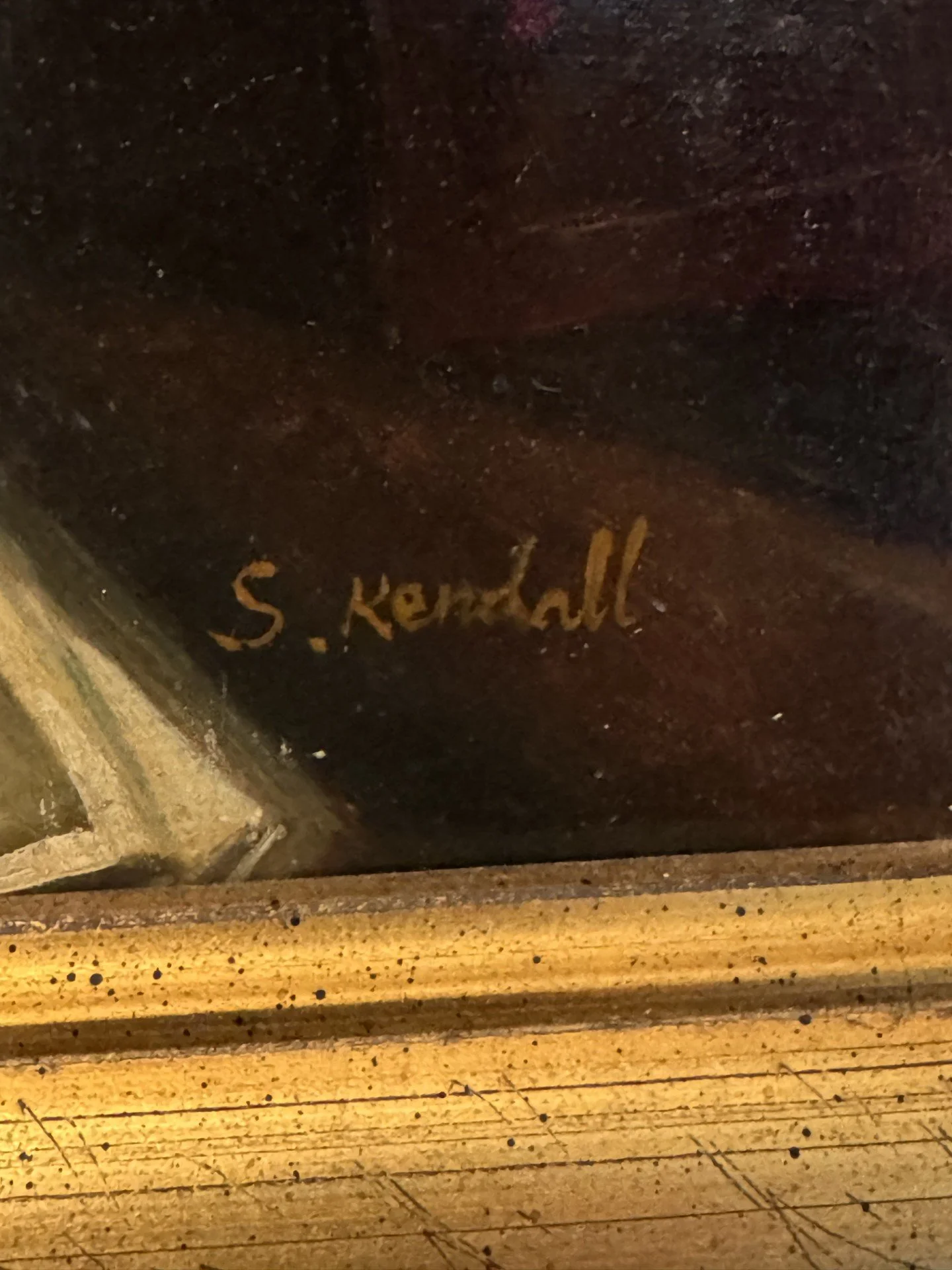
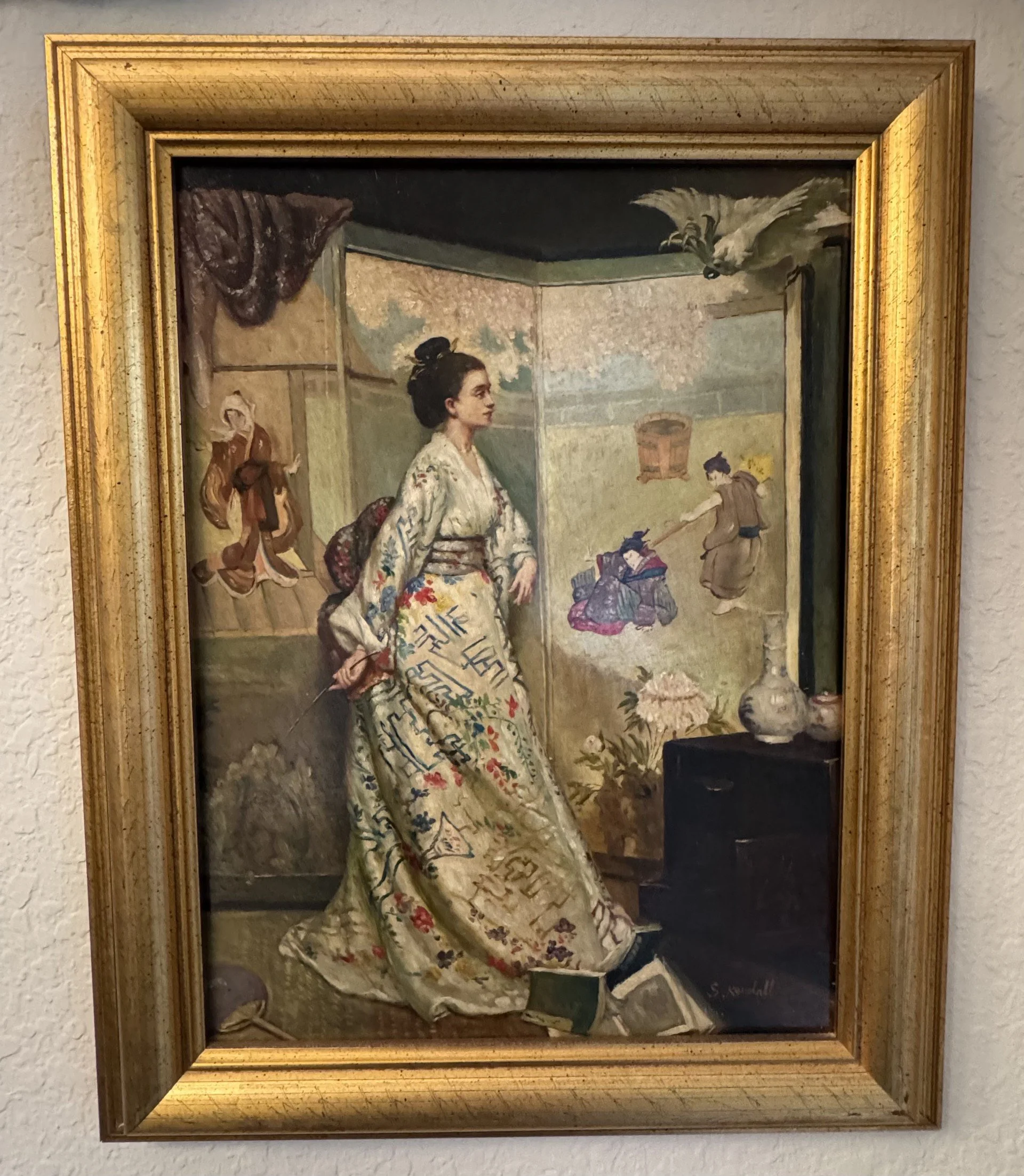
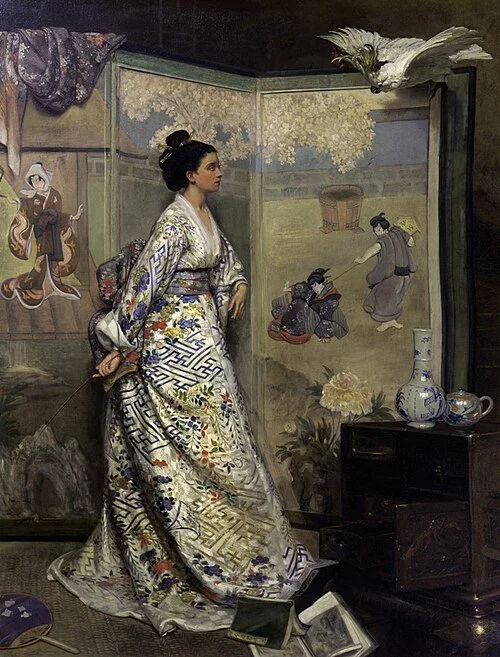
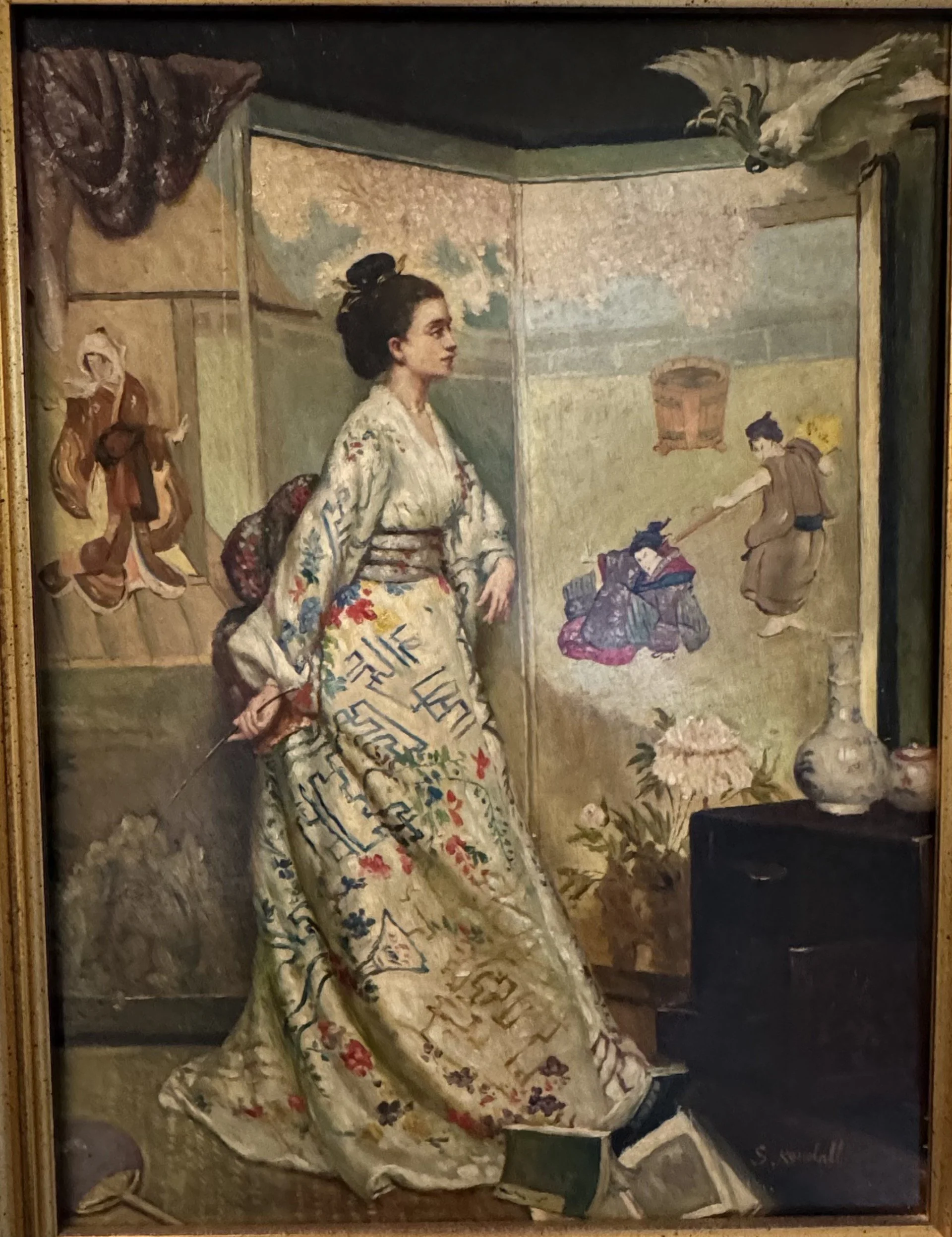
Pictured: Close-up comparison of Kendall’s painting (left) and the original work by de Jonghe (right) that Kendall copied. Artists have copied the work of other artists for centuries as a way to study technique, composition, color, and handling of paint. This comparison reveals how a young American artist studied a European master to learn the language of paint.
The Mayflower Descendants Museum’s holdings include a painting signed “S. Kendall” and attributed to American artist William Sergeant Kendall (1869–1938), after Belgian painter Gustave Léonard de Jonghe (1829–1893) and his circa-1865 composition The Japanese Fan.
De Jonghe’s original, also known by the French title L’Admiratrice du Japon, reflects the nineteenth-century European fascination with Japanese art and decorative objects. The painting is now in the collection of the Cummer Museum of Art & Gardens in Jacksonville, Florida. Learn more through the Cummer Museum.
Gustave Léonard de Jonghe
Gustave Léonard de Jonghe (1829–1893) was a Belgian painter who trained at the Royal Academy of Fine Arts in Brussels and spent much of his career in Paris, becoming particularly known for elegant portraits and genre scenes depicting fashionable women and bourgeois family life.
His work is represented in major museum collections including the Musée d’Orsay in Paris, the State Hermitage Museum in St. Petersburg, the Royal Museum of Fine Arts Antwerp, the Museum of Fine Arts Ghent, and the Clark Art Institute in Massachusetts. A painting by de Jonghe now at the Musée d’Orsay was formerly held by the Musée du Louvre before being transferred to the Musée d’Orsay.
William Sergeant Kendall
Kendall began his artistic training while still a teenager and studied under Thomas Eakins, first at the Brooklyn Art Guild and later at the Pennsylvania Academy of the Fine Arts. After additional study at the Art Students League in New York, he traveled to France, where he continued his training and spent summers painting in Brittany. Learn more through the U.S. Commission of Fine Arts.
He became particularly known for portraits and intimate scenes of domestic life, frequently using his wife and daughters as subjects. Kendall was elected an Associate of the National Academy of Design in 1901 and a full Academician in 1905. Learn more through the National Academy of Design.
His career eventually combined painting with significant leadership in American art education. In 1913, Kendall became dean of the Yale School of Fine Arts, a position he held until 1922. Yale’s institutional history records his tenure as dean from 1913 to 1922. Learn more through Yale University.
Kendall’s papers are today preserved by the Smithsonian Archives of American Art. View the William Sergeant Kendall papers through the Smithsonian.
Although the Museum has not identified Kendall himself as a Mayflower descendant, his professional career brought him directly together with an artist who was.
Copying Earlier Masters in Kendall’s Practice
The Museum’s painting is based upon de Jonghe’s The Japanese Fan, c. 1865. Although further research into the Museum’s signed painting is ongoing, copying and studying the work of earlier artists was a documented part of William Sergeant Kendall’s artistic development.
In 1887, Kendall painted a copy after Charles Willson Peale that is now held by the Princeton University Art Museum and inscribed by Kendall “after C.W. Peale 1786.” In 1891, while studying in Europe, Kendall traveled to Madrid specifically to study and copy the work of Diego Velázquez.
These documented examples provide important context for the Museum’s painting and its relationship to de Jonghe’s earlier composition.
If the Museum’s estimated dating is correct, Kendall’s rendering of The Japanese Fan may belong to this formative period of his artistic development and European study. Research into the painting, its date, and its history is continuing.
Copying as Artistic Study
Copying the work of other artists has been an important part of artistic training and study for centuries. Artists used the practice to closely examine composition, technique, color, brushwork, anatomy, and the approaches of artists they admired.
The National Gallery in London notes that copying was common workshop practice during the Renaissance and later became an established part of formal artistic education. The Gallery itself has welcomed artists to copy paintings from its collection since it opened in 1824.
Some of the most celebrated artists in history participated in this tradition. Édouard Manet registered as a copyist at the Louvre in 1850, at a time when copying was considered an essential element of an artist’s training. He later copied Titian’s Venus of Urbino while in Florence, a work that subsequently became an important source for Manet’s own Olympia.
Vincent van Gogh likewise created nearly thirty paintings after artists he admired, including Jean-François Millet and Eugène Delacroix, during his time at Saint-Rémy.
Seen within this broader tradition, the Museum’s painting after de Jonghe would not be unusual simply because it follows an earlier composition. Rather, its relationship to another artist’s work is an important part of the object’s history and one of the questions the Museum is continuing to investigate.
Kendall and Walter Gay
Walter Gay (1856–1937) was a prominent American expatriate painter who spent much of his career in France and became particularly celebrated for his paintings of elegant interiors. He was also a Mayflower descendant.
The professional connection between Gay and Kendall was more substantial than simply appearing in the same artistic circles.
In 1903, William Sergeant Kendall and Walter Gay served together on the Jury of Selection for the Pennsylvania Academy of the Fine Arts’ 72nd Annual Exhibition. They were therefore among the artists entrusted with evaluating and selecting works for one of the country’s major annual art exhibitions.
Gay was himself represented in that exhibition: PAFA’s annual report records the Academy’s purchase of his painting La Console from the 72nd Annual Exhibition of 1903. View the PAFA annual report.
The two artists also appeared together in major national exhibitions, including multiple Carnegie Internationals, and both belonged to the National Institute of Arts and Letters.
Sources and Further Reading
Pennsylvania Academy of the Fine Arts, Annual Report covering the 72nd Annual Exhibition, 1903. (PAFA Archives)
National Academy of Design, William Sargeant Kendall, documenting his training and election as ANA in 1901 and NA in 1905. (National Academy Museum)
U.S. Commission of Fine Arts, William Sergeant Kendall, including his Paris study, 1891 Salon recognition, and Yale career. (Commission of Fine Arts)
Yale University, history of the School of Art, listing William Sergeant Kendall as dean, 1913–1922. (Bulletin of Yale University)
Smithsonian Archives of American Art, William Sergeant Kendall Papers, 1900–1936. (American Art Museum)
Cummer Museum of Art & Gardens, The Japanese Fan by Gustave Léonard de Jonghe. (The Cummer Museum)