
Florence Standish Whiting and Howard Chandler Christy
A Connection Hidden in the Painting
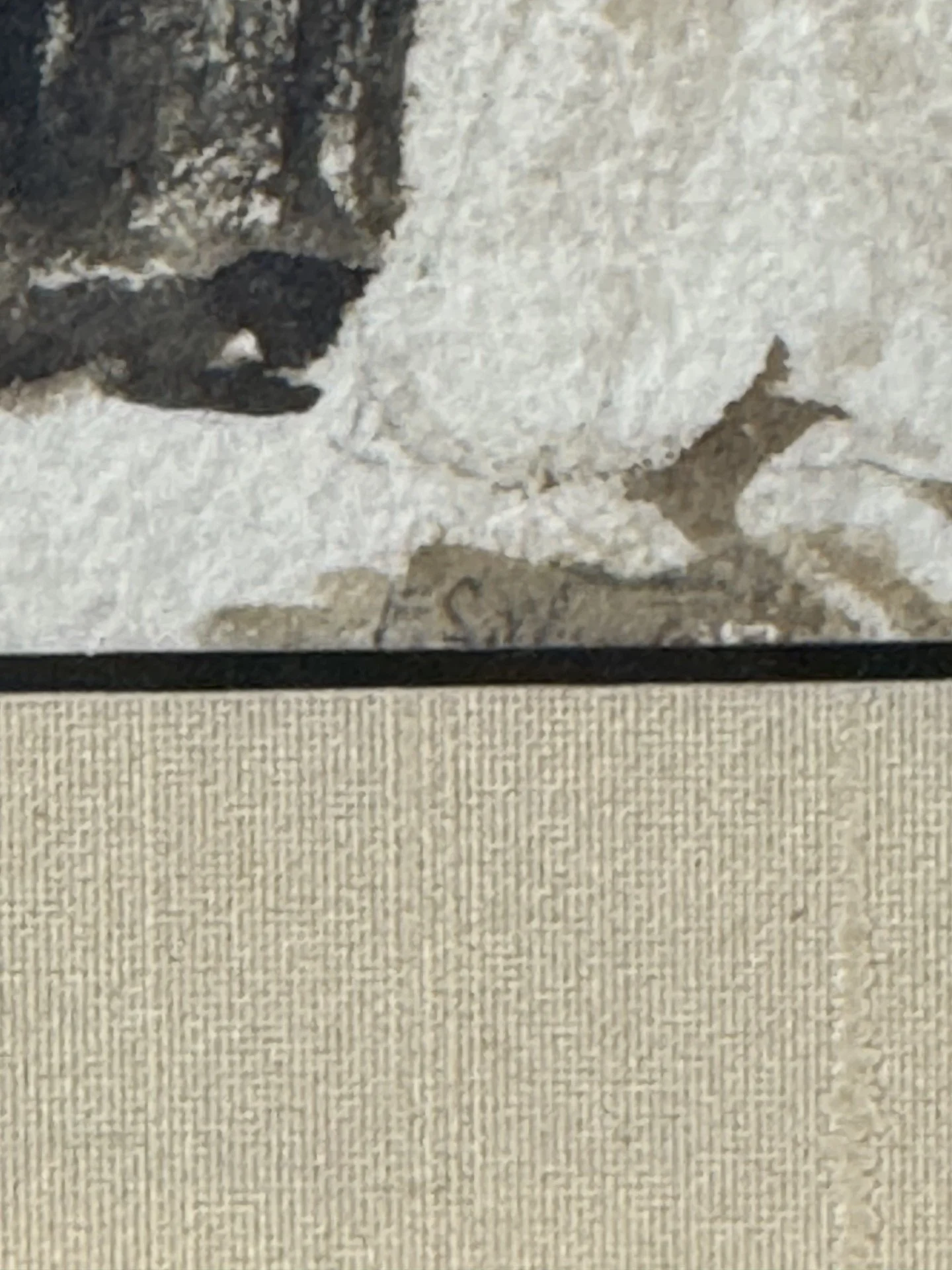
In this case, the name Standish became the starting point for further research.
When the Mayflower Descendants Museum acquired a watercolor painting signed F.S.W. and attributed to Florence Standish Whiting (1888–1947), her middle name prompted further genealogical research by the Museum’s founder. Standish is a name closely associated with Myles Standish, the military leader of Plymouth Colony who arrived aboard the Mayflower in 1620.
Another clue surfaced in contemporary reporting. When Whiting died in Philadelphia in 1947, an Associated Press notice described her as an artist and a “descendant of an early American family.” The same account noted her recognition in exhibitions connected with the Corcoran Galleries, Paris, Pittsburgh, and the New York and San Francisco world’s fairs.
A name alone, however, does not establish genealogy. The Museum continues to research Florence Standish Whiting’s ancestry, and at present has not confirmed that she descended from Myles Standish or any other Mayflower passenger.
Further examination of the painting revealed an unexpected connection.
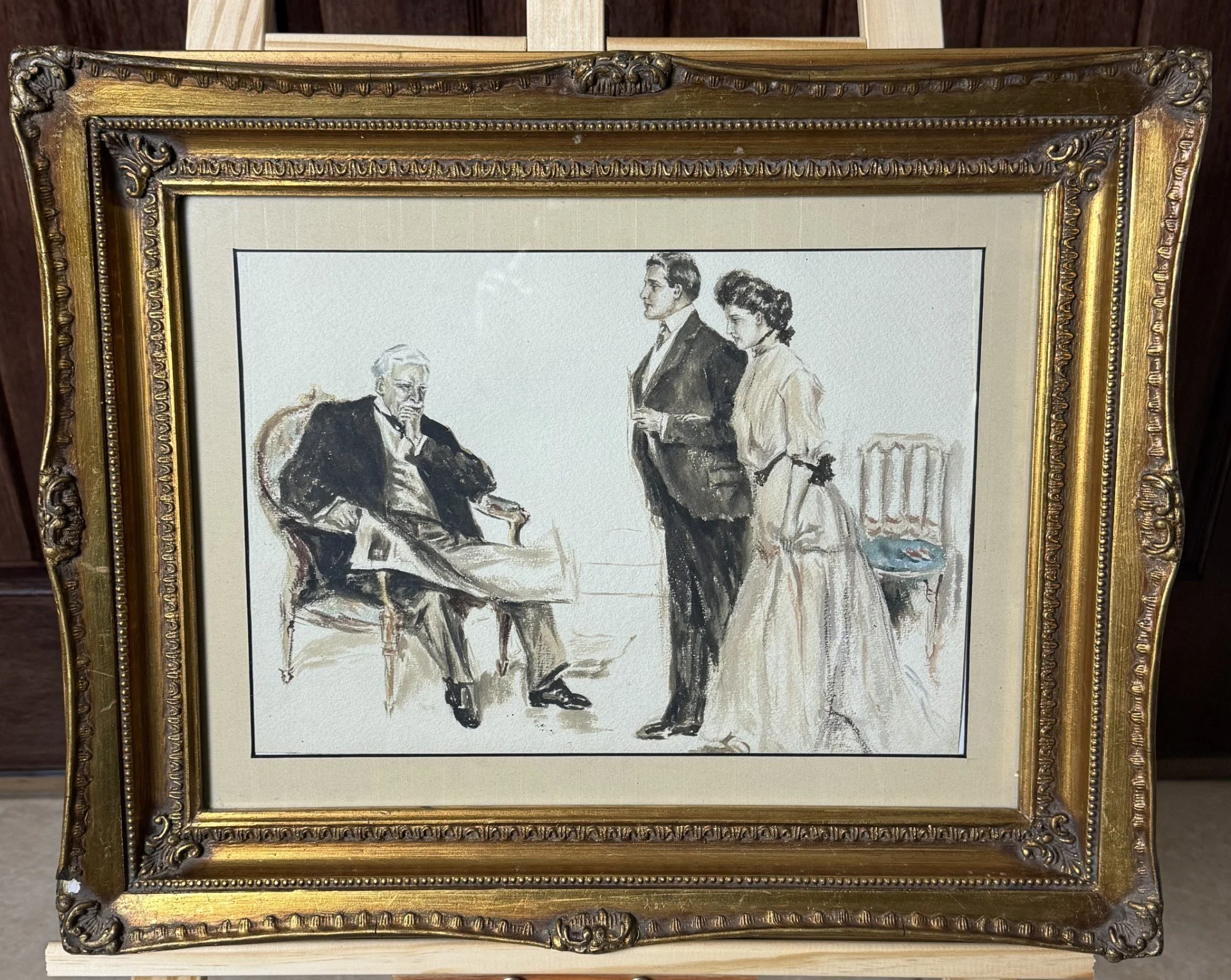
While reviewing Whiting’s works held by the Smithsonian and the Pennsylvania Academy of the Fine Arts, the Museum’s founder observed that the style of the watercolor differed sharply from Whiting’s documented paintings. A comparative image search identified the source composition: the Whiting-attributed watercolor is a hand-painted rendering of The Oldest Trust Company, a composition by American illustrator and portrait painter Howard Chandler Christy (1872–1952).
The Standish Connection Emerges in an Unexpected Way
Further research into Howard Chandler Christy revealed that he was a documented descendant of Myles Standish. The connection is striking: Florence Standish Whiting, whose own possible Standish lineage remains under research, created a watercolor version of a commercially published composition by an artist who was himself a confirmed descendant of Myles Standish and who had illustrated the story of his Mayflower ancestor.
Whether Whiting knew of Christy’s Standish ancestry when she selected The Oldest Trust Company is unknown. No evidence has yet surfaced explaining her choice of this particular Christy composition. What can be documented is the artistic connection between the two works.
The Oldest Trust Company
Christy’s composition depicts a young woman, a young man, and an older male figure in what appears to be a courtship scene. The title “trust company” invites two interpretations: the familiar financial term and, more playfully, the idea of familial trust or guardianship as a suitor approaches a young woman accompanied by an elder.
The Museum has not located a statement by Christy explaining the humor, so this reading remains interpretive.
A surviving 1908 example includes “American Trust Company” printed on its reverse, indicating that the composition also functioned in a literal banking or promotional context. Whiting therefore did not simply paint an unidentified Christy image; she created a watercolor version of a named, commercially circulated Christy work.
Florence Standish Whiting
Florence Standish Whiting was a Philadelphia-born painter, muralist, illustrator, etcher, and decorator whose career extended well beyond the city’s art community.
She trained at the Pennsylvania Academy of the Fine Arts and the Philadelphia School of Design for Women, studying under Henry McCarter and Earl Horter. Whiting became particularly associated with landscapes and floral still lifes while also producing murals, illustrations, and works on paper.
Her exhibition record was substantial. She exhibited repeatedly at PAFA during the 1910s, 1930s, and 1940s, and belonged to the Philadelphia Art Alliance and the Plastic Club. Published records credit her with a Plastic Club gold medal in 1931, a Pennsylvania Academy award in 1936, and a Philadelphia Sketch Club gold medal in 1939.
Her career also reached international audiences. Contemporary Philadelphia reporting documents her exhibiting in the Paris Salon in the autumn of 1927.
By the 1930s, Whiting was participating in major American exhibitions, including Corcoran Gallery biennials and, in 1939, the Golden Gate International Exposition in San Francisco.
That exposition provides another Mayflower-descendant intersection: Georgia O’Keeffe’s Bob’s Steer Head was shown at the same fair, and O’Keeffe descended from Mayflower passenger Edward Fuller.
Whiting and New Deal Art
Whiting also contributed to federal art programs during the Depression. The Smithsonian American Art Museum catalogs Decoration (ca. 1933–1934), an oil on canvas transferred from the U.S. Department of Labor and identified with the Public Works of Art Project in Pennsylvania.
Howard Chandler Christy
Howard Chandler Christy became one of the most recognizable American illustrators and portrait painters of his generation. He first gained national attention through his Spanish-American War illustrations and later became a sought-after portraitist. His monumental Scene at the Signing of the Constitution of the United States (1940), measuring approximately 20 by 30 feet, remains installed in the U.S. Capitol.
Christy will be explored further in a dedicated Museum discussion featuring an original period lithograph of The Oldest Trust Company alongside Whiting’s hand-painted version.
Sources & Further Reading
Smithsonian American Art Museum — Florence Standish Whiting
Institutional artist record documenting Whiting’s birth and death in Philadelphia and her career as an American artist.
Smithsonian American Art Museum — Florence Standish Whiting
Smithsonian American Art Museum — Decoration, ca. 1933–1934
Documents Whiting’s oil painting Decoration, transferred from the U.S. Department of Labor, and identifies the work with the Public Works of Art Project in Pennsylvania.
Smithsonian — Florence Standish Whiting, Decoration
Pennsylvania Academy of the Fine Arts — White Flowers, ca. 1934
Provides an institutional example of Whiting’s documented painting style. PAFA identifies the work as an oil on canvas by Florence Standish Whiting and records its accession into the collection in 1935.
PAFA — Florence Standish Whiting, White Flowers
National Historic Landmark Documentation — John and Priscilla Alden Family Sites
This documentation provides particularly important support for the Mayflower connection in this preview. It identifies Howard Chandler Christy as a descendant of Myles Standish and records that Christy illustrated a 1903 edition of Henry Wadsworth Longfellow’s The Courtship of Miles Standish.
John and Priscilla Alden Family Sites — National Historic Landmark documentation
Architect of the Capitol — Howard Chandler Christy, Signing of the Constitution
Documents Christy’s monumental painting in the U.S. Capitol. Completed in 1940, the oil-on-canvas work measures 20 by 30 feet and remains installed in the east grand stairway of the House wing.
Architect of the Capitol — Signing of the Constitution
Smithsonian Institution / National Portrait Gallery — Howard Chandler Christy, The Signing of the Constitution of the United States
Provides additional institutional documentation of Christy and his monumental Constitution composition.
Smithsonian — The Signing of the Constitution of the United States
Period Examples — Howard Chandler Christy, The Oldest Trust Company
Surviving early twentieth-century postcards document The Oldest Trust Company as a named Howard Chandler Christy composition that circulated commercially. CardCow catalogs multiple surviving examples, while a surviving 1908 example also documents the title and period circulation of the image.
View surviving Howard Chandler Christy postcard examples
Contemporary Newspaper Research — Florence Standish Whiting
Contemporary newspaper research conducted by the Mayflower Descendants Museum includes the 1947 Associated Press notice describing Whiting as a “descendant of an early American family,” as well as Philadelphia reporting documenting her participation in the Paris Salon in autumn 1927 and other exhibitions during her career.