
Mayflower Descendant Myron Leslie Fuller (1873–1960): Geologist, Hydrologist, Agricultural Entrepreneur, Humanitarian and Philanthropist
Besides appearing in this collection, Myron Leslie Fuller (1873–1960) and his family are also featured in the Museum’s Fuller Family of Massachusetts collection. His remarkable scientific contributions, the impact of his work on millions of lives, his direct paternal-line descent from Mayflower passenger Dr. Samuel Fuller, and important aspects of his family’s history are among the stories the Mayflower Descendants Museum is dedicated to researching, preserving, and sharing with the public.
About the Video
The information below provides additional context for the video featured in this section and shared on the Museum’s social media accounts. Read below to learn what the video explores. You can watch the video by clicking the image of Myron’s book.
His Work Impacts Millions—Revealing His Legacy. Art by Boston Tea Party Participant’s Great‑Grandson
Do you ever stop to think about the scientists who helped us understand where safe drinking water could be found, how groundwater moved beneath the land, how wells and springs should be located and protected—or how contaminated water could threaten families, farms, crops, and livestock?
We begin with two Mayflower descendants and an unexpected intersection between their work.
Myron Leslie Fuller (1873–1960)
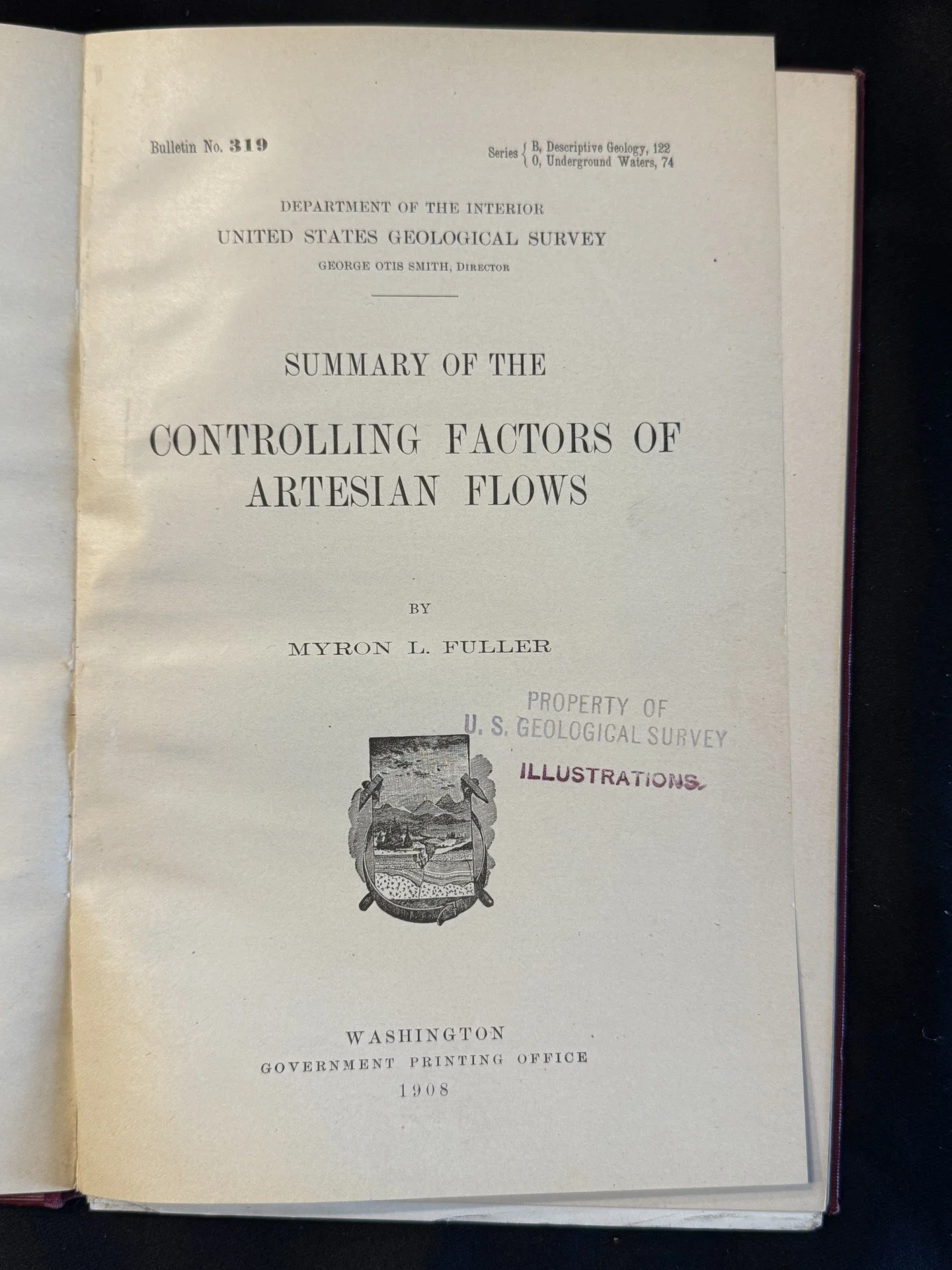
First up: Myron Leslie Fuller (1873–1960), a direct paternal-line descendant of Mayflower Pilgrim Dr. Samuel Fuller.
A humanitarian as well as a scientist, Myron left behind a generational gift of knowledge whose impact has extended to millions of lives. This is the largely untold story of the human impact behind his science—and how the knowledge he helped advance continues to shape the way people understand, locate, use, and protect water and other natural resources.
An MIT graduate and instructor, Myron became an award-winning multidisciplinary federal scientist and early energy-resource expert whose career crossed geology, hydrology, groundwater science, land and underground resources, and energy research.
His work extended far beyond a single town or state.
As a U.S. Geological Survey scientist and leader in federal hydrology work, Fuller conducted, directed, and helped assemble investigations of wells, springs, underground water, and water supplies across numerous parts of the United States. His 1905 Underground Waters of Eastern United States, for example, was prepared in response to demand from drillers and others for practical information about groundwater resources in individual states and regions.
U.S. Geological Survey — Underground Waters of Eastern United States
His work was intended not only for scientists, but also for governments, engineers, drillers, farmers, communities, and others who needed practical information about where underground water could be found and how those supplies could be developed and understood.
Fuller’s federal groundwater work reached across numerous states and regions. He participated in or directed investigations involving water supplies from New England and the Mid-Atlantic through portions of the South and Midwest, including major studies concerning Long Island, southern Louisiana, southwestern Ohio, and other areas.
But Fuller did more than help locate water.
He also taught people how groundwater moved beneath the land, how wells and springs could become polluted, how water supplies could be protected, and why the location and construction of a well could determine whether the water drawn from it was safe.
At a time when contaminated wells and waterways could contribute to deadly diseases such as typhoid fever, this knowledge had direct implications for public health.
Fuller explained how human and animal waste could enter groundwater, how contamination could travel beneath the surface, and how seemingly clean water could still pose a danger to the people and animals drinking it.
Reimagining a Day in His Scientific Work
Fuller’s scientific career was much broader than any single publication. For this video, however, we are focusing on one particularly human part of his work.
His 1910 U.S. Geological Survey publication, Underground Waters for Farm Use, demonstrates how practical groundwater science could become.
U.S. Geological Survey — Underground Waters for Farm Use
Despite its title, the publication was about far more than agriculture.
Fuller used the farm as a real-world setting through which to explain groundwater science, drinking-water safety, pollution, well placement, spring protection, and disease prevention. He addressed how to find and access groundwater, how water moved underground, how wells and springs could become contaminated, and how safer supplies could be protected.
Using Fuller’s own published writings as our guide, this video reimagines what a day in his scientific work may have looked like as he studied the land, examined water sources, and helped people understand how to find and protect the water upon which their families, farms, crops, and animals depended.
And that brings us to this painting.
The Painting: William Houghton Sprague Pearce (1864–1935)
Cows are drinking from a shared water source.
The watercolor is by William Houghton Sprague Pearce (1864–1935), another Mayflower descendant—through passenger Richard Warren—and the great-grandson of Boston Tea Party participant and Revolutionary War veteran Samuel Sprague (1753–1844).
Pearce was known particularly for landscapes, cattle, and pastoral subjects. His work was exhibited at the Boston Art Club, and published biographical material records that he was commissioned by Henry Ford to paint the Wayside Inn and a portrait of Ford.
askART — William Houghton Sprague Pearce
Pearce’s artistic life also included a remarkable decades-long relationship with his older brother, internationally recognized expatriate painter Charles Sprague Pearce (1851–1914). William reportedly sent photographs of his paintings to Charles for criticism, while their correspondence discussed composition, values, lighting, technique, style, and pricing.
The Museum explores William and Charles Pearce, their artistic relationship, their shared Mayflower ancestry, and the opportunity to compare and contrast the brothers’ work in greater depth in the Mayflower Families in the Arts collection.
For this story, however, William’s watercolor serves another purpose.
Pearce recorded in art the rural world in which questions of water, land, livestock, and agriculture were part of everyday life.
His painting helps us visually imagine the kind of landscape Fuller was writing about: animals depending upon a shared water source, land influencing the movement of water, and the unseen relationship between what occurred on the surface and what entered the groundwater below.
A peaceful pastoral scene therefore becomes more than an image of cattle drinking.
It illustrates the intersection of water, land, livestock, agriculture, and public health that Fuller worked to understand—and that he wanted others to understand as well.
Two Mayflower Descendants, One Unexpected Intersection
Here, the work of two Mayflower descendants intersects in an unexpected way.
One studied the land and water scientifically.
The other preserved the rural landscape artistically.
Through Pearce’s art and Fuller’s own published words, we reimagine one day within a much larger scientific career—and explore how knowledge developed more than a century ago continues to help us understand the water beneath our feet and the lives that depend upon it.
We explore the lives and connections of Mayflower descendants, and those connected to them.
Sources & Further Reading
U.S. Geological Survey — Myron L. Fuller, Underground Waters for Farm Use (1910)
Fuller’s practical study of groundwater, drinking-water safety, wells, springs, pollution, water supply, and groundwater use in rural settings.
Read Underground Waters for Farm Use
U.S. Geological Survey — Myron L. Fuller, Underground Waters of Eastern United States (1905)
Major federal groundwater study prepared in response to demand for practical information about underground-water resources across the eastern United States.
Read Underground Waters of Eastern United States
U.S. Geological Survey — Contributions to the Hydrology of Eastern United States, 1903
Documents the scope of federal groundwater investigations associated with Fuller’s hydrology work across numerous states.
Read the report
U.S. Geological Survey — Harris and Fuller, Underground Waters of Southern Louisiana (1904)
Study examining underground-water resources for water supply and agricultural use, including rice irrigation.
Read Underground Waters of Southern Louisiana
U.S. Geological Survey — Fuller, Clapp, and Dole, The Underground Waters of Southwestern Ohio (1912)
Detailed investigation of groundwater resources and the chemical character of water supplies in southwestern Ohio.
Read The Underground Waters of Southwestern Ohio
U.S. Geological Survey — Long Island Geology and Groundwater Research
Federal research conducted under Fuller’s direction examining the geology and underground-water resources of Long Island, where groundwater was especially important to municipal and community water supplies.
Read the Long Island report
askART — William Houghton Sprague Pearce
Biographical account of Pearce’s Massachusetts career, landscapes and cattle subjects, Boston Art Club exhibitions, Henry Ford commissions, Richard Warren ancestry, and decades-long artistic correspondence with his brother Charles Sprague Pearce.
William Houghton Sprague Pearce biography
National Academy of Design — Charles Sprague Pearce
Background on William’s older brother Charles, including his Boston origins, Paris training, career in France, and international artistic recognition.
Charles Sprague Pearce — National Academy of Design
Boston Tea Party Ships & Museum — Samuel Sprague
Biographical information about William Houghton Sprague Pearce’s great-grandfather Samuel Sprague and his participation in the Boston Tea Party and Revolutionary War.
Samuel Sprague — Boston Tea Party Ships & Museum