
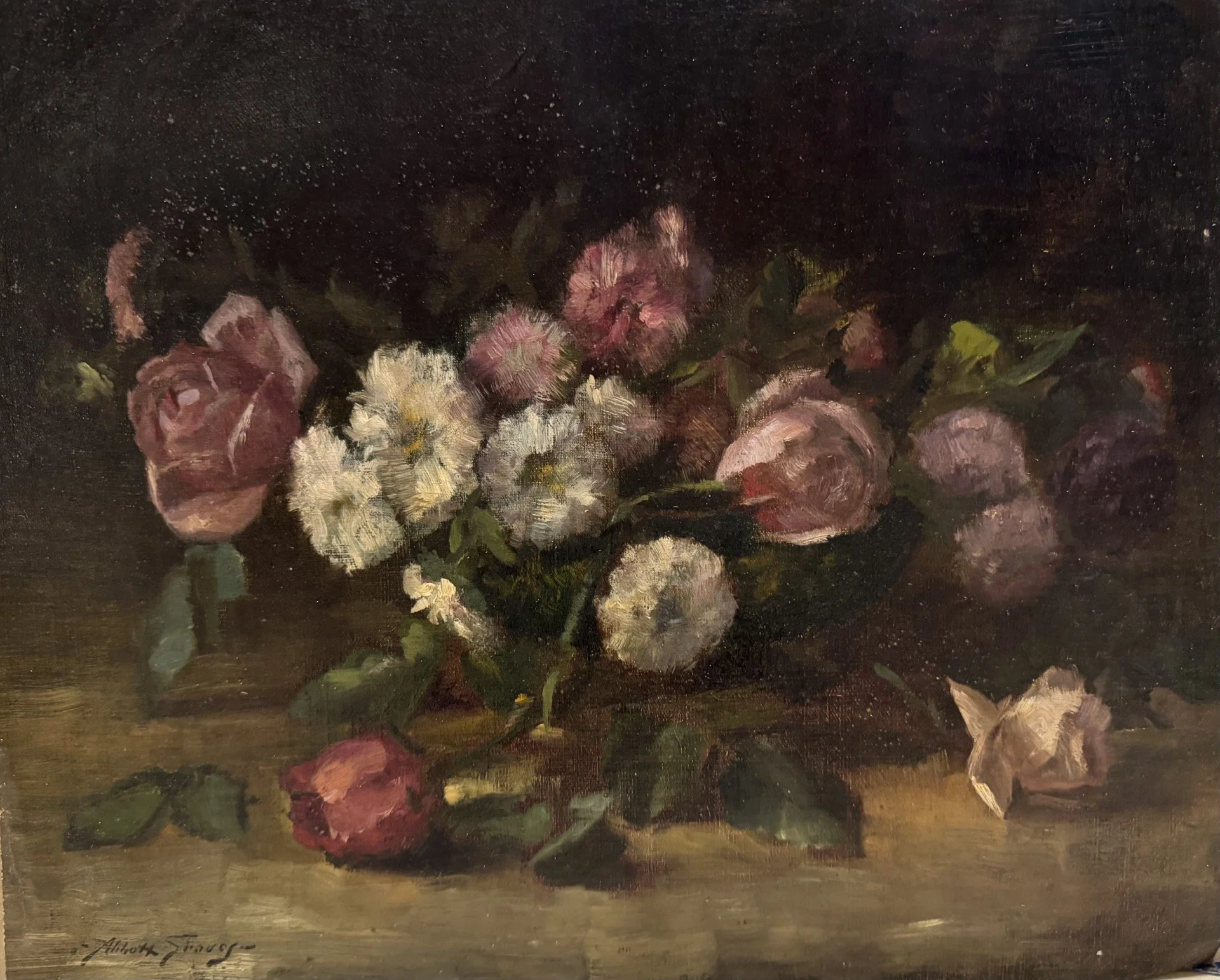
Mayflower Descendant Artist Abbott Fuller Graves
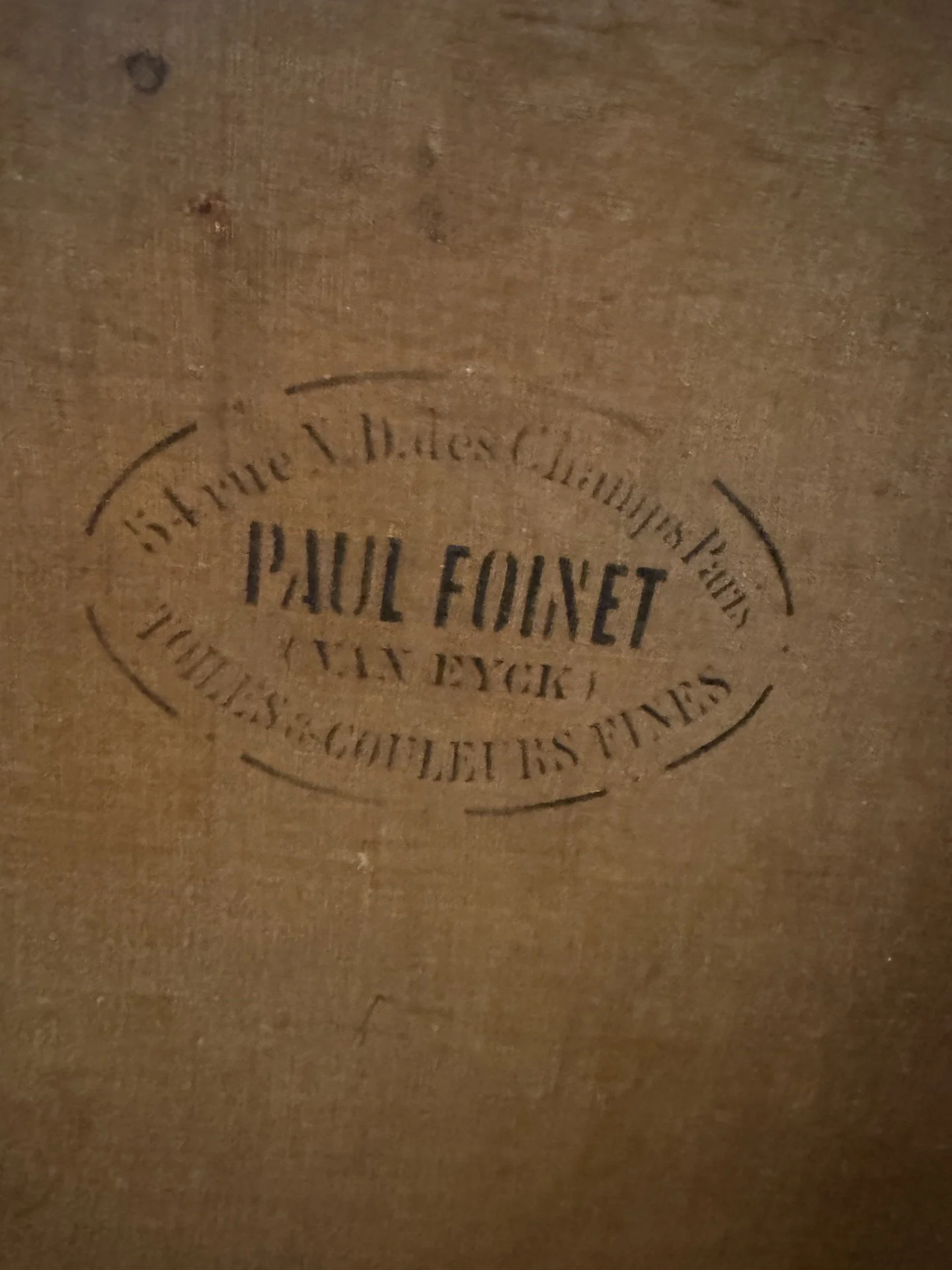
Mayflower Descendant Artist Abbott Fuller Graves (1859–1936)
The floral still-life oil painting, estimated to date between 1884 and 1890, signed by Mayflower descendant Abbott Fuller Graves was executed on a canvas supplied by Paul Foinet of 54 rue Notre-Dame-des-Champs in Paris, a supplier whose canvases were also used by some of the era’s most celebrated artists, including Claude Monet, John Singer Sargent, and Carolus-Duran. Graves is documented as using this particular supplier for other works as well.
Mayflower descendant Abbott Fuller Graves was an American painter, teacher, and illustrator who became particularly known for floral still lifes and sun-filled garden scenes. Born in Weymouth, Massachusetts, Graves initially studied architecture at the Massachusetts Institute of Technology before turning his attention increasingly toward painting.
In 1884, Graves traveled to Paris, where he studied flower painting with Georges Jeannin, one of the leading French painters specializing in floral subjects. After returning to Boston the following year, Graves taught at the Cowles Art School. He returned to Paris in 1887 and spent approximately three years studying at the Académie Julian under Fernand Cormon, Jean-Paul Laurens, and Paul Gervais. During these years he exhibited in the Paris Salons and participated in the city's community of American artists. (nationalacademy.emuseum.com)
Flowers were already becoming central to Graves's artistic identity during his years in Paris. He exhibited flower paintings at the Paris Salons of 1888 and 1889. At the 1889 Exposition Universelle in Paris, he exhibited two works, Peonies and Basket of Flowers. A large surviving Floral Still Life, signed and dated “Paris 88,” has been identified by Christie's as possibly one of the works exhibited at the Paris Salon in 1888 or 1889. A contemporary account cited by Christie's described Graves as the only American flower painter whose works were accepted by the Exposition jury to represent American art in that specialty. (christies.com)
The floral still-life painting in the Mayflower Descendants Museum collection provides a physical connection to this important period in Graves's career. The painting was executed on a canvas supplied by Paul Foinet of 54 rue Notre-Dame-des-Champs in Paris.
Paul Foinet was a prominent Parisian artists' colourman. Research by the National Portrait Gallery documents Foinet at 54 rue Notre-Dame-des-Champs by 1885, with the business remaining at that address into the early twentieth century. Foinet manufactured and supplied artists' canvases, paints, brushes, and other materials used for oil painting, watercolor, and pastel. American artist Will Hicok Low later recalled Foinet appearing regularly at Carolus-Duran's atelier carrying supplies of colors, brushes, and canvas for the artists working there. (npg.org.uk)
The Foinet mark on the Museum's Graves canvas connects the physical object to a supplier whose materials were used by a remarkable group of artists working in Paris during the same era.
John Singer Sargent used Foinet canvas for works including Gabriel Fauré, c. 1889, and J. P. Wolff, c. 1891–95. Foinet also supplied materials to artists associated with the Parisian studios and exhibitions of the period, and surviving Foinet marks have been documented on canvases used by numerous European and American painters. (npg.org.uk)
Carolus-Duran, one of the most influential painters and teachers working in Paris at the time, also used Foinet canvas. His The Artist's Gardener of 1893 retains a Paul Foinet supplier mark on its original canvas. Foinet's close connection to Carolus-Duran's atelier is particularly well documented through the recollections of artists who studied there.
American artists working in France also regularly purchased Foinet materials. The National Portrait Gallery's research identifies Theodore Earl Butler, Maria Oakey Dewing, Anne Elisabeth Klumpke, Frederick William MacMonnies, Elizabeth Nourse, Theodore Robinson, and others among American artists known to have used Foinet canvases. (npg.org.uk)
These surviving supplier marks provide something more tangible than a stylistic comparison. Artists' colourmen formed part of the physical infrastructure of nineteenth-century art production. A supplier's stencil on the back of a canvas can help establish where, and sometimes approximately when, an artist obtained the material on which a painting was created. In the case of the Museum's Graves painting, the Paul Foinet mark is consistent with the period in which Graves was studying, exhibiting, and establishing his reputation as a flower painter in Paris.
Another surviving Graves painting reinforces just how important flower painting had become to him during these years. His Still Life with Roses bears the inscription “Abbott Graves Paris,” while his much larger Floral Still Life of 1888 was also signed and dated in Paris. Together with his documented Salon and Exposition appearances, these works demonstrate that floral painting was already a defining specialty during Graves's Paris years rather than merely a subject he adopted later in his career. (christies.com)
After returning to the United States, Graves continued developing the specialty that had earned him attention abroad. He became closely associated with Kennebunkport, Maine, and produced garden paintings characterized by abundant flowers, vivid color, and the changing effects of natural light. He also traveled and painted in warmer regions, including South America, Trinidad, and Havana, incorporating different vegetation and brilliant sunlight into his work. The National Academy of Design describes Graves as primarily a painter of gardens, noting that although figures sometimes appeared in his compositions, the garden itself and the play of sunlight within it remained the focus. (nationalacademy.emuseum.com)
Graves was elected an Associate of the National Academy of Design in 1929, an acknowledgment of his standing within the American art community.
His paintings are represented in American public collections including the Princeton University Art Museum, the Norton Museum of Art in West Palm Beach, Florida, and the Birmingham Museum of Art. The Norton holds Graves's Gathering Lilies, c. 1900, while the Birmingham Museum of Art holds A Kennebunkport Doorway (Peace and Sunshine), painted in 1931.
Flowers were therefore not simply an occasional subject within Abbott Fuller Graves's career. They formed one of its defining threads—from his specialized study of flower painting in Paris and his Salon exhibitions of the 1880s to the luminous floral still lifes and garden paintings for which he became best known. The Paul Foinet canvas of the Mayflower Descendants Museum painting provides a surviving material connection to the Paris art world in which that specialty developed.
Sources and Further Reading
National Academy of Design, “Abbott Fuller Graves” — biographical record documenting Graves's architectural studies, training with Georges Jeannin, teaching at the Cowles Art School, study at the Académie Julian, travels, garden painting, and association with the National Academy.
National Academy of Design — Abbott Fuller Graves
Christie's, “Abbott Fuller Graves (1859–1936), Floral Still Life” — catalogue entry for Graves's 1888 Paris floral painting, including his Paris training, the Salons of 1888 and 1889, and Peonies and Basket of Flowers at the 1889 Exposition Universelle.
Christie's — Abbott Fuller Graves, Floral Still Life, Paris 1888
Christie's, “Abbott Fuller Graves, Still Life with Roses” — catalogue record for a floral still life inscribed “Abbott Graves Paris.”
Christie's — Still Life with Roses
National Portrait Gallery, London, “British Artists' Suppliers, 1650–1950: F” — research on Paul Foinet, his business at 54 rue Notre-Dame-des-Champs, artists who used his materials, and documented Foinet canvas marks.
National Portrait Gallery — Paul Foinet and Artists' Suppliers
Norton Museum of Art, “The Priscilla and John Richman Gift of American Impressionism and Realism” — includes Abbott Fuller Graves's Gathering Lilies, c. 1900.
Norton Museum of Art — Gathering Lilies
Birmingham Museum of Art, “A Kennebunkport Doorway (Peace and Sunshine)” — collection record for Graves's 1931 painting.
Birmingham Museum of Art — A Kennebunkport Doorway
Princeton University Art Museum
Princeton University Art Museum