
Rediscovering Albert A. Munro
Artist, Designer, Performer, and Tiffany Connection
Some artists remain prominent in art history. Others leave behind scattered traces—in paintings, exhibition reviews, census records, newspapers, and family memories—waiting to be put back together.
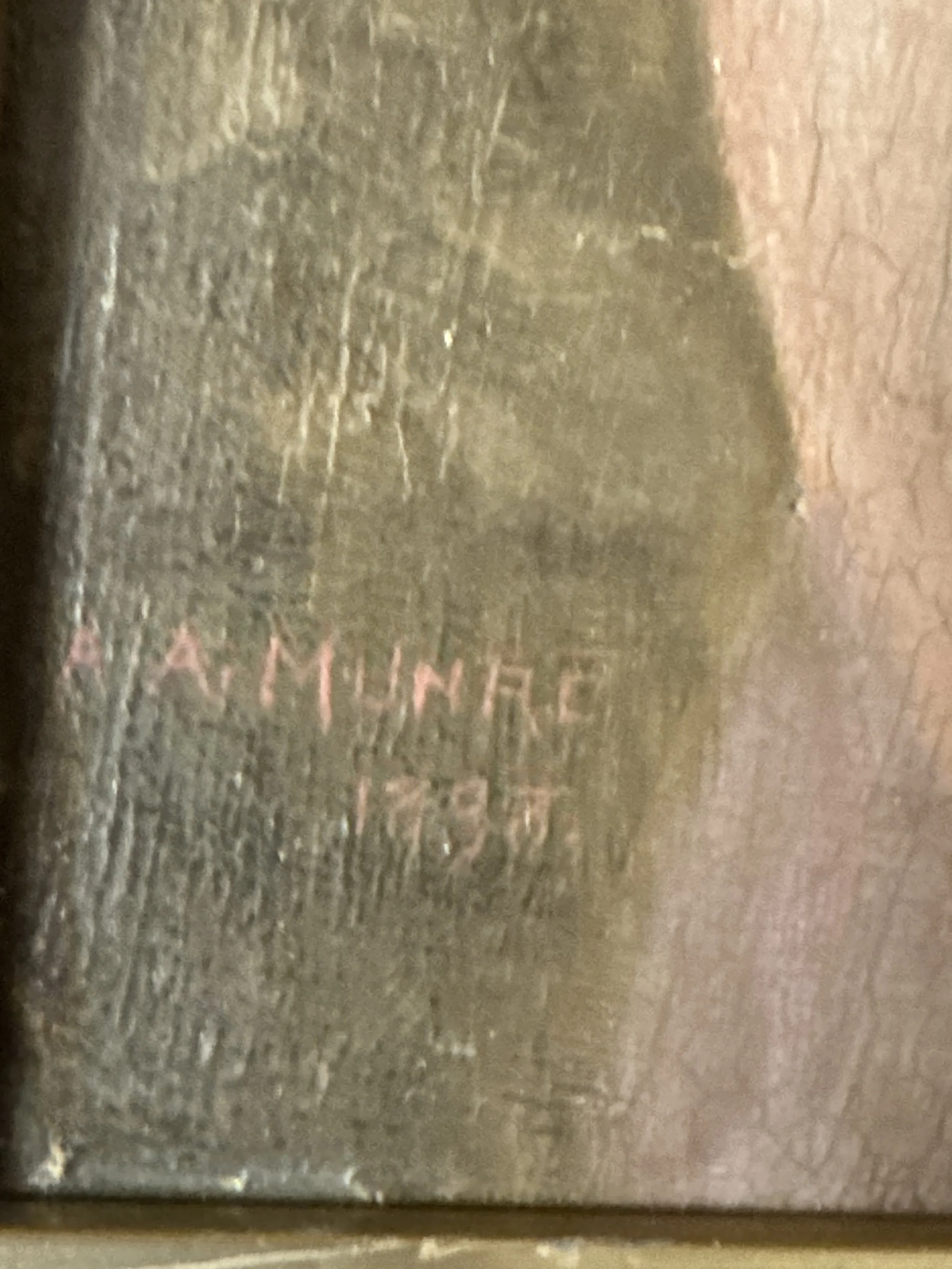
Albert A. Munro, born in Hoboken, New Jersey, in 1868, is one of those artists.
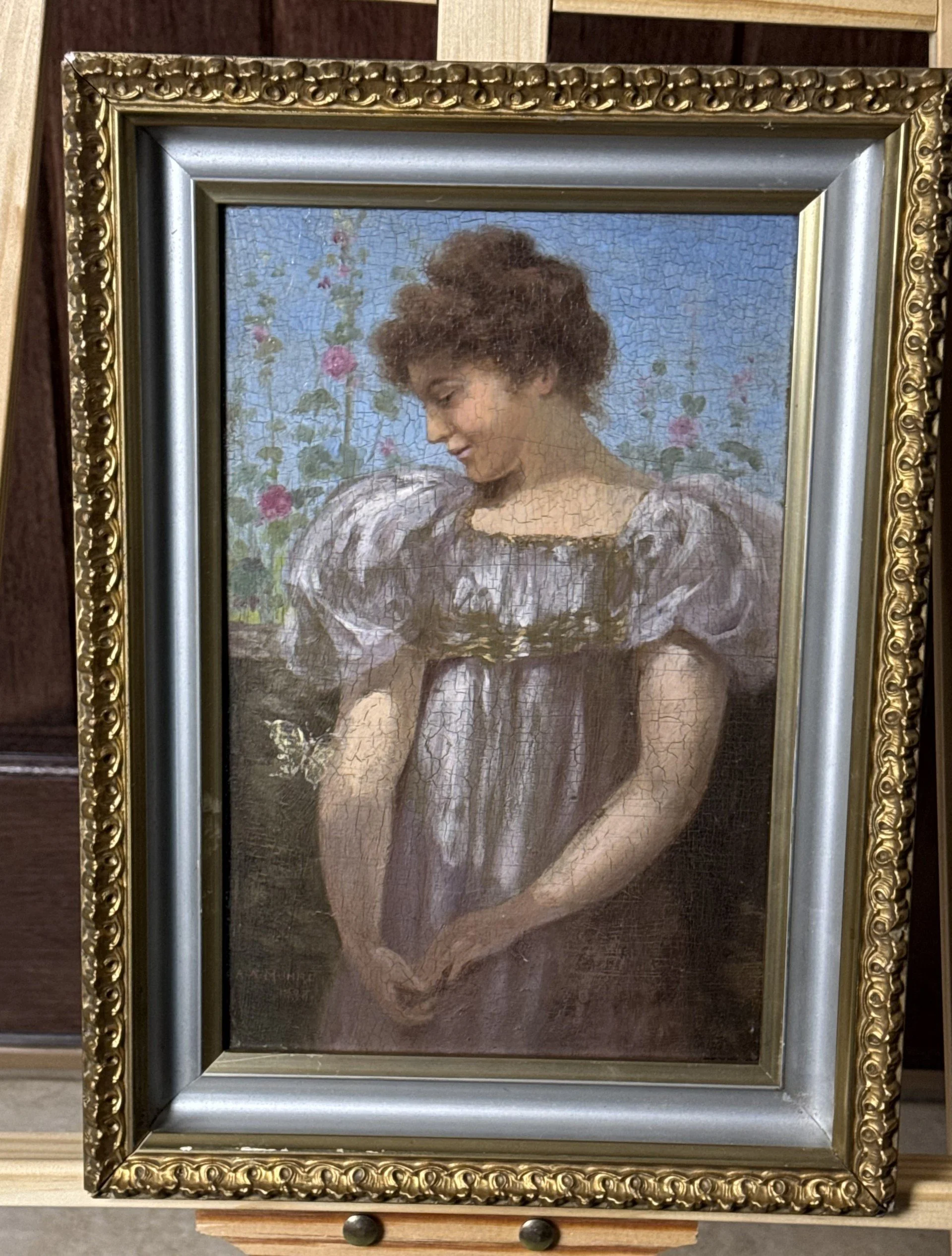
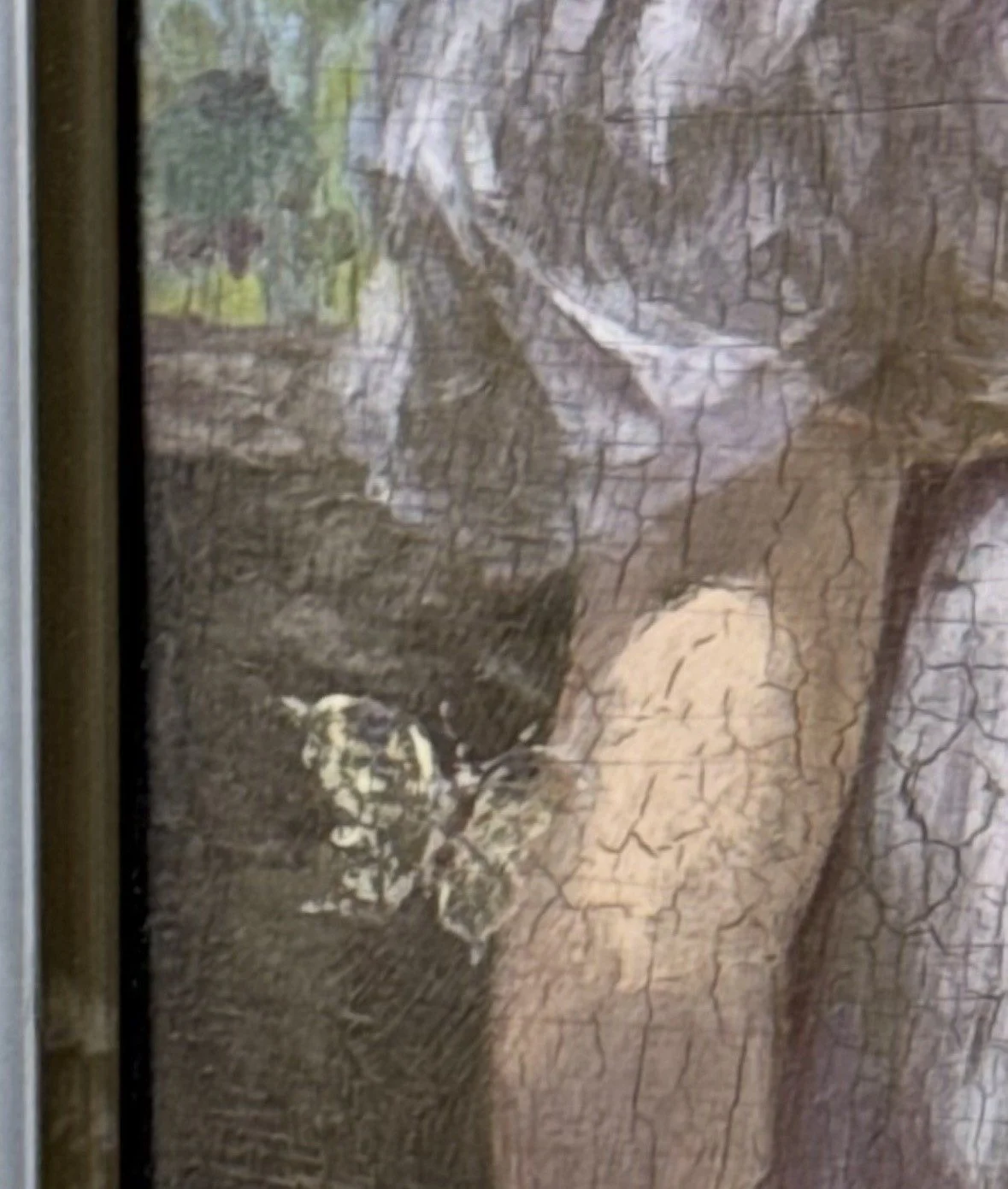
The Mayflower Descendants Museum holds a painting by Munro that our founder has given the descriptive title Girl with a Butterfly in a Rose Garden while research continues to determine whether an original title survives.
When the painting first surfaced, the seller relayed information from a family member connecting Munro with Tiffany Studios. The reported Tiffany Studios connection prompted further research by the Museum’s founder to determine what could be supported by the historical record.
Research to date has established the following: a contemporary 1892 newspaper account identifies Albert A. Munro as employed by Tiffany & Co. of New York. Additional census and death records located during the Museum’s research describe him variously as an artist and jewelry designer.
An Artist from an Artistic Family
Munro was already receiving notice for his artistic ability as a young man. In 1893, a Brooklyn newspaper reported that a new title-page design for The American Pressman had been created “from the brush of Albert A. Munro,” son of the publication’s editor, P. S. M. Munro, and said that the design demonstrated the young artist’s “great artistic merit.”
By 1896, Munro was deeply involved with Brooklyn’s Pen and Pencil Club. Contemporary coverage identifies him as a club officer and records both his visual artwork and his musical performances. At one exhibition, his watercolor Sister was singled out for praise, while Munro himself also performed vocal solos during the evening.
That combination was not unusual for him.
Newspapers repeatedly document Albert A. Munro as a tenor, appearing in concerts and vaudeville-style programs alongside members of his family. In 1907, for example, he performed both Songs of Araby and Mighty Like a Rose at a Brooklyn entertainment.
Munro therefore moved across several creative worlds—not only as a painter and designer, but also as a performer.
A Working New York Artist
His painting career continued alongside those other pursuits.
At the New York Water Color Club’s nineteenth annual exhibition in 1908, Munro exhibited In the Berkshire. A contemporary critic described the work as a modest but successful contribution to the exhibition.
His work continued to appear in major group exhibitions. In 1920, Albert A. Munro was among the artists represented in the Brooklyn Water Color Club exhibition at Pratt Institute, an exhibition comprising more than 100 works by Brooklyn-area artists.
He also exhibited repeatedly with the Society of Independent Artists, appearing among the artists in its 1924 exhibition at the Waldorf-Astoria and again in its 1931 exhibition at Grand Central Palace.
That record makes clear that Munro was not simply an amateur who happened to paint. He maintained an artistic presence extending across several decades.
The Tiffany and Mayflower Connection
Munro’s documented employment with Tiffany & Co. creates an especially interesting connection for this Museum.
Louis Comfort Tiffany (1848–1933) was himself a documented Mayflower descendant. The General Society of Mayflower Descendants identifies Tiffany as descended from Mayflower passengers Francis Cooke, Richard Warren, Isaac Allerton, and Stephen Hopkins. The Society also identifies him with the 1897 stained-glass Mayflower seal at what is now the Mayflower Meetinghouse in Plymouth. (The Mayflower Society)
Munro’s connection to the Tiffany world appears in more than one part of his career. In addition to his documented employment with Tiffany & Co., Munro later exhibited with the Society of Independent Artists, an organization with which Louis Comfort Tiffany was also affiliated. (askART)
At present, the Museum is not claiming that Munro worked personally with Louis Comfort Tiffany; further research would be required to establish that. What the surviving evidence does reveal is a professional career repeatedly intersecting with institutions and artistic circles connected to Tiffany.
This broader context has made the painting particularly significant to the Museum’s research.
An artist who is scarcely remembered today turns out to have been a painter, watercolorist, designer, jewelry professional, singer, club officer, and exhibiting New York artist, with a documented career stretching from at least the 1890s into the 1930s.
The Museum’s research into Albert A. Munro is ongoing.
Girl with a Butterfly in a Rose Garden provides an opportunity to bring one of those nearly forgotten artistic lives back into view—and to follow another invisible thread through the interconnected world of American art.
Sources and Further Reading
Contemporary Brooklyn reporting on Albert A. Munro’s early design work, 1893.
Pen and Pencil Club exhibition and performance coverage, 1896.
New York Water Color Club exhibition, 1908.
Brooklyn Water Color Club exhibition at Pratt Institute, 1920.
Society of Independent Artists exhibitions, 1924 and 1931.
General Society of Mayflower Descendants, Louis Comfort Tiffany and the Mayflower Meetinghouse. (The Mayflower Society)