
A Time Capsule from 1897
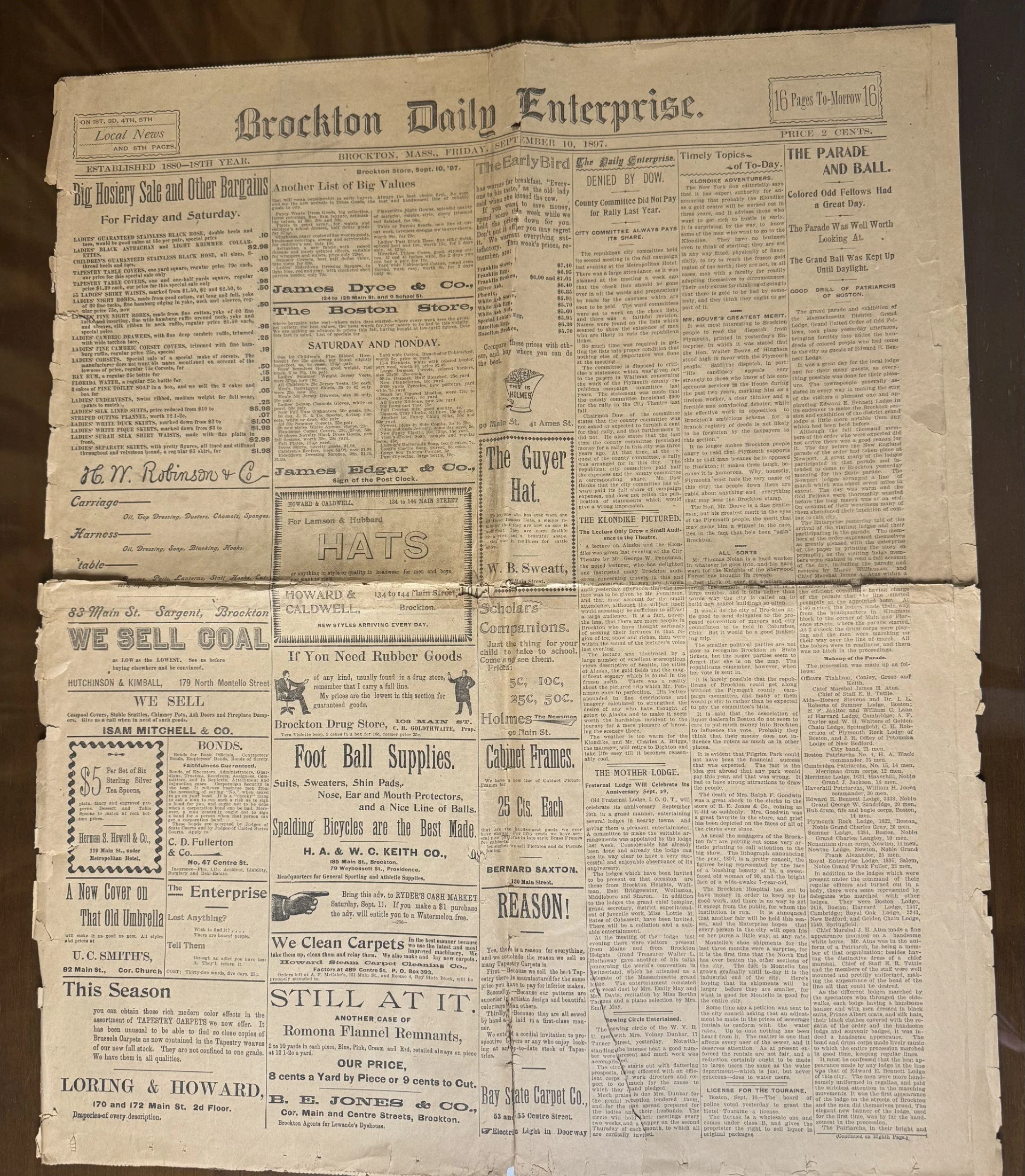
The Brockton Daily Enterprise
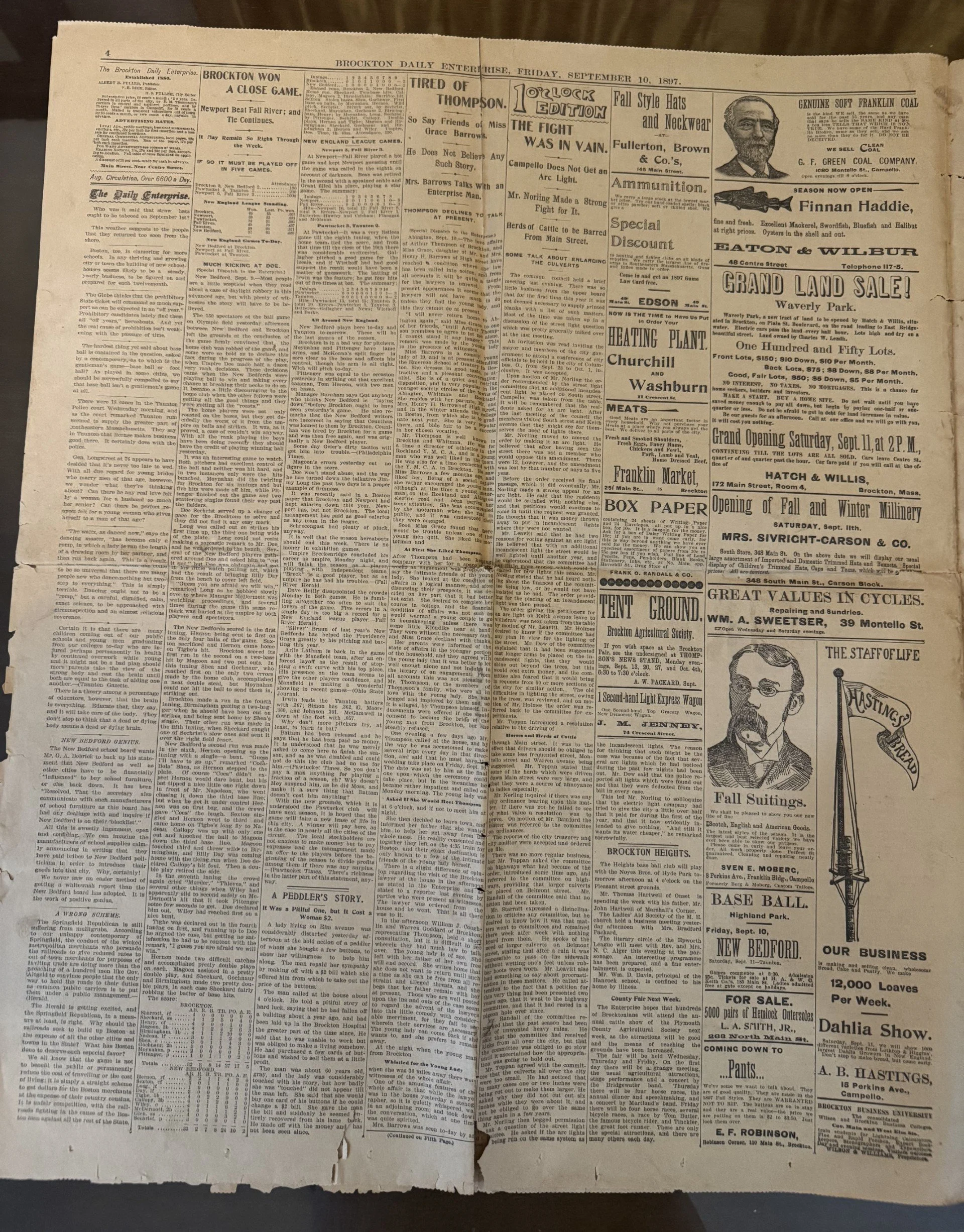
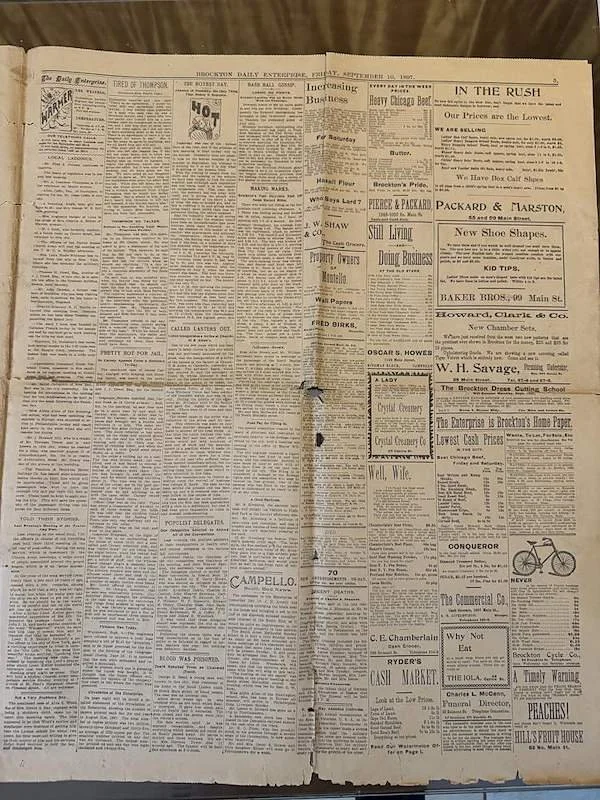
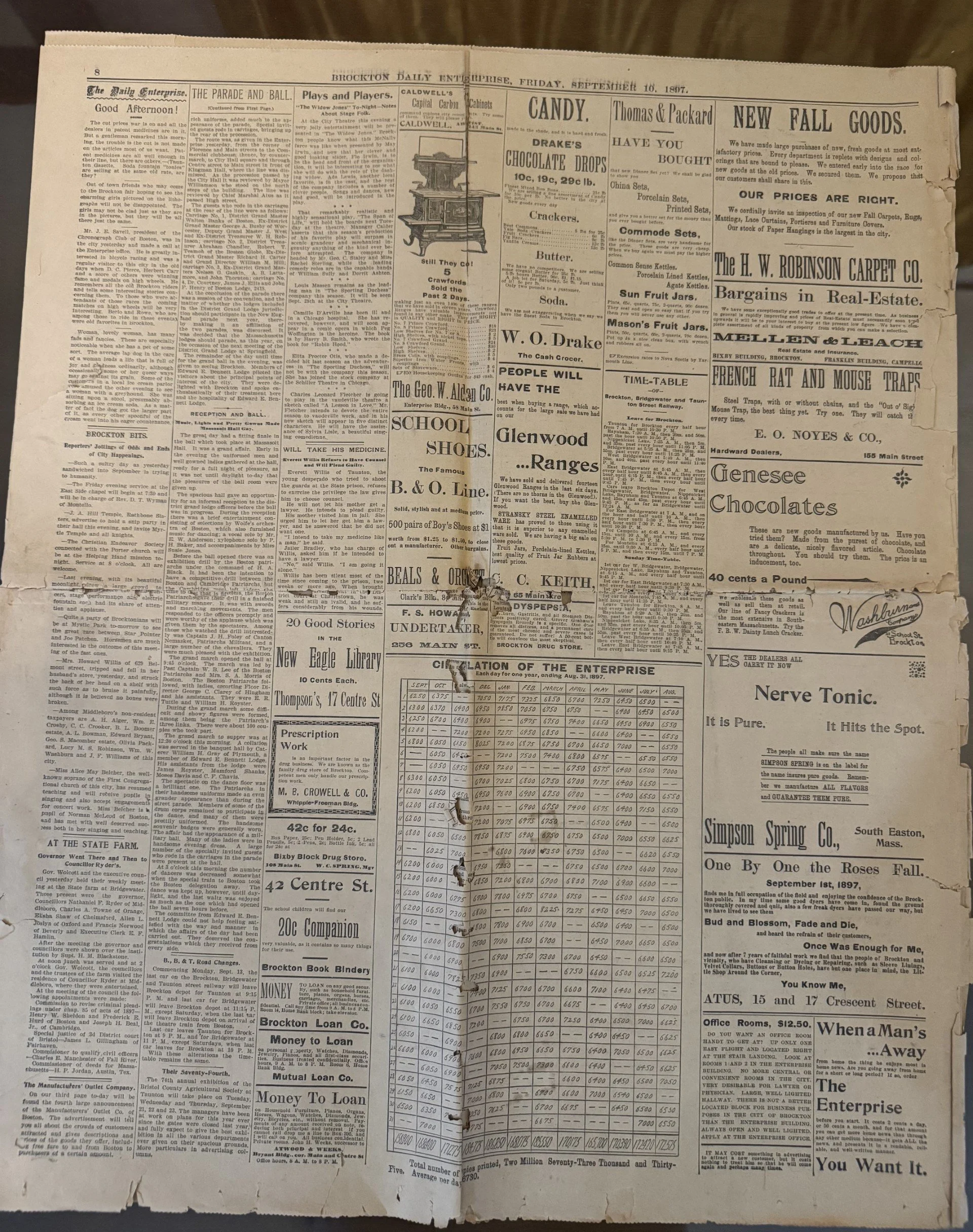
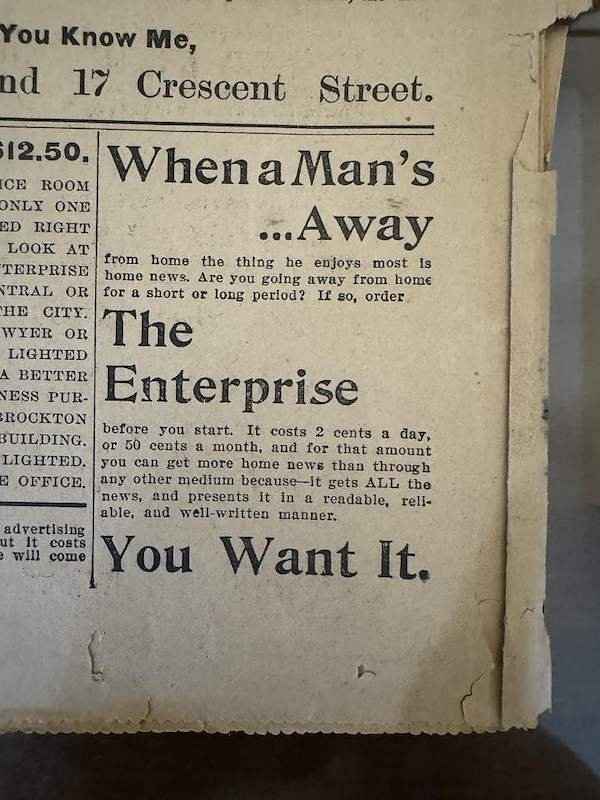
A Day in Massachusetts, Preserved: The Brockton Daily Enterprise, September 10, 1897
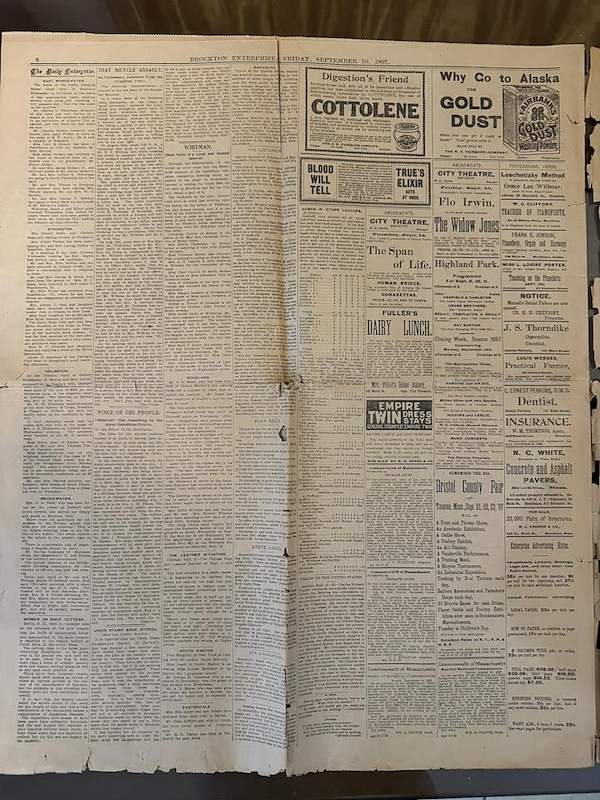
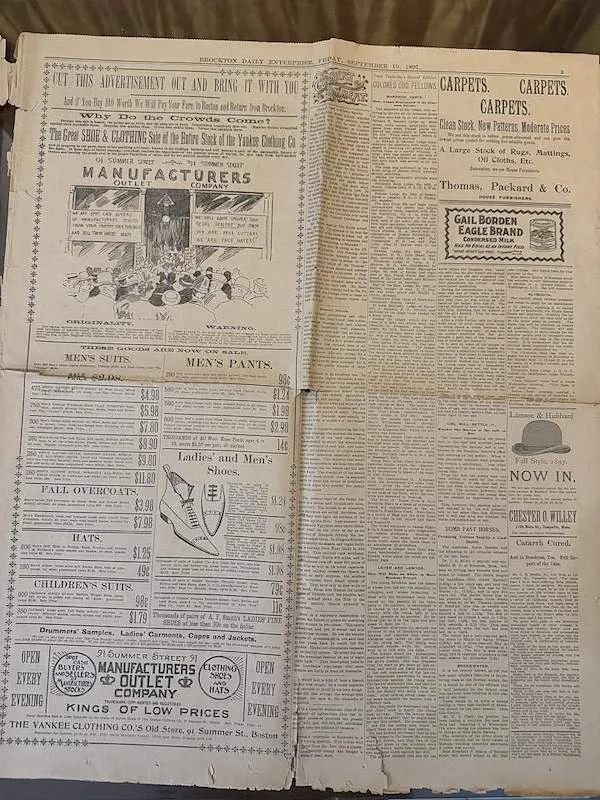
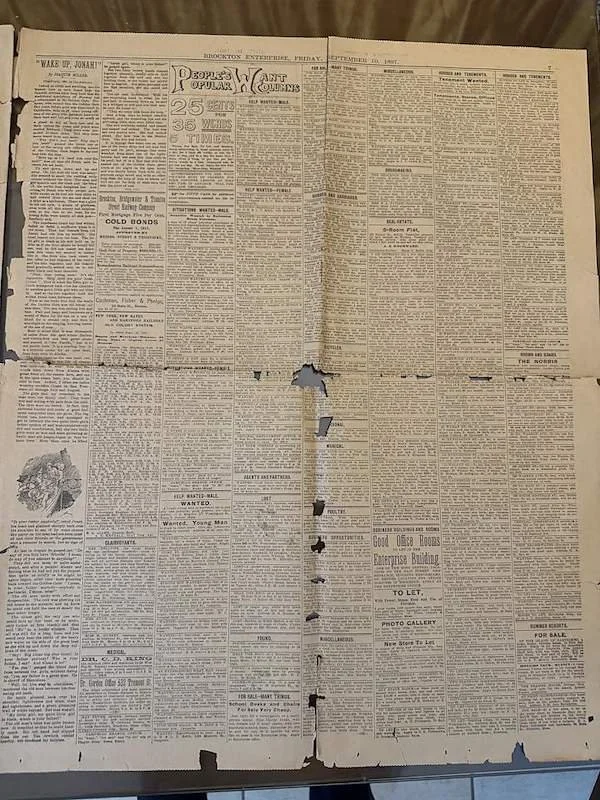
During renovations to her 1850 home in Avon, Massachusetts, Irene Meaney made an unexpected discovery: an original September 10, 1897, issue of the Brockton Daily Enterprise, preserved within the house like a time capsule.
Recognizing its historical value, Meaney generously donated the newspaper to the Mayflower Descendants Museum, preserving a remarkable glimpse into everyday life in Massachusetts more than 125 years ago.
A Glimpse into Massachusetts in 1897
Published in Brockton, Massachusetts, in Plymouth County, approximately 24 driving miles south of Boston and 28 miles northwest of Plymouth, the newspaper originated in a region deeply connected to the history of southeastern Massachusetts.
By 1897, Brockton had become a thriving industrial city, particularly recognized for its shoe-manufacturing industry. Its newspapers documented the daily experiences of the people who lived and worked there, offering a view of history beyond major events and prominent individuals.
Local businesses, advertisements, community gatherings, politics, entertainment, employment opportunities, public notices, and reports of deaths provide insight into the concerns and interests of the period.
Meaney's discovery preserves what residents of Brockton and its surrounding communities were reading on one particular day: September 10, 1897.
But the newspaper itself has another story to tell—one involving a Massachusetts family whose ancestry reaches back to the Mayflower.
Albert H. Fuller and the Founding of the Enterprise
Albert H. Fuller (1848–1926) played an important role in the development of Brockton journalism, founding two newspapers and helping establish the first daily newspaper in Plymouth County.
On May 6, 1876, Albert H. Fuller began his publishing career by founding his first newspaper, the Brockton Weekly Advance, published under the firm A. H. Fuller & Co. Walter L. Hathaway held an interest in the venture, while W. J. Jenks served as editor.
In 1878, Fuller sold the newspaper to Isaac Folger and S. Heath Rich, who operated it until financial difficulties brought the venture under the control of creditors in 1879.
Fuller and Rich subsequently joined forces to establish a new publication, the Brockton Weekly Enterprise, in July 1879.
The newspaper's beginnings were remarkably modest. Without a printing press of their own, the partners typeset their early editions by hand on the second floor of a small building on Centre Street. The printing forms were then transported by wheelbarrow to the press of the competing Brockton Gazette, where their newspaper was printed.
Interestingly, this arrangement suggests a cooperative relationship between competing newspapers. Although the Gazette and the newly established Enterprise competed for readers, the Gazette provided the printing services that enabled Fuller and Rich to produce their early editions.
This apparent spirit of friendly competition finds a parallel in a later chapter of Fuller family history: Massachusetts's cranberry industry, where members of the Fuller and Makepeace families were friendly competitors.
The Mayflower Descendants Museum will explore this connection further in an upcoming feature examining the Fuller family's involvement in cranberry production and its relationship with the Makepeace family.
On January 26, 1880, Fuller and Rich launched the Brockton Enterprise as a daily newspaper, establishing Plymouth County's first daily newspaper.
In introducing their newspaper to the public on January 26, 1880, Fuller and Rich explained their mission:
“We do not aspire to rival — at present — the great city dailies, or to encroach upon the field they so completely occupy; but to give such full and correct accounts of local happenings as they may occur from day to day.”
They concluded their inaugural message with a simple invitation:
“The DAILY is before you, and awaits your verdict.”
It was a modest beginning for a newspaper that would remain under Fuller-family ownership for more than a century. Fuller served as publisher and business manager, while Rich directed editorial and news operations. Their partnership endured until Fuller's death in 1926, spanning more than four decades.
A Direct Paternal Line to the Mayflower
Albert H. Fuller's contributions to Massachusetts journalism represent one chapter in a much longer family history.
Genealogical research conducted by the Mayflower Descendants Museum identifies Fuller as a direct paternal-line descendant of Dr. Samuel Fuller, a passenger aboard the Mayflower in 1620.
A direct paternal line follows successive generations from father to son, connecting Albert H. Fuller to one of Plymouth Colony's early physicians and surgeons.
Dr. Samuel Fuller provided medical care to the Plymouth colonists and assisted neighboring communities during periods of illness. During the devastating epidemic of 1633, he cared for the sick before succumbing to the disease himself.
Nearly three centuries later, another Fuller was contributing to civic life in southeastern Massachusetts—not through medicine, but through journalism.
The family's Mayflower ancestry was also acknowledged in historical reporting. When Albert H. Fuller's son Charles Leon Fuller died in 1958, his obituary in The Daily Item identified both of his parents, Albert H. Fuller and Phebe Alden Fuller, as Mayflower descendants.
A Newspaper Becomes a Family Legacy
The Fuller family's involvement in the Enterprise extended across three generations.
Following Albert H. Fuller's death in 1926, his son Charles Leon Fuller (1877–1958) became treasurer and vice president of the Enterprise Publishing Company, continuing the family's leadership alongside S. Heath Rich.
When Rich died in 1947, Charles assumed the positions of president and treasurer, marking a new chapter in the newspaper's management.
Charles remained active in publishing until his death in 1958. His obituary described him as one of New England's oldest active daily newspaper publishers and documented his decades of service to the Enterprise.
The family's leadership extended into a third generation through Charles's son, Albert Walker Fuller, who served as co-publisher and editor-in-chief.
Following Albert Walker Fuller's death in 1969, the Congressional Record recognized him as the third generation of Fuller publishers, acknowledging the family's long-standing contribution to Massachusetts journalism.
Fuller-family ownership continued until 1997, when the newspaper was sold, ending more than a century of family ownership of the publication established by Albert H. Fuller and S. Heath Rich.
A Fuller Visits the Boston Globe in 1958
The Enterprise also maintained professional connections with other Massachusetts newspapers.
On May 22, 1958, The Boston Globe published a photographic feature documenting a visit by newspaper publishers and editors to its modern production facilities.
Among the visitors was Albert Walker Fuller, managing editor of the Brockton Enterprise-Times and a third-generation member of the Fuller publishing family.
Fuller examined the Globe's printing operations and commented on its impressive equipment, including the temptation to acquire similar technology for his own newspaper.
Kenneth C. Dalton, another editor associated with the Brockton Enterprise-Times, was also among the visitors.
The article provides contemporary documentation of professional interaction between the two newspapers while the Enterprise remained under Fuller-family leadership.
It also offers an interesting parallel to the newspaper's beginnings in 1879, when the competing Brockton Gazette provided the printing facilities used to produce its earliest editions.
Together, these accounts illustrate how newspapers could compete for readers while also participating in a broader professional community.
Preserving a Day—and a Family's Place in History
Irene Meaney's discovery preserves more than an old newspaper.
It provides a tangible record of daily life in late-nineteenth-century Massachusetts while connecting that history to a family whose roots extended back to Plymouth Colony.
From Dr. Samuel Fuller's service to the early colonists to Albert H. Fuller's role in establishing Plymouth County's first daily newspaper, successive generations of the Fuller family contributed to Massachusetts history in different ways.
What began in 1879 with printing forms carried by wheelbarrow to a competitor's press developed into a newspaper that remained under Fuller-family ownership for more than a century.
Through Meaney's thoughtful donation, the Mayflower Descendants Museum preserves both an original September 10, 1897, issue of the Brockton Daily Enterprise and the history of the Mayflower-descendant family associated with its publication.
One newspaper. One day in 1897. Generations of Massachusetts history.
Sources and Further Reading
The following historical publications, newspaper articles, and genealogical records support the Mayflower Descendants Museum's research into the Brockton Enterprise and the Fuller family's contributions to Massachusetts journalism.
1. History of Plymouth County, Massachusetts (1884)
D. Hamilton Hurd, editor. Philadelphia: J. W. Lewis & Co.
Documents Albert H. Fuller's founding of the Brockton Weekly Advance in 1876, its subsequent sale, and the establishment of the Brockton Weekly Enterprise in 1879.
2. History of Plymouth, Norfolk and Barnstable Counties, Massachusetts, Volume III (1928)
Documents the Fuller-Rich publishing partnership, early newspaper operations, and the continuation of leadership through Charles L. Fuller.
3. Boyle, Maureen. “January 125th Section: The Enterprise” (January 26, 2005)
The Enterprise, Brockton, Massachusetts.
Published for the newspaper's 125th anniversary, this retrospective documents the January 26, 1880, launch of the daily Enterprise, including its original circulation of 500 copies, two-cent price, and $500 founding investment.
It also reproduces the newspaper's inaugural statement of purpose, including its invitation to readers: “The DAILY is before you, and awaits your verdict.”
Source retained in the Mayflower Descendants Museum's research archive.
4. The Daily Item (August 23, 1958), Pages 1 and 8
Obituary of Charles Leon Fuller (1877–1958).
Documents his newspaper leadership, his assumption of the presidency following S. Heath Rich's death in 1947, and the Mayflower ancestry of his parents, Albert H. Fuller and Phebe Alden Fuller.
5. The Boston Globe (May 22, 1958), Page 11
“Newspaper Executives Say ‘Ah!’ Globe Plant Best, Visitors Exclaim,” with accompanying coverage of the visit by suburban newspaper executives.
Documents Albert Walker Fuller's visit to The Boston Globe's production facilities, providing evidence of professional interaction between the newspapers during Fuller-family leadership.
View the original newspaper page
6. Congressional Record (February 17, 1969)
Congressional tribute to Albert Walker Fuller, recognizing him as a third-generation Fuller newspaper publisher and documenting his contributions to Massachusetts journalism.
7. Bruce Pulsifer Smith Obituary (2021)
The Enterprise, August 1, 2021.
The obituary of former executive editor Bruce Pulsifer Smith documents the newspaper's sale by the Fuller family in 1997, following approximately 116 years of family ownership.
8. Mayflower Descendants Museum — Fuller Family Genealogical Research
Museum research identifying Albert H. Fuller (1848–1926) as a direct paternal-line descendant of Dr. Samuel Fuller, a passenger aboard the Mayflower in 1620.
Supporting genealogical documentation is maintained in the museum's research records. Additional historical evidence of the family's Mayflower ancestry appears in Charles Leon Fuller's 1958 obituary, cited above.