
Henry Wadsworth Longfellow’s Grandson Seeks Original Longfellow Letters 1943
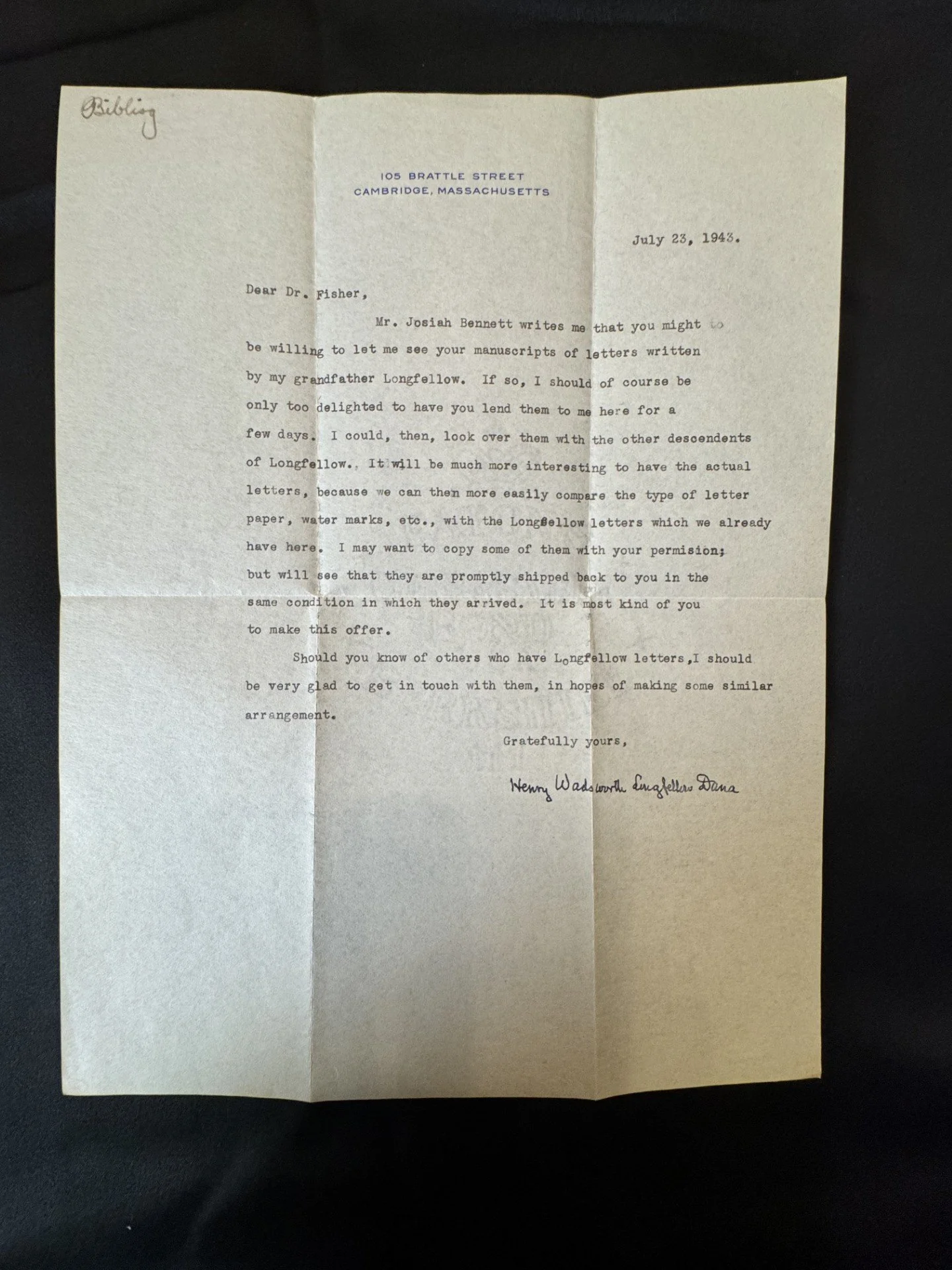
This original letter, dated July 23, 1943, was written and signed by Henry Wadsworth Longfellow Dana (1881–1950), grandson of celebrated American poet Henry Wadsworth Longfellow (1807–1882). Dana was a scholar, educator, and preservationist who devoted much of his life to studying and preserving his family’s history and the papers and possessions associated with his famous grandfather.
Longfellow holds a particularly important place in the cultural history of the Mayflower. He was himself a descendant of Mayflower passengers John Alden and Priscilla Mullins, and in 1858 he published his famous narrative poem The Courtship of Miles Standish.
The poem tells the story of Captain Myles Standish asking John Alden to speak to Priscilla Mullins on his behalf, only for Alden and Priscilla ultimately to fall in love themselves. Longfellow was a direct descendant of John and Priscilla Alden, making the subject part of his own family history.
Although the romantic episode portrayed in the poem is not documented in surviving seventeenth-century records, The Courtship of Miles Standish became one of the most influential literary treatments of Plymouth Colony. The National Park Service notes that the poem helped make John Alden and Priscilla Mullins national icons of Pilgrim history and generated widespread interest in places and objects associated with the early Plymouth settlers.
In this 1943 letter, Longfellow’s grandson continues another aspect of that family legacy: the preservation and study of the poet’s documentary history. Writing from 105 Brattle Street in Cambridge, Massachusetts—the historic Longfellow family home—Dana contacts a Dr. Fisher concerning original letters written by his grandfather.
He explains that Josiah Bennett had told him Fisher might be willing to allow Dana to examine the manuscripts. Dana asks whether the letters could be lent to him for several days so that he could review them with other Longfellow descendants.
Dana explains exactly why having the original documents mattered. With the physical letters in hand, he could compare features including the type of letter paper and watermarks with Longfellow correspondence already held at the house. He also asks permission to copy some of the letters and promises that the manuscripts would be returned promptly and “in the same condition in which they arrived.”
The letter offers an intimate look at historical research and preservation before the era of digital archives. Dana was not simply collecting family memorabilia. He was examining physical evidence, comparing manuscripts, documenting correspondence, and actively seeking additional Longfellow letters still held in private hands.
The scale of Dana’s archival work can still be seen today. The National Park Service preserves the Henry Wadsworth Longfellow Dana Papers, 1744–1972, an extensive archival collection measuring approximately 114 linear feet. It contains correspondence, photographs, newspaper clippings, pamphlets, published and unpublished manuscripts, research materials, and other records produced or collected by Dana.
The finding aid also documents a substantial separate series of research index cards used by Dana to organize information about Longfellow’s writings, correspondence, family history, and other subjects.
Dana’s influence extended beyond his own papers. The National Park Service notes that, because of his long residence at 105 Brattle Street and his deep interest in family history, he was instrumental in constructing the archives now preserved at the Longfellow House, with evidence of his work appearing throughout numerous archival collections associated with the Longfellow and Dana families.
For the Mayflower Descendants Museum, the letter creates a particularly fitting connection across generations: a grandson preserving the papers of a poet who was himself a Mayflower descendant—and whose writing helped shape the cultural memory of John Alden, Priscilla Mullins, and Myles Standish.
Original typed letter signed by Henry Wadsworth Longfellow Dana, July 23, 1943.
Holdings of the Mayflower Descendants Museum.
Sources & Further Reading
U.S. National Park Service, “Henry Wadsworth Longfellow Dana.”
Provides biographical information on Henry Wadsworth Longfellow Dana, his relationship to Henry Wadsworth Longfellow, his scholarship, and his role in preserving the history and collections associated with the Longfellow family.
https://www.nps.gov/people/henry-wadsworth-longfellow-dana.htm
U.S. National Park Service, Longfellow House–Washington’s Headquarters National Historic Site, “Archives.”
Provides information about the extensive archival collections preserved at the Longfellow House, including family papers, correspondence, manuscripts, photographs, and other historical records associated with the Longfellow and Dana families.
https://www.nps.gov/long/learn/historyculture/archives.htm
U.S. National Park Service, Longfellow House Bulletin, Vol. 12, No. 1.
Discusses Henry Wadsworth Longfellow’s The Courtship of Miles Standish, his descent from Mayflower passengers John Alden and Priscilla Mullins, and the poem’s role in shaping the popular memory of the Alden and Standish story.
U.S. National Park Service, Finding Aid for the Henry Wadsworth Longfellow Dana Papers, 1744–1972.
Documents the extensive archival collection created and preserved by Henry Wadsworth Longfellow Dana. The collection measures approximately 114 linear feet and includes correspondence, photographs, manuscripts, research materials, newspaper clippings, pamphlets, and other records. The finding aid also describes Dana’s extensive research index cards and his role in organizing and preserving the Longfellow family archives.