
Artists Ellen Day Hale and Gabrielle de Veaux Clements
Ellen Day Hale
Ellen Day Hale (1855–1940) was an American painter, printmaker, and teacher born into a prominent New England family. The only daughter of author and clergyman Edward Everett Hale, she studied with artists including William Rimmer and William Morris Hunt before continuing her training in Paris at the Académie Julian. Her work was exhibited at venues including the Paris Salon and the Royal Academy in London. (National Museum of Women in the Arts)
Hale was also a Mayflower descendant. Through her mother, Emily Baldwin Perkins, her ancestry traced to Mayflower passenger John Howland. Ellen came from a remarkable artistic and literary family: her father was the celebrated author and Unitarian minister Edward Everett Hale, best known for The Man Without a Country, while her younger brother, Philip Leslie Hale, also became a noted painter, teacher, and art critic.
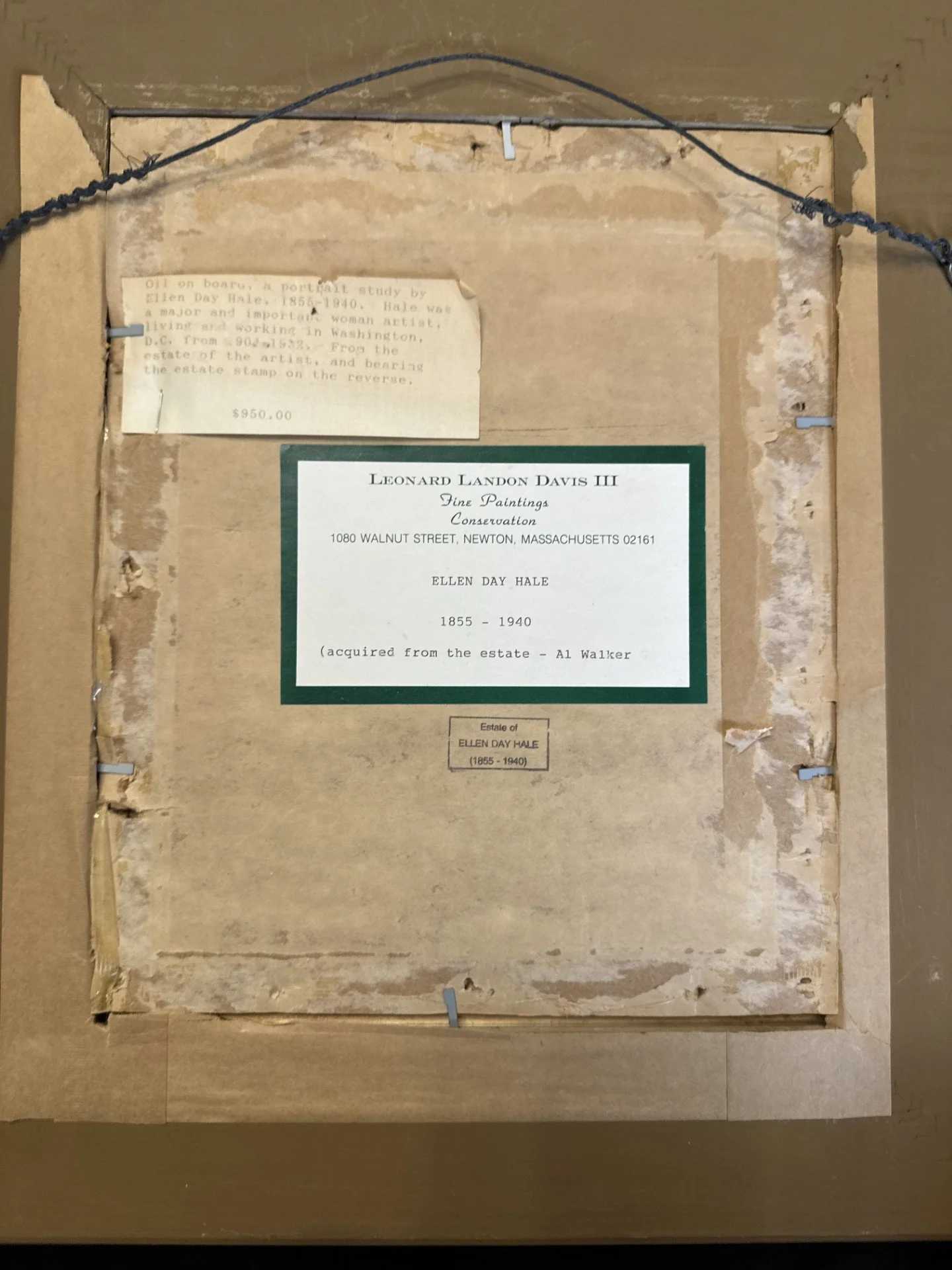
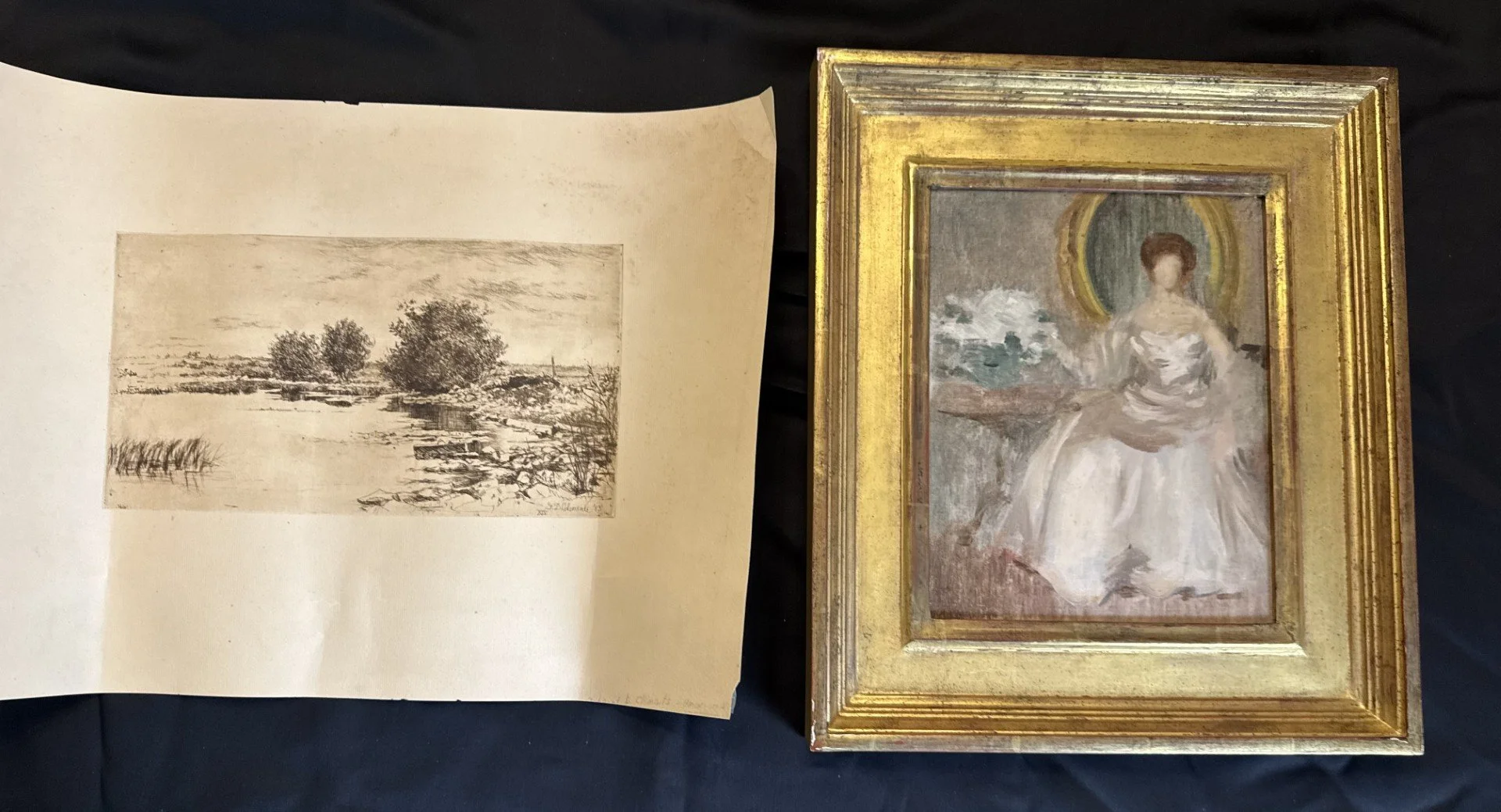
Shown here is an oil-on-board painting identified as a work by Ellen Day Hale from her estate. The Mayflower Descendants Museum will continue researching the painting and its history as part of its study of Hale’s career.
Gabrielle de Veaux Clements
Gabrielle de Veaux Clements (1858–1948) was an accomplished painter, etcher, muralist, printmaker, and teacher. After graduating from Cornell University in 1880, she studied with Thomas Eakins at the Pennsylvania Academy of the Fine Arts, where she received the school’s Toppan Prize. Her career later included exhibitions, teaching, major mural commissions, and an extensive body of prints inspired by her travels. (American Art Archives)
The Significance of Clements’s 1883 Etching
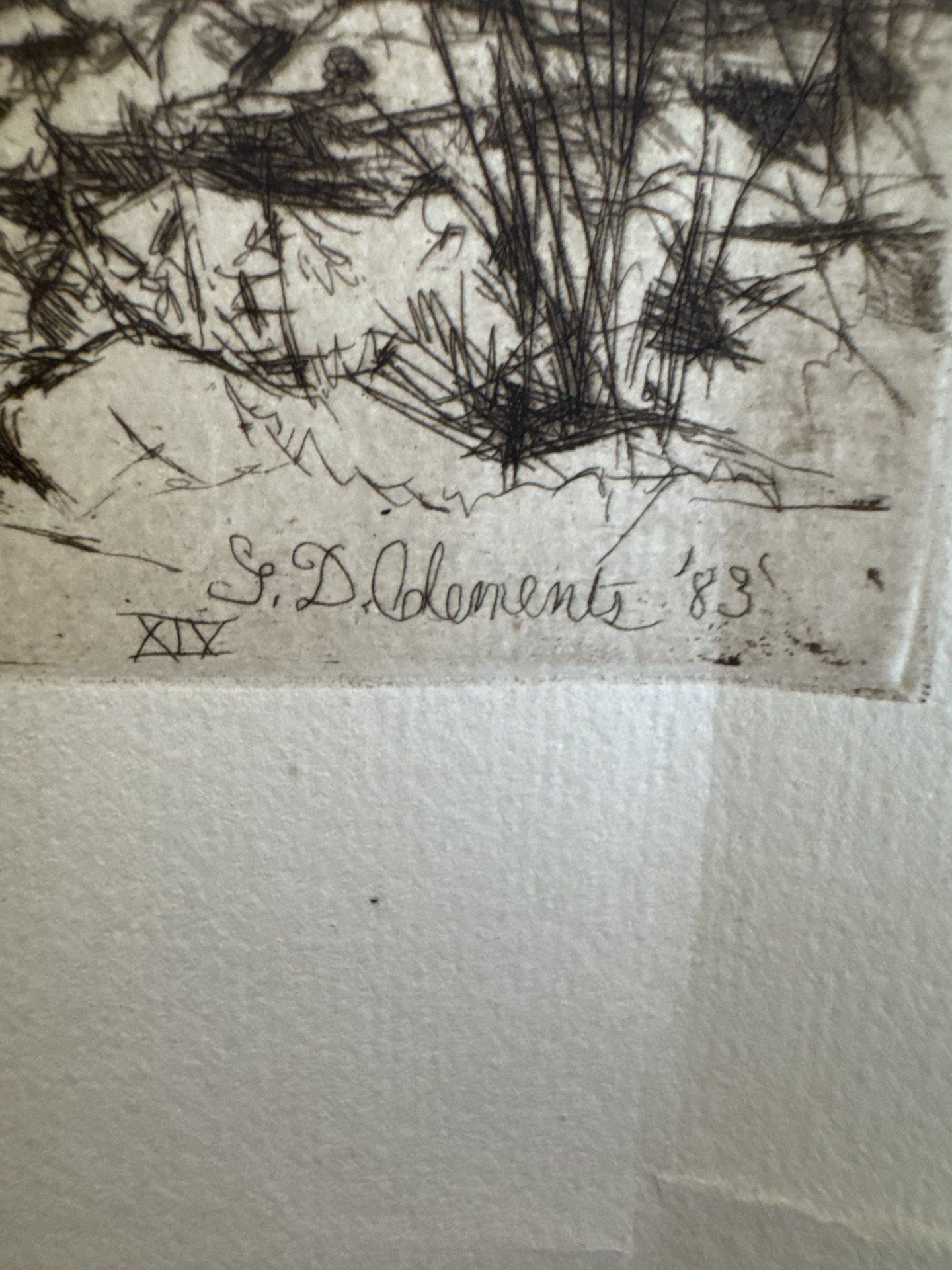
Shown alongside Hale’s painting is the Museum’s signed 1883 etching by Clements, Pond. Its date is particularly significant.
In 1883, artist Stephen Parrish introduced Clements to the techniques of etching, and she began producing, exhibiting, and printing her works professionally. Pond therefore dates from the very beginning of what would become an important part of her artistic career. (American Art Archives)
But 1883 was important for another reason: it was also the year Clements met Ellen Day Hale. (American Art Archives)
The Museum’s Pond thus dates from both the beginning of Clements’s professional work in etching and the beginning of a relationship that would shape the rest of her life.
Their Life Together
Hale and Clements met in 1883. Clements traveled to Paris in 1884 to study at the Académie Julian, where Hale joined her in 1885. Clements subsequently taught Hale etching, a medium Hale would pursue extensively throughout her own career. Their relationship continued for the remainder of their lives; the Smithsonian Archives of American Art describes Clements as Hale’s “lifelong companion,” while the Smith College Museum of Art refers to Hale as Clements’s future life partner. (American Art Archives)
In 1893, the two artists purchased a home near Gloucester, Massachusetts, known as “The Thickets.” Together they traveled extensively through France, Italy, Egypt, Syria, Palestine, and elsewhere, while continuing to paint, print, teach, and experiment with artistic techniques. They also opened their studios to other women artists and shared their knowledge of painting, etching, and color printmaking. (American Art Archives)
Holdings of the Mayflower Descendants Museum.
Sources & Further Reading
Smithsonian Archives of American Art — Gabrielle de Veaux Clements Papers. Gabrielle de Veaux Clements biographical note
Smithsonian Archives of American Art — Ellen Hale and Hale Family Papers. Ellen Day Hale biographical note
National Museum of Women in the Arts — Ellen Day Hale. Ellen Day Hale artist profile
Smith College Museum of Art — Gabrielle de Veaux Clements. Gabrielle de Veaux Clements: Artist, Teacher and World Traveler
.