
Mayflower Descendant Artists Kenyon Cox, Louise Howland King Cox, and Allyn Cox
Teacher, Student, Marriage, and an Artistic Legacy
The story of artists Kenyon Cox (1856–1919), Louise Howland King Cox (1865–1945), and their son Allyn Cox (1896–1982) is one of artistic influence passing from teacher to student, developing into marriage and professional collaboration, and continuing into a second generation.
It is also a Mayflower story. Kenyon Cox was a descendant of Mayflower passenger William Brewster. FamousKin.com, compiled by genealogist Rich Hall, provides a generation-by-generation lineage connecting Cox to Brewster. Hall is a member of the General Society of Mayflower Descendants and a published contributor to Mayflower Descendant.
During the Museum’s research into the Cox family, our founder also discovered evidence that Louise Howland King Cox was herself a Mayflower descendant. According to the FamilySearch Family Tree pedigree identified during that research, Louise descends from at least one Mayflower passenger, Richard Warren, through his daughter Elizabeth Warren Church.
This means that their son, Allyn Cox, inherited Mayflower ancestry through both of his artist parents—Kenyon through William Brewster and Louise through Richard Warren.
Holding works by Kenyon Cox, Louise Howland King Cox, and their son Allyn Cox together gives the Mayflower Descendants Museum a rare opportunity to examine artistic influence across both mentorship and family. The collection allows viewers to consider Kenyon as teacher, Louise as his student who became an accomplished artist and collaborator in her own right, and Allyn as the next generation who grew up within that artistic household and carried the family tradition into monumental mural painting. Together, their works make it possible to trace how artistic training, shared ideas, professional collaboration, and family influence moved from teacher to student, from husband and wife, and ultimately from parents to son.
Kenyon Cox and The Blessed Damozel
Kenyon Cox was a prominent American painter, illustrator, teacher, writer, and muralist. He studied at the Pennsylvania Academy of the Fine Arts and later in Paris before returning to the United States, where he illustrated books and magazines and taught at the Art Students League of New York. It was there that one of his students would become especially important to both his personal and professional life: Louise Howland King. The two married in 1892. Smithsonian records describe both as prominent painters and document their collaboration on murals for the Liberal Arts Building at the 1893 World’s Columbian Exposition in Chicago. (American Alliance of Museums)
The Blessed Damozel-An Exceptionally Rare Book
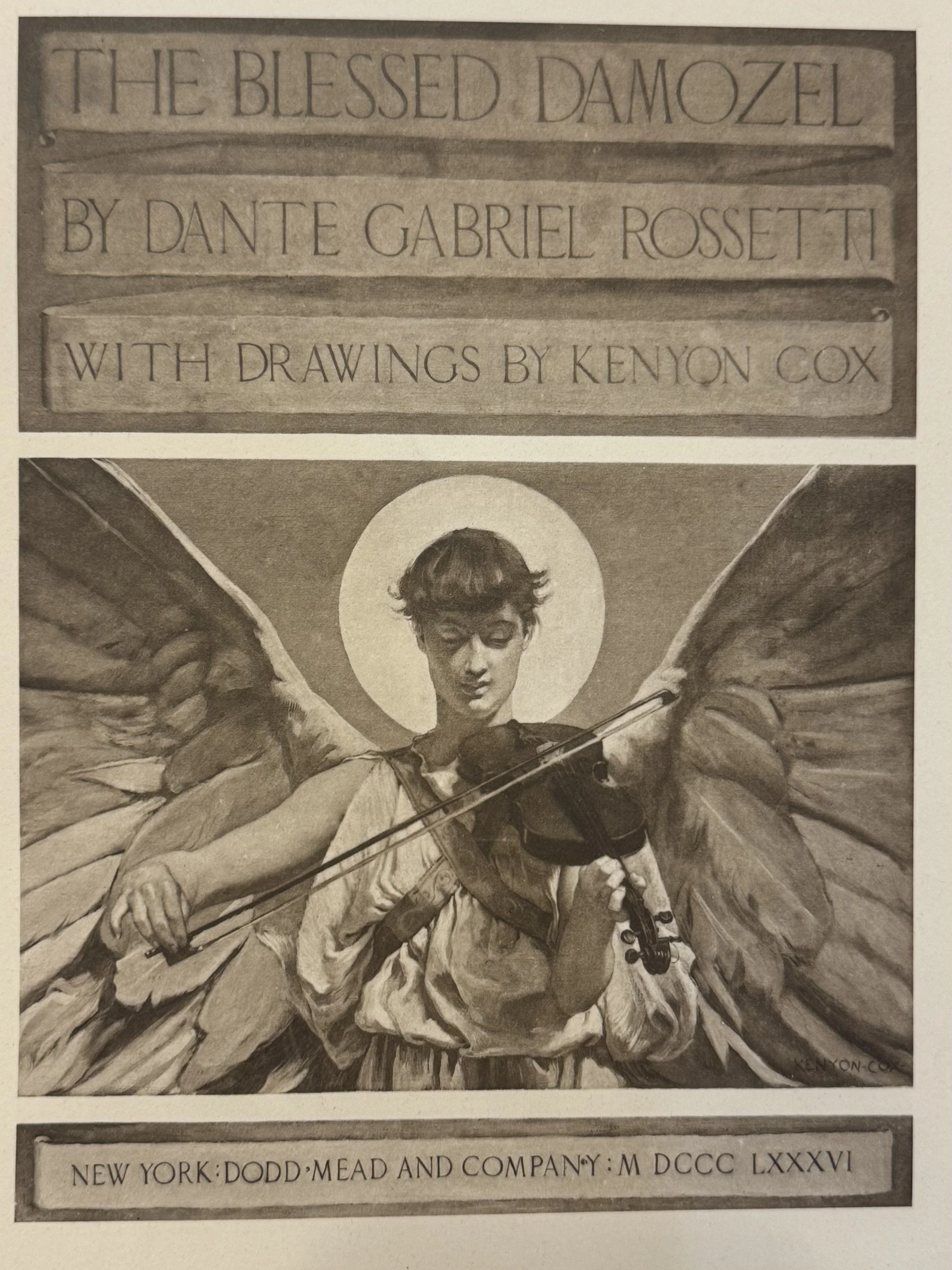
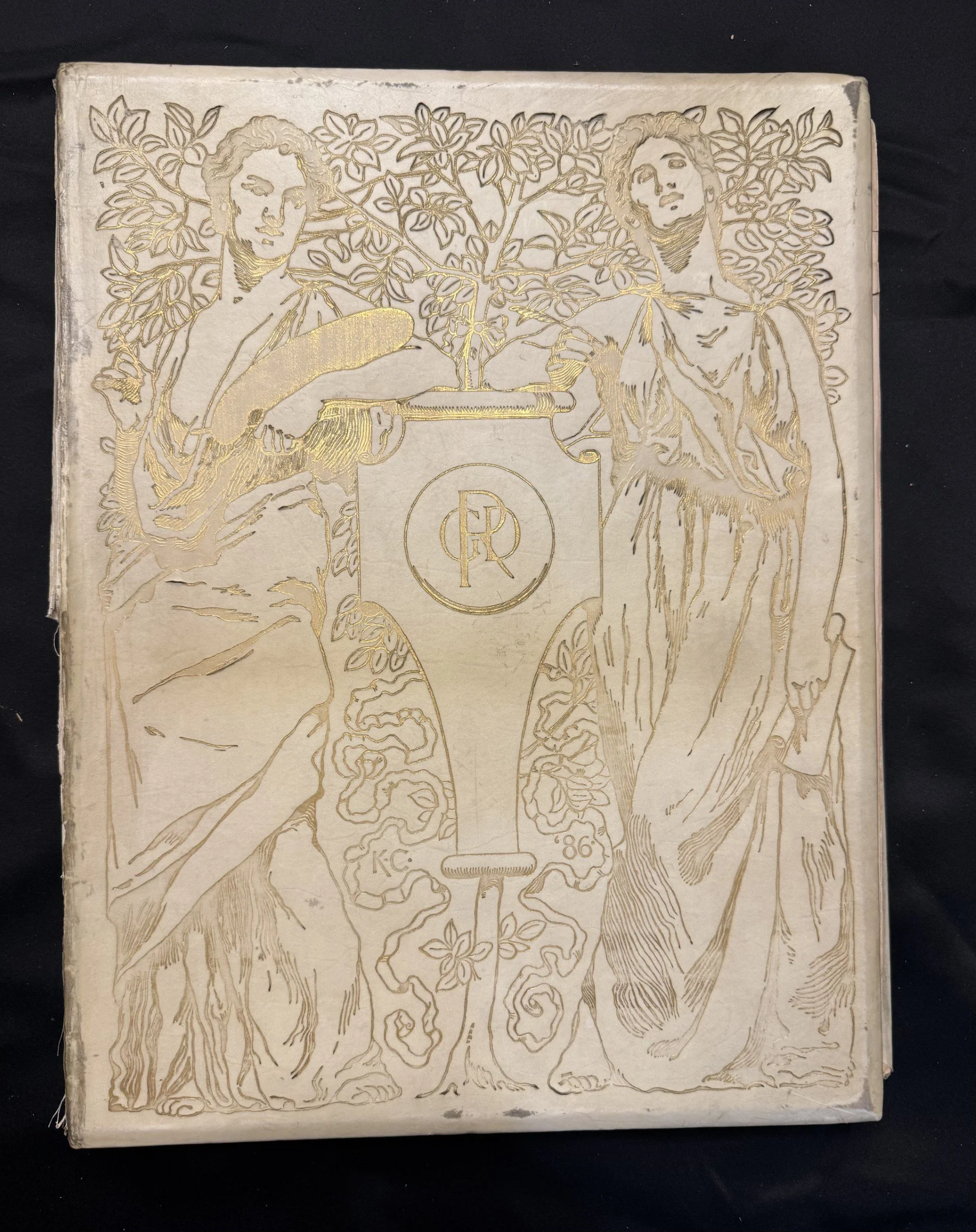
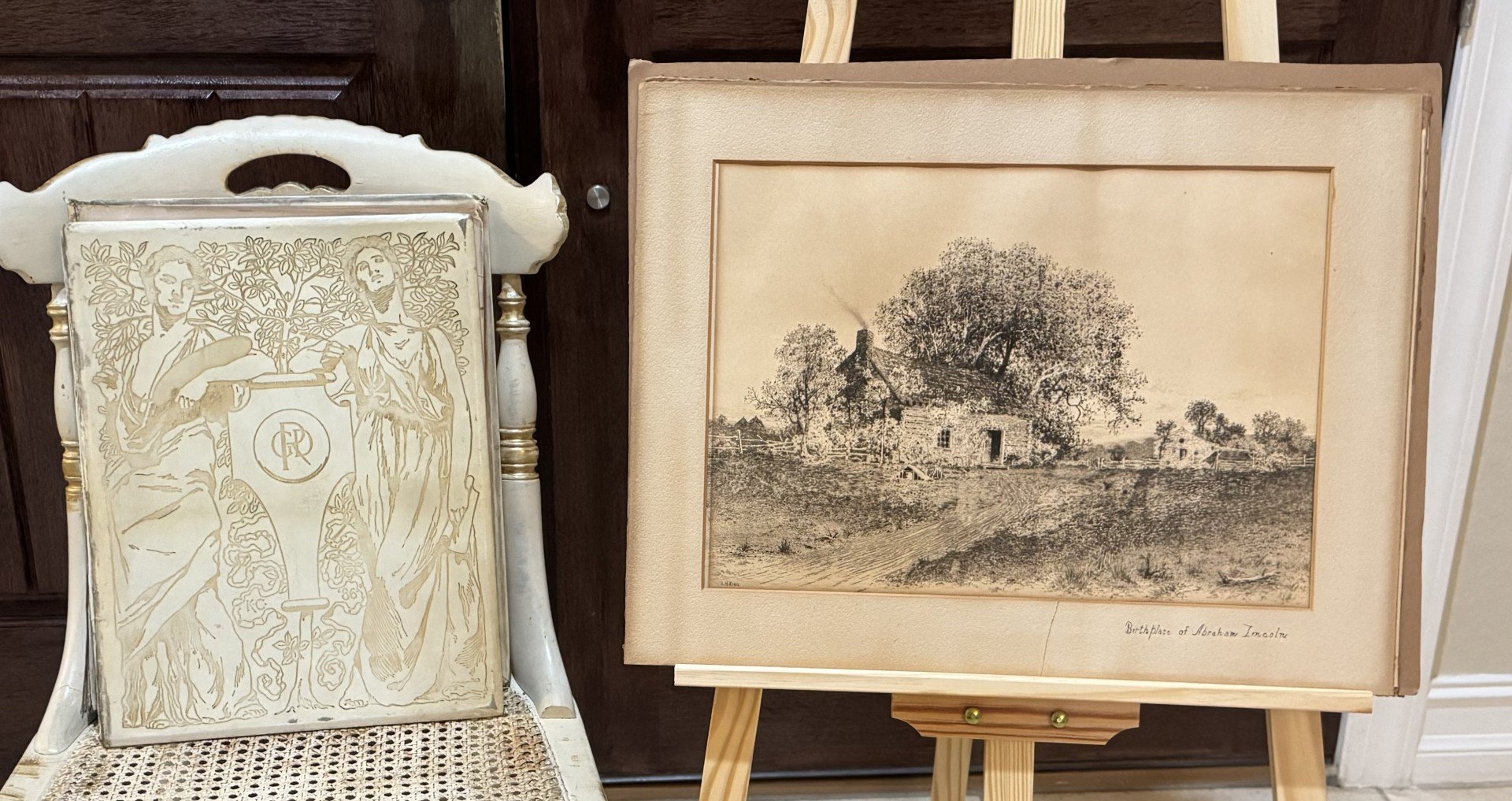
The gilt vellum cover of the exceptionally rare 1886 deluxe edition of The Blessed Damozel by Dante Gabriel Rossetti, is held in the collection of the Mayflower Descendants Museum.
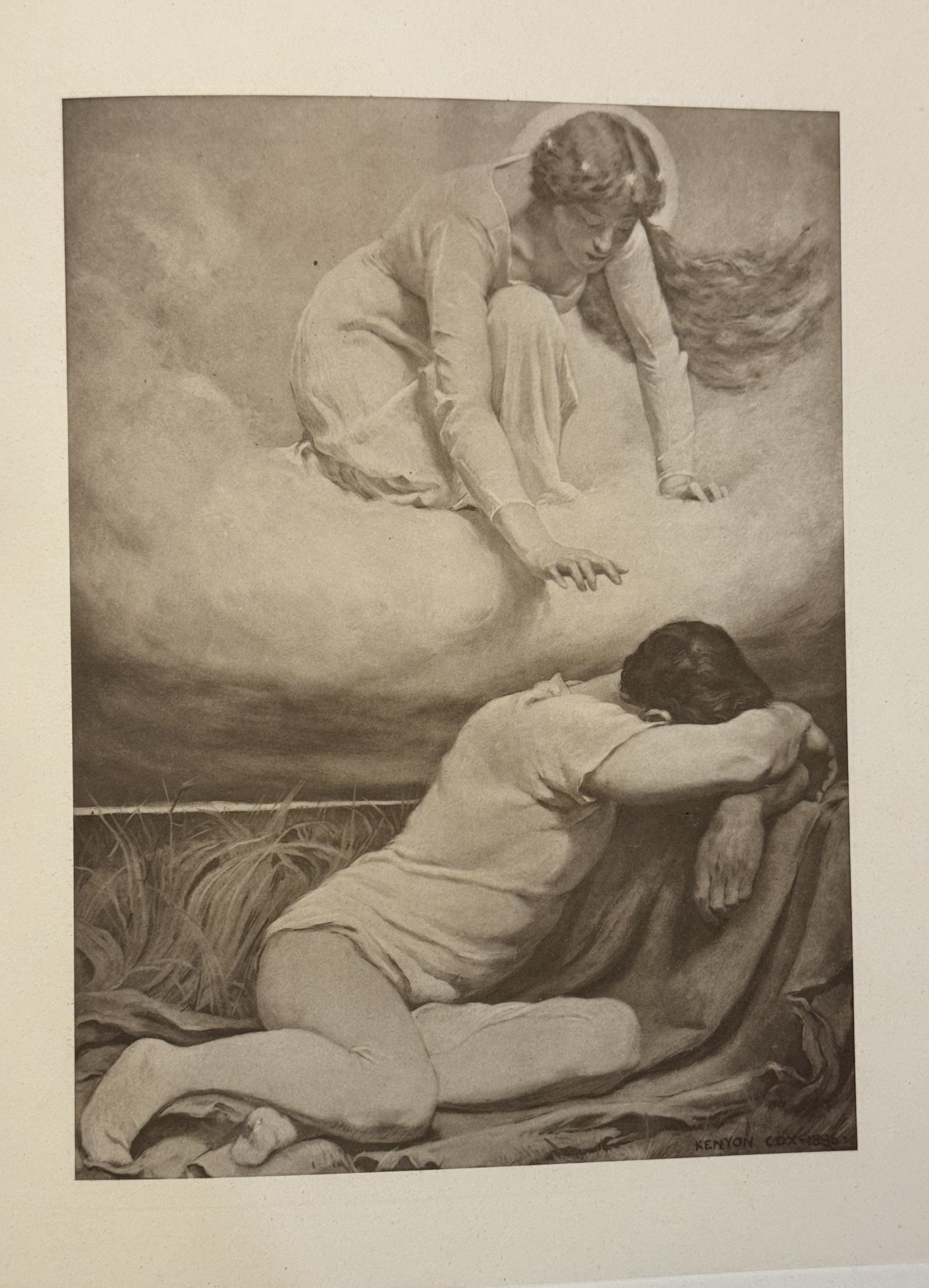
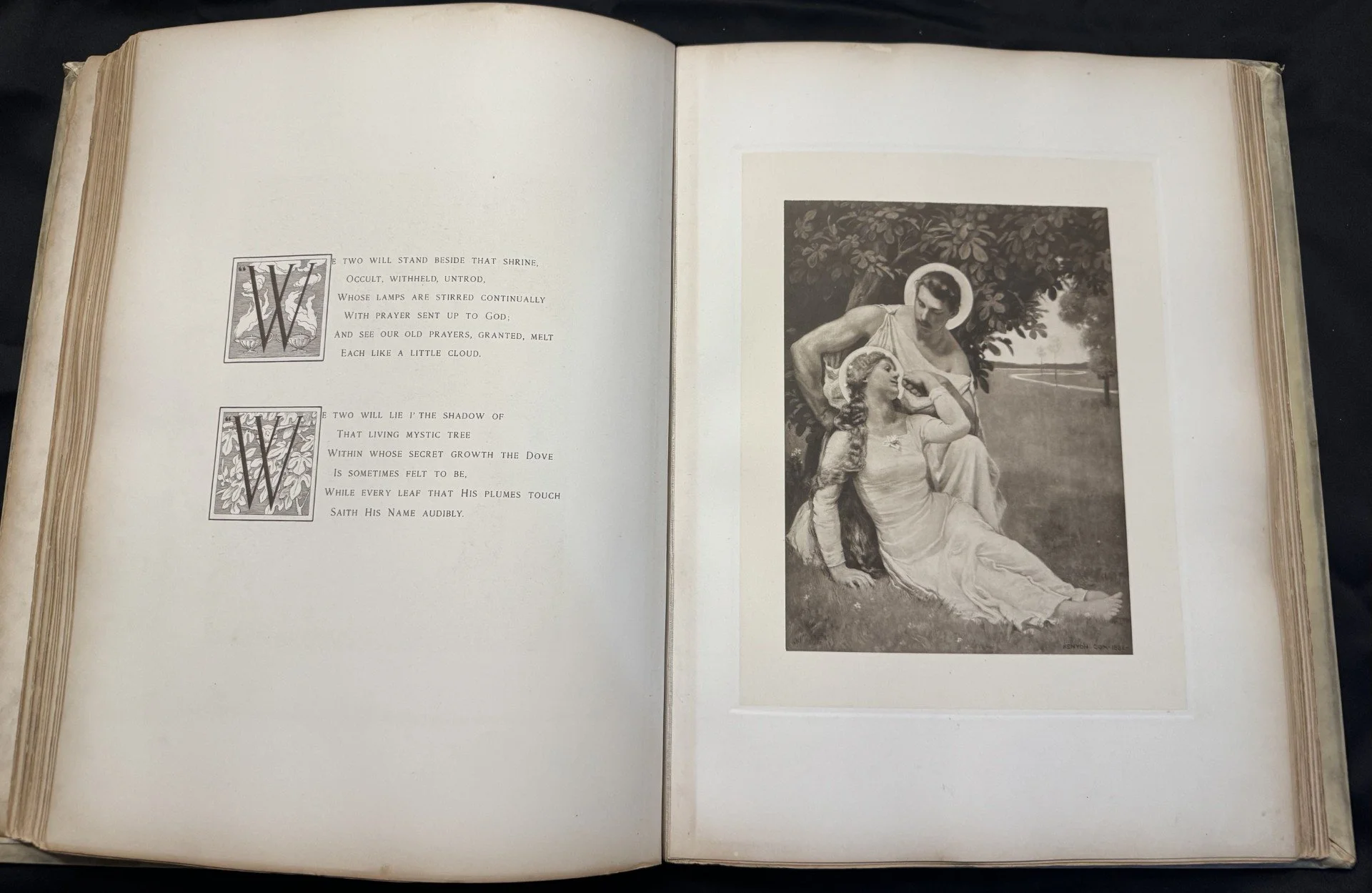
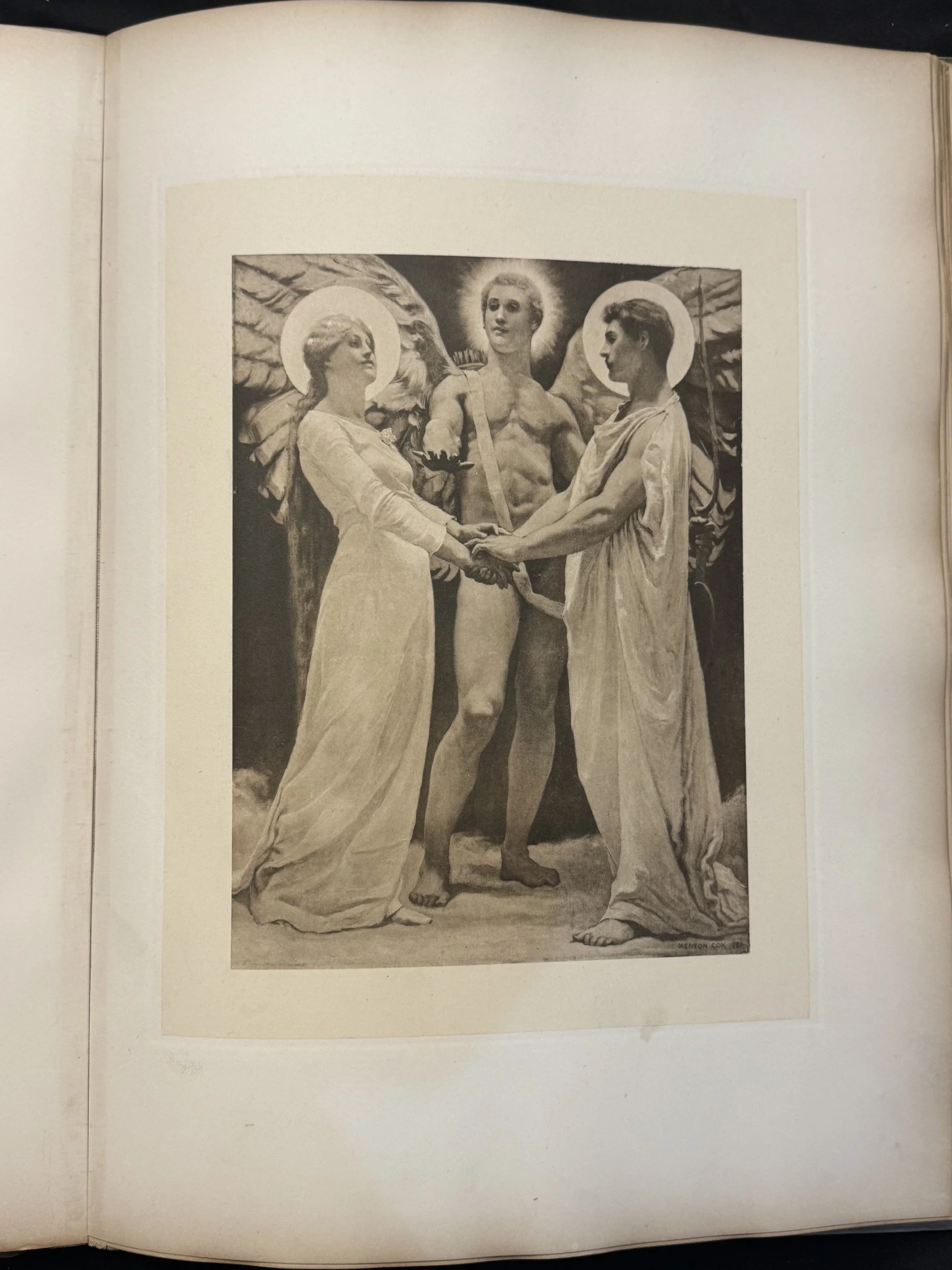
Only 35 copies of this deluxe edition were produced, each containing proof impressions on India paper. Rossetti’s hauntingly romantic poem envisions a young woman in heaven gazing down upon the man she loves on earth, longing for the day they will be reunited. Among the museum collections we have identified, The Metropolitan Museum of Art is the only other institution known to hold an 1886 Cox‑illustrated edition of The Blessed Damozel. (The Metropolitan Museum of Art)
The Blessed Damozel is a rare book. The Museum’s copy belongs to the limited large-folio issue of only 35 copies, produced with proof impressions of Cox’s illustrations on India paper and bound in elaborately gilt-decorated vellum. Surviving examples of this issue have specifically been catalogued as having a Pre-Raphaelite cover design by Cox. (LOT-ART)
The Museum’s copy also bears the bookplate of Frederick Norton Finney, dated 1904 and designed by J. Winfred Spenceley. The Library of Congress holds another example of Finney’s bookplate in its Ruthven Deane Bookplate Collection, where it identifies Finney as the owner and records an inscription describing him as “a civil engineer fond of books & gems.” This bookplate adds a documented layer of provenance to the Museum’s exceptionally rare volume.
The connection to Pre-Raphaelite art is an important part of understanding the book.
What Is Pre-Raphaelite Art?
The Pre-Raphaelite Brotherhood was formed in Britain in 1848 by a group of young artists that included Dante Gabriel Rossetti, John Everett Millais, and William Holman Hunt. They challenged many conventions of established academic art and developed an approach characterized by close observation, precise drawing, brilliant color, literary and religious subjects, and renewed interest in medieval and early Renaissance art. The National Gallery of Art describes Pre-Raphaelitism as Britain’s first avant-garde art movement. (National Gallery of Art)
Books were an important part of that artistic world. Members and associates of the Pre-Raphaelite circle worked not only as painters but also as poets, illustrators, and designers, bringing art, literature, typography, and ornament together within the book itself. (National Gallery of Art)
Rossetti was therefore not simply the author of a poem that Cox happened to illustrate. He had been one of the founders of the Pre-Raphaelite movement. The Blessed Damozel was first published in February 1850 in the second issue of The Germ, the literary periodical associated with the Pre-Raphaelite Brotherhood. (Rossetti Archive)
Cox belonged to a later generation and was not himself a member of the Pre-Raphaelite Brotherhood. He came instead from the American and European academic tradition. His treatment of The Blessed Damozel therefore represents an intriguing meeting of two artistic worlds.
That meeting is particularly visible on the Museum’s gilt-vellum cover. Its elongated figures, flowing drapery, dense natural foliage, pronounced linear contours, flattened decorative arrangement, and dreamlike literary imagery recall the visual vocabulary associated with Rossetti and later Pre-Raphaelite art. At the same time, Cox’s figures retain the controlled drawing and carefully ordered composition associated with his academic training.
The result is an unusual artistic intersection: the literary and visual world of the British Pre-Raphaelites interpreted by an academically trained American artist of the next generation.
Louise Howland King Cox: A Mayflower Descendant and Artist in Her Own Right
Louise Howland King Cox (1865–1945) was born in San Francisco and pursued serious artistic training from a young age. According to research by the Mayflower Descendants Museum’s founder, a FamilySearch pedigree also identifies Louise as a descendant of Mayflower passenger Richard Warren, meaning that both Louise and Kenyon brought Mayflower ancestry into their family. FamilySearch pedigree for Louise Howland King Cox
In 1881, at only sixteen years old, Louise entered the National Academy of Design in New York. There she studied under Lemuel Wilmarth and spent two school years “drawing from the antique.” (National Academy Museum)
Despite how the phrase sounds today, “drawing from the antique” did not mean sketching old household objects. It was a traditional form of academic art training in which students drew carefully from plaster casts of ancient Greek and Roman sculpture. This helped students learn proportion, anatomy, contour, shading, and the construction of the human figure before or alongside more advanced study from living models. The practice was a foundational part of nineteenth-century academic art education. (LINEA)
At eighteen, Louise continued her education at the Art Students League of New York, where her teachers included George de Forest Brush, Charles Yardley Turner, and J. Alden Weir. In 1884, Kenyon Cox became an instructor in her class. He took an interest in both her artistic development and, eventually, Louise herself. After a lengthy courtship, the two married in 1892. (National Academy Museum)
Louise soon established an important professional career independent of her husband. Her figure painting Psyche attracted attention when it was exhibited at the Society of American Artists in 1893, and she was elected a member of the Society that same year. In 1896, the National Academy of Design awarded her the Julius Hallgarten Prize for her painting Pomona. In 1902, she was elected an Associate of the National Academy of Design. (National Academy Museum)
Although Louise initially specialized in allegorical figure paintings, she became particularly known for her portraits of children, a genre in which she developed a substantial reputation. Her paintings were painstakingly developed from drawings, reflecting the rigorous technical training she had received as a young artist. She was also known for stained-glass design. (National Academy Museum)
Louise and Kenyon also collaborated professionally. Smithsonian records document that together they were responsible for murals decorating the Liberal Arts Building at the 1893 World’s Columbian Exposition in Chicago. (American Alliance of Museums)
The Museum’s collection reveals still another aspect of Louise’s work: printmaking.
A Mayflower Descendant’s Art Connected to Presidents and Thanksgiving
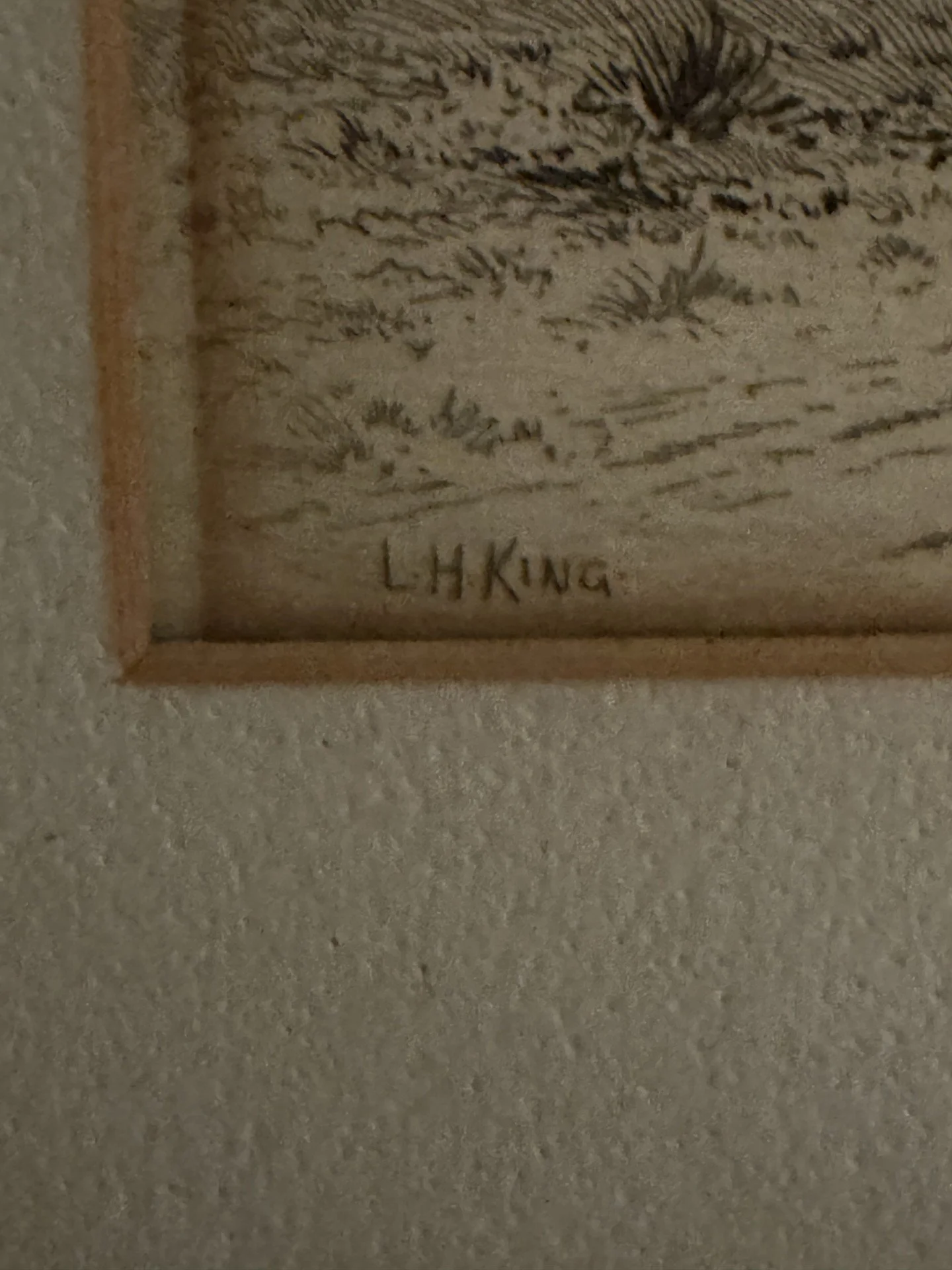
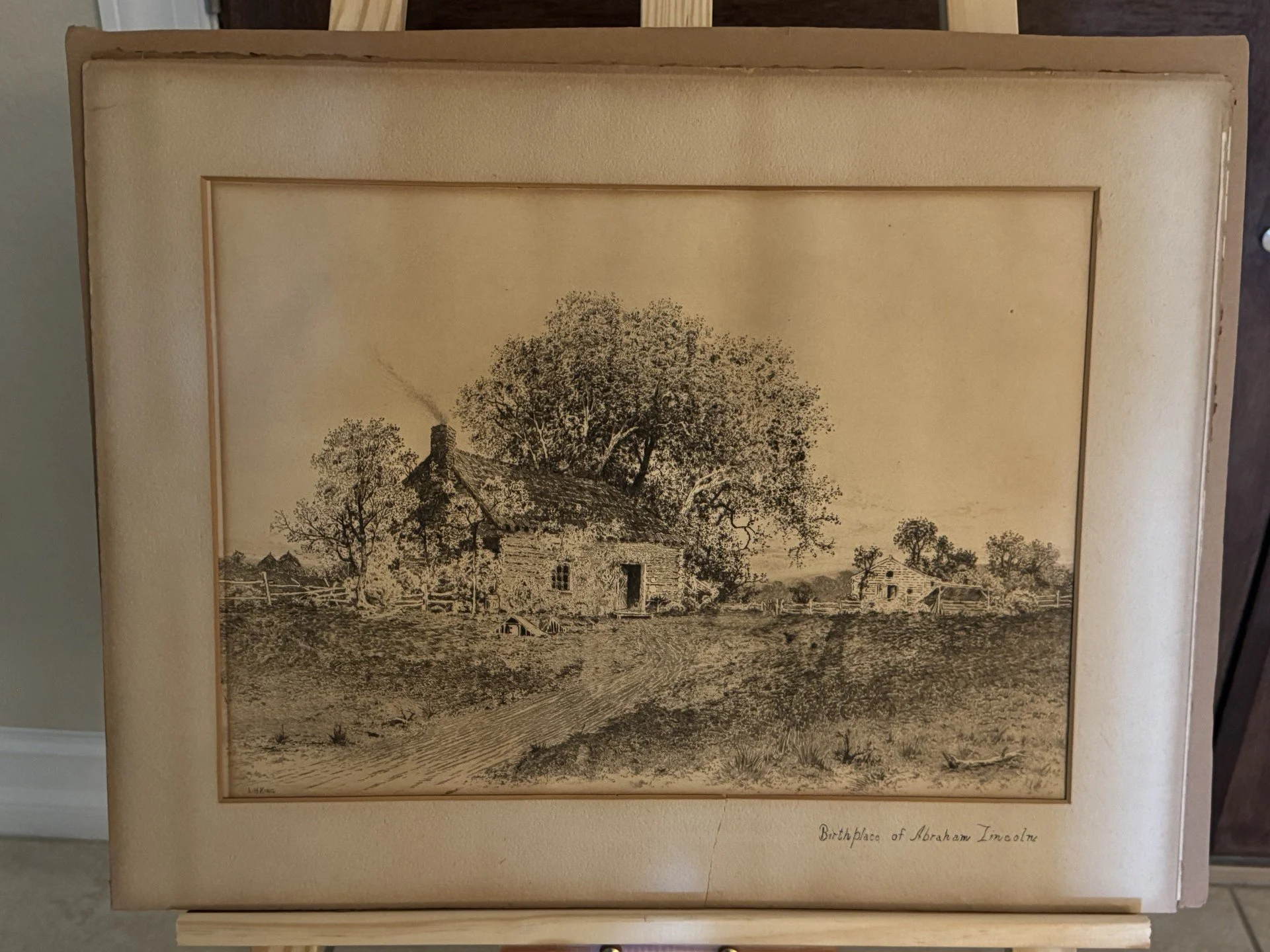
The Mayflower Descendants Museum holds signed etchings by Louise Howland King Cox depicting the birthplaces of two American presidents: George Washington and Abraham Lincoln. Shown here is Cox’s etching of Lincoln’s birthplace.
Both presidents also occupy important places in the development of Thanksgiving as a national observance. Following a resolution of the First Federal Congress, President George Washington issued a proclamation in 1789 naming Thursday, November 26, as a day of public thanksgiving. The National Archives describes this as the first Thanksgiving celebrated under the new U.S. Constitution. Presidential thanksgiving proclamations continued afterward, although the dates and even months varied. (National Archives)
More than seventy years later, during the Civil War, President Abraham Lincoln issued his October 3, 1863 proclamation, calling for the last Thursday of November to be observed nationally as a day of Thanksgiving. His proclamation established the precedent for Thanksgiving to be commemorated annually at the national level thereafter. (National Archives)
Through these two etchings, Louise’s work creates an unexpected connection among Mayflower ancestry, American presidential history, and the development of the national Thanksgiving tradition.
The Next Generation: Allyn Cox
The artistic tradition continued with their son, Allyn Cox (1896–1982). Born into a household of two professional artists—and, through both parents, into a family with Mayflower ancestry—Allyn began his artistic education by working with his father.
Around 1912, he served as Kenyon Cox’s assistant while his father was working on murals for the Wisconsin State Capitol. Allyn later attended the National Academy of Design and the Art Students League. In 1916 he received the Prix de Rome and subsequently studied for two years at the American Academy in Rome before beginning his own career as a mural painter. (American Alliance of Museums)
Allyn eventually became an important American muralist whose career brought the Cox family story directly into the United States Capitol.
Among his best-known projects are the extensive paintings now known as the Cox Corridors in the House wing of the Capitol. The central corridor, called the Great Experiment Hall, contains sixteen murals illustrating milestones in American legislative history across three centuries—from the Mayflower Compact in 1620 through the enactment of women’s suffrage in 1920. (Architect of the Capitol)
The first of those murals is particularly meaningful in the context of the Cox family. Allyn’s The Mayflower Compact, 1620 depicts William Brewster signing the document—the very Mayflower passenger through whom his father, Kenyon Cox, traced his ancestry. (Architect of the Capitol)
The Mayflower Descendants Museum also holds a yellow-flower painting by Allyn Cox, bringing a work by the second generation of this remarkable artistic family into the collection.
Together, Kenyon Cox, Louise Howland King Cox, and Allyn Cox offer a compelling example of artistic influence moving from teacher to student, from courtship to marriage, from marriage to artistic collaboration, and from parents to son.
Their story stretches from a nineteenth-century American interpretation of Dante Gabriel Rossetti and the Pre-Raphaelite movement, through Louise’s independent career as a painter, designer, and printmaker, and finally to Allyn Cox’s monumental murals inside the United States Capitol.
And running through all three is another thread: Mayflower ancestry—William Brewster through Kenyon, Richard Warren through Louise according to the FamilySearch pedigree identified during the Museum’s research, and both family lines carried forward through their son Allyn.
Three Artists in American Museum Collections
The artistic legacy of Kenyon Cox, Louise Howland King Cox, and their son Allyn Cox can also be traced through major American museum collections. Particularly notable are institutions in which the work of more than one generation of the family is preserved together.
The Smithsonian American Art Museum holds works by all three artists.
Its collection includes numerous works by Kenyon Cox, among them Study for Drapery of “Pursuit of the Ideal” (1891) and studies for several of his mural commissions. (Smithsonian American Art Museum — Kenyon Cox)
Louise Howland King Cox is represented by May Flowers (1911), an oil painting of a young girl beside a vase of flowers. The painting entered the Smithsonian collection in 1911 as a gift of William T. Evans. (Smithsonian American Art Museum — May Flowers)
The Smithsonian also holds Allyn Cox’s Two Murals, dating to about 1938, an unusually large pair of oil paintings measuring approximately eight by fourteen feet. (Smithsonian American Art Museum — Two Murals)
This means that the Smithsonian American Art Museum preserves artwork by the teacher, the student who became his wife, and the son who carried their mural tradition into another generation. The Smithsonian’s Archives of American Art further preserves the Kenyon and Louise Cox Papers as well as the extensive Allyn Cox Papers, documenting the family’s personal and professional history. (Smithsonian Archives of American Art — Kenyon and Louise Cox Papers) (Smithsonian Archives of American Art — Allyn Cox Papers)
The National Academy of Design provides another remarkable intersection among all three members of the family.
Kenyon Cox is extensively represented in the National Academy’s collection. Among its holdings is his 1886 painting Noon, which was given to the Academy in 1959 by his children Allyn Cox, Caroline Cox Lansing, and Leonard Cox. (National Academy of Design — Noon)
Louise Howland King Cox is also represented there. Particularly meaningful within the family story is her 1940 oil portrait Allyn Cox, depicting her son as a professional artist standing with the tools of his profession. The painting is recorded as belonging to the National Academy of Design. (Smithsonian National Portrait Gallery, Catalog of American Portraits — Allyn Cox by Louise Howland King Cox)
Allyn’s own art is preserved in the National Academy collection as well. Its holdings include his portrait of sculptor Moissaye Marans, painted around 1970. Allyn had studied at the National Academy as a young man and was elected an Associate in 1940 and a full National Academician in 1962. (National Academy of Design — Allyn Cox)
The National Academy connection is therefore especially unusual: the institution preserves work by Kenyon, work by Louise—including Louise’s portrait of their artist son—and work created by Allyn himself.
Their work also extends into other prominent public collections and spaces. The Metropolitan Museum of Art holds multiple works by Kenyon Cox, including his 1908 replica of Augustus Saint-Gaudens and the 1883 Landscape. The National Gallery of Art holds his Flying Shadows. (The Metropolitan Museum of Art — Kenyon Cox, Augustus Saint-Gaudens) (National Gallery of Art — Flying Shadows)
Allyn Cox’s most monumental surviving work remains in the United States Capitol, where his murals include the Cox Corridors, additions to the Rotunda’s Frieze of American History, and America’s First Moon Landing, July 21, 1969. (Architect of the Capitol — Allyn Cox)
Seen together, these collections reinforce the unusual continuity of the Cox family’s artistic history. Kenyon taught Louise; Kenyon and Louise became professional artists and collaborators; their son trained within that artistic household and continued the family tradition on a monumental scale. Today, major institutions preserve works by all three—sometimes within the very same collection.
Sources & Further Reading
Smithsonian Archives of American Art — Kenyon and Louise Cox Papers, 1876–1977. Biographical material documenting Kenyon Cox’s career, his teaching at the Art Students League, his marriage to former student Louise Howland King in 1892, their work for the 1893 World’s Columbian Exposition, and their son Allyn Cox.
Explore the Kenyon and Louise Cox Papers
Smithsonian American Art Museum — Louise Cox. Biography of Louise Howland King Cox, including her studies at the Art Students League under Kenyon Cox and their marriage in 1892.
Learn more about Louise Cox
National Academy of Design — Kenyon Cox. Includes Cox’s work as an illustrator and his 1886 commission to illustrate Dante Gabriel Rossetti’s The Blessed Damozel.
Learn more about Kenyon Cox
Smithsonian Archives of American Art — Allyn Cox Papers. Documents Allyn Cox’s early training as his father’s assistant, his studies at the National Academy of Design and Art Students League, and his receipt of the Prix de Rome in 1916.
Explore the Allyn Cox Papers
Architect of the Capitol — Allyn Cox. An official biography of Cox and his decades of work in the U.S. Capitol, including the Frieze of American History, the Cox Corridors, and other major commissions.
Learn more about Allyn Cox
Architect of the Capitol — Cox Corridors Murals. Describes the Great Experiment Hall, whose 16 murals trace legislative milestones from the Mayflower Compact of 1620 through women’s suffrage in 1920.
Explore the Cox Corridors Murals
National Archives — Congress Establishes Thanksgiving. Documents George Washington’s 1789 Thanksgiving proclamation and Abraham Lincoln’s 1863 proclamation establishing the precedent for an annual national Thanksgiving observance.
Read about Washington, Lincoln, and Thanksgiving
Bauman Rare Books — The Blessed Damozel, 1886. Describes the deluxe edition illustrated by Kenyon Cox as one of only 35 large-folio copies, with proof impressions on India paper and an elaborate gilt-vellum binding.
View the 1886 deluxe edition description