
Mayflower Descendant Artist Oliver Ingraham Lay
and His Teacher, Thomas Hicks
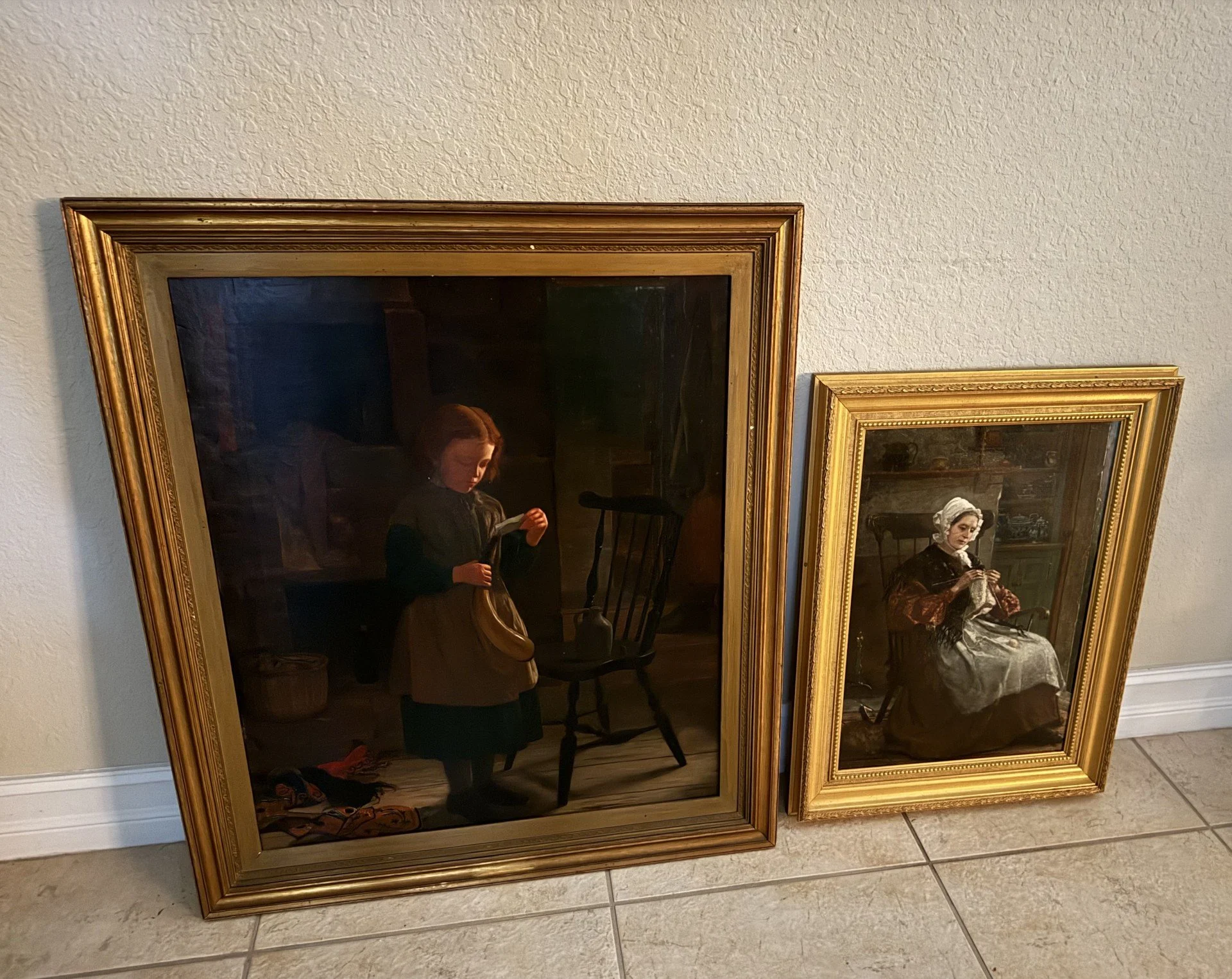
The Mayflower Descendants Museum holds paintings from these artists and an extraordinary letter that documents a relationship between two nineteenth-century American artists whose works are represented together in several important American collections: Thomas Hicks (1823–1890) and his student and Oliver Ingraham Lay (1845–1890), who research indicates was a Mayflower descendant.
Their connection was not merely one of artistic influence. Lay studied directly under Hicks early in his career. The Smithsonian American Art Museum identifies Lay as a pupil of Hicks, while the National Academy of Design records that Lay made his first oil study in 1861 under Hicks’s guidance.
Both artists later received recognition from the National Academy of Design, and works by both are now preserved in several of the same major American institutional collections.
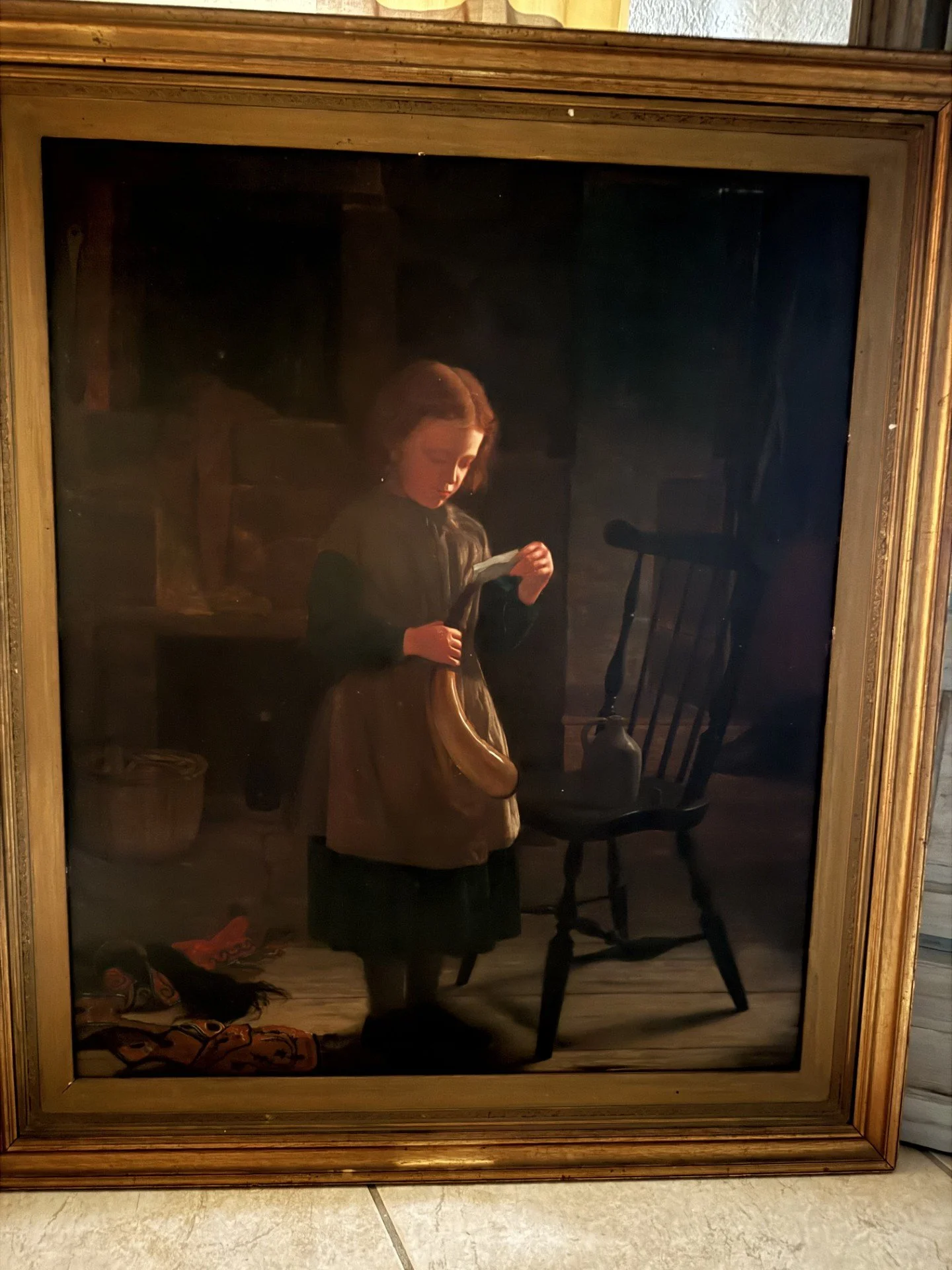
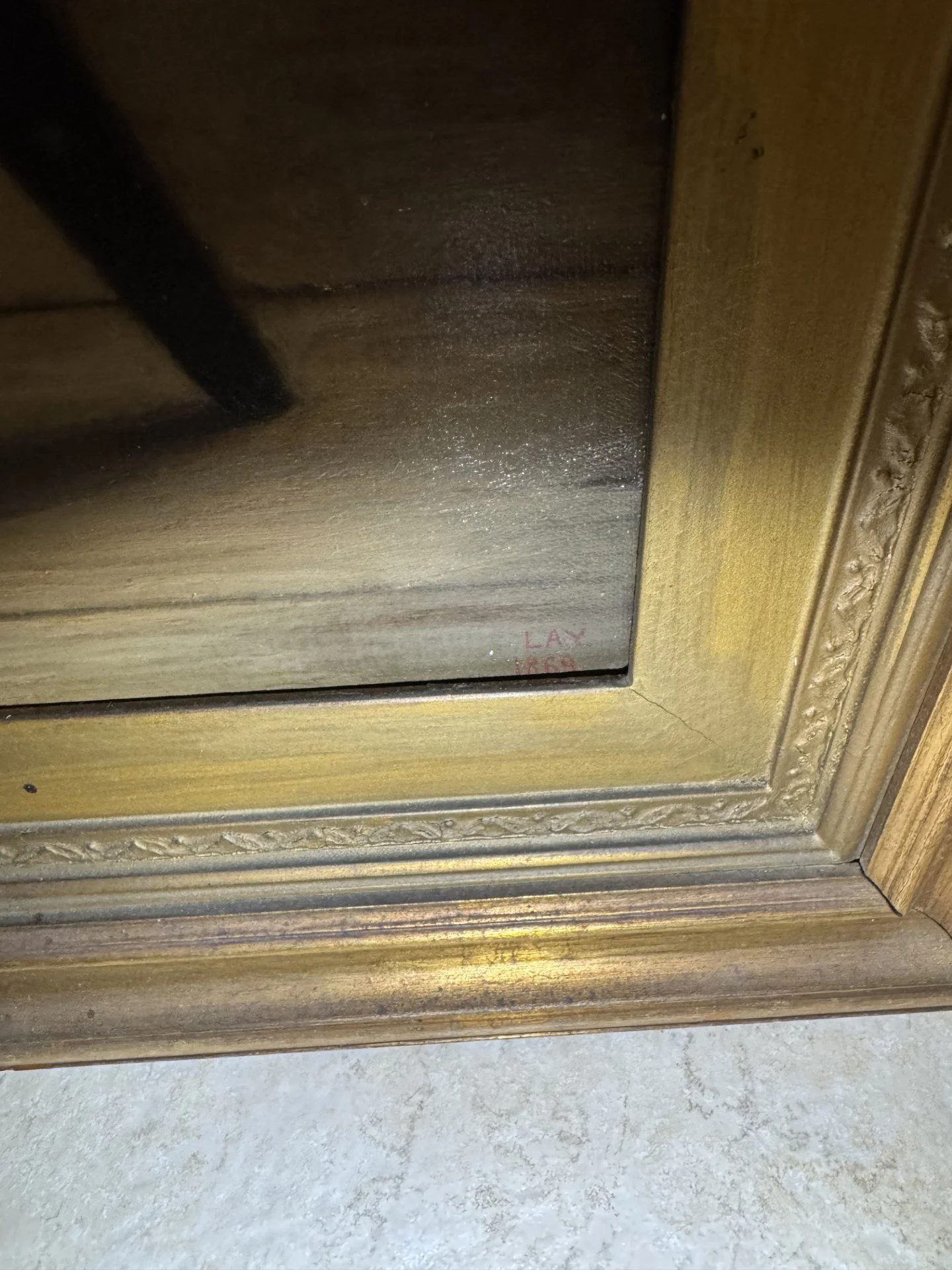
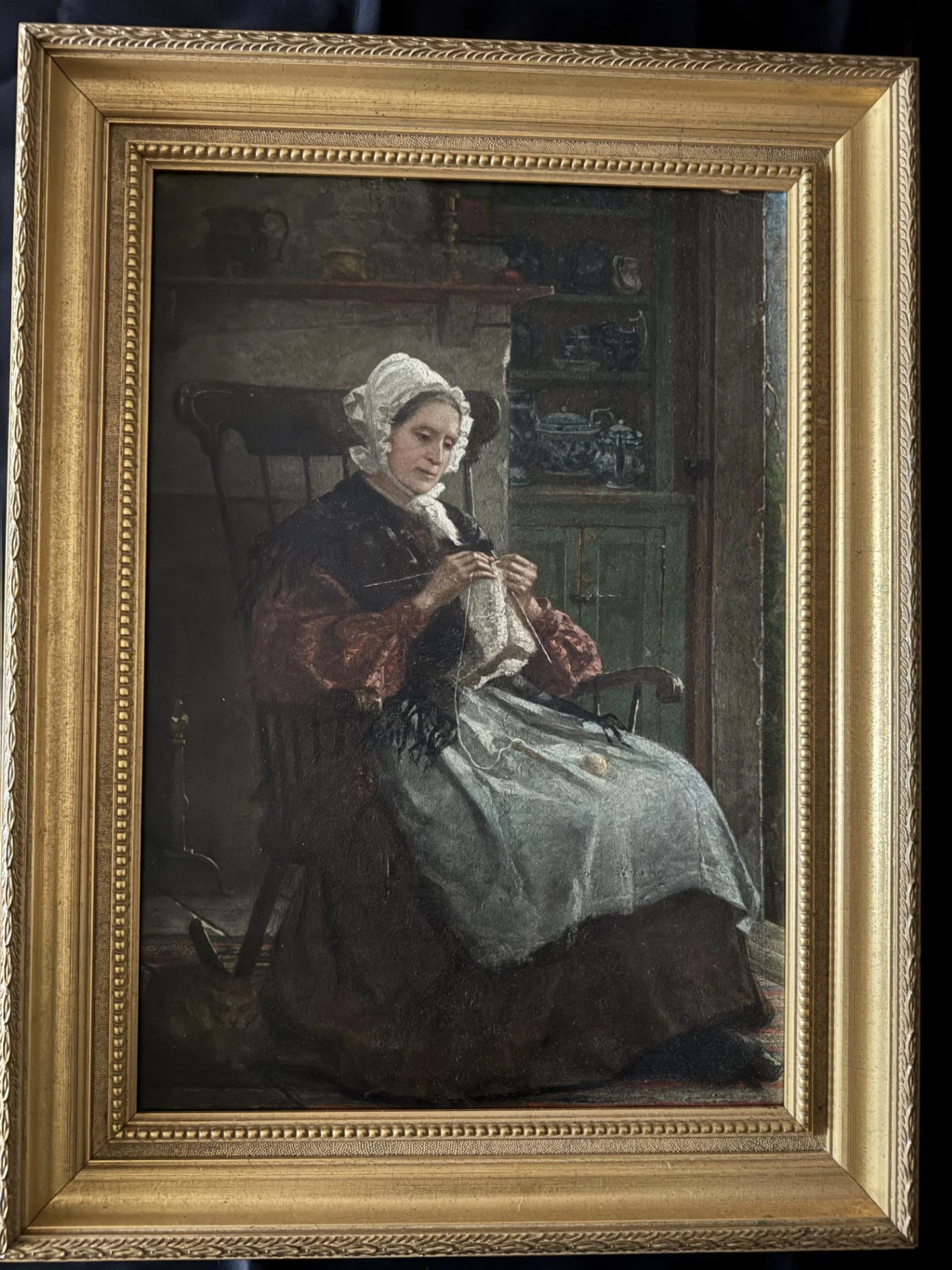
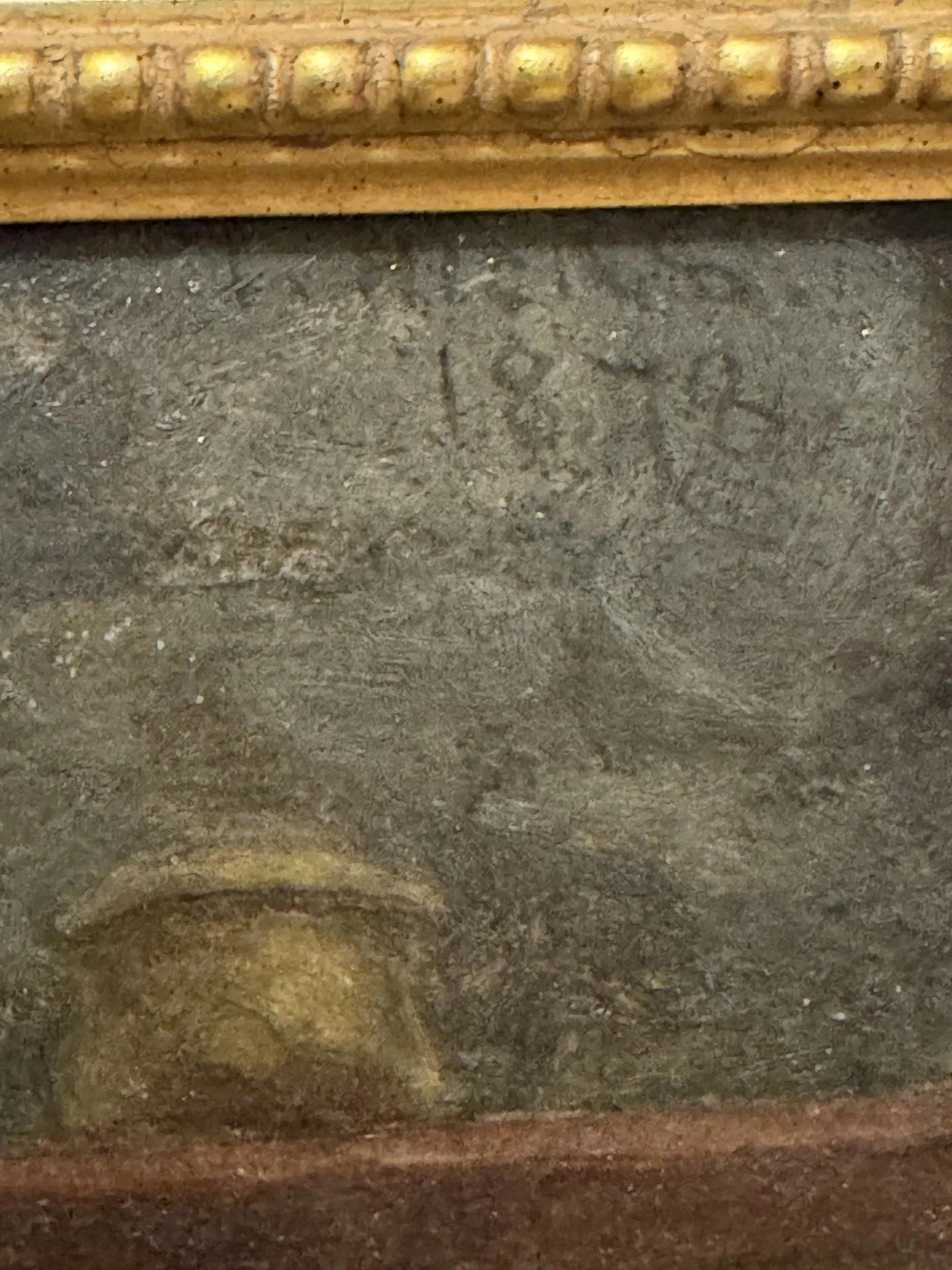
Shown here are Lay’s 1869 painting known as Filling the Powder Horn and an 1878 painting by Hicks depicting an older woman knitting while seated in a rocking chair with a cat nearby.
Thomas Hicks (1823–1890)
Born in Newtown, Pennsylvania, Thomas Hicks began his artistic training at an early age. He was apprenticed to his cousin, the well-known Quaker painter Edward Hicks, initially learning the trade of carriage painting. His early attempts at portraiture showed enough promise that he was encouraged to pursue formal artistic study.
Hicks studied briefly at the Pennsylvania Academy of the Fine Arts before moving to New York, where he entered the Antique class at the National Academy of Design in 1838. Within a year, he was already exhibiting portraits in the Academy’s annual exhibitions.
In 1845 Hicks traveled to Europe. After visiting London and Florence and spending an extended period in Rome, he settled in Paris in 1848 and entered the studio of the influential French painter Thomas Couture. He studied with Couture for approximately a year and a half before returning to the United States in 1849.
Although Hicks produced landscapes, genre scenes, literary subjects, and historical compositions, portraiture became the foundation of his reputation. His sitters included some of the most recognizable literary, artistic, theatrical, and political figures of nineteenth-century America, among them Margaret Fuller, Washington Irving, Henry Wadsworth Longfellow, William Cullen Bryant, Edwin Booth, and Bayard Taylor.
In June 1860, shortly after Abraham Lincoln received the Republican presidential nomination, Hicks traveled to Springfield, Illinois, and painted Lincoln from life. The portrait became one of Hicks’s best-known works and is described by the National Academy as having been regarded as the first oil likeness of Lincoln made following his nomination.
Hicks was elected an Associate National Academician in 1841 and a full National Academician in 1851. He remained deeply involved with the Academy for decades, exhibiting regularly and repeatedly serving on its Council. He also served as president of the Artists’ Fund Society from 1873 to 1885.
It was within this established New York artistic world that the young Oliver Ingraham Lay came under Hicks’s instruction.
Oliver Ingraham Lay (1845–1890)
Born in New York City in 1845, Oliver Ingraham Lay became a painter of portraits and genre scenes. Following a trip to Europe in 1860, he began serious artistic study in New York.
Lay studied directly under Thomas Hicks and also attended the Cooper Institute and the National Academy of Design. The National Academy records that Lay’s first oil study was executed in 1861 under Hicks’s guidance.
By 1863, Lay was exhibiting at the National Academy. Portraits and genre paintings by him subsequently became regular features of Academy exhibitions throughout the remainder of his life.
In 1876, Lay was elected an Associate National Academician, placing the former student within the same institution that had played such an important role in the career of his teacher.
Lay became particularly known for portraiture. His sitters included artists, actors, political figures, friends, and members of his own family. The Smithsonian Archives of American Art specifically identifies subjects including painter Fidelia Bridges and actor Edwin Booth, while the Smithsonian American Art Museum notes that Lay was particularly known during his lifetime for his portrait of Ulysses S. Grant.
One especially important surviving work is Lay’s 1865 portrait of fellow American artist Winslow Homer, now held by the National Academy of Design. According to the Academy, Lay began the portrait in Homer’s New York studio in February 1865. The two artists arranged an exchange: Lay was to receive a painting by Homer in return for the portrait.
The Smithsonian’s Archives of American Art now preserves an extensive collection of Lay family material, including correspondence, diaries, writings, scrapbooks, photographs, family records, sketches, and other documentation relating to Lay’s life and professional circle.
Lay died of tuberculosis in 1890 at approximately forty-five years old. The National Academy records that both his portraits and genre paintings had appeared regularly in its annual exhibitions from 1863 until his death.
Research Suggests a Mayflower Connection
Research conducted by the founder of the Mayflower Descendants Museum suggests that Oliver Ingraham Lay was a descendant of Mayflower passenger William Brewster.
This Mayflower connection does not generally appear in standard published biographies of Lay. It emerged through the Museum’s genealogical research into artists represented in its collection.
The Museum’s founder reconstructed Lay’s family line across successive generations using a variety of genealogical and biographical sources, including records and family connections found through Ancestry, Find a Grave, and WikiTree. By comparing these sources and following the relationships across generations, the research indicates he was a descent of Mayflower passenger, William Brewster.
The research illustrates an important part of the Museum’s process: connections that may not appear in conventional artist biographies can sometimes become visible when art history, family history, archival records, cemetery records, and genealogical sources are examined together.
The Mentor and the Student
The relationship between Hicks and Lay is especially meaningful within the Mayflower Descendants Museum’s Mentor/Student Collection because the surviving historical record allows the two artists to be viewed not simply as painters working during the same period, but as participants in an identifiable chain of artistic education.
Hicks himself had moved through several levels of nineteenth-century artistic training—from his early apprenticeship with Edward Hicks, through study at the Pennsylvania Academy and National Academy of Design, to European study and the Paris studio of Thomas Couture.
He then became, in turn, a teacher to the young Oliver Ingraham Lay.
Lay’s first recorded oil study was made under Hicks’s guidance. He subsequently developed his own professional career, exhibited at the same National Academy in which Hicks had established himself, and eventually earned Academy recognition himself.
Hicks became an Associate National Academician in 1841 and a full National Academician in 1851. Lay became an Associate in 1876.
Their careers therefore intersect not only through private artistic instruction but through one of the principal institutions of professional American art in the nineteenth century.
Works in the Mayflower Descendants Museum Collection
The Mayflower Descendants Museum holds paintings by both teacher and student, offering an unusual opportunity to consider their work side by side.
Oliver Ingraham Lay — Filling the Powder Horn, 1869
Filling the Powder Horn received notable recognition from AMG Attorneys, a European art-law firm specializing in cultural heritage and provenance, in a social-media tribute published for Lay’s birthday on January 31, 2026.
AMG singled out three paintings as being among Lay’s most notable works:
“Among his most notable works, ‘Hester Marian Wait Lay, Portrait of the Artist’s Wife,’ ‘Charles Downing Lay, Portrait of the Artist’s Son,’ and ‘Filling the Powder Horn’ stand as remarkable examples of his skill.”
The other two paintings identified by AMG—Hester Marian Wait Lay, Portrait of the Artist’s Wife and Charles Downing Lay, Portrait of the Artist’s Son—are held by the Smithsonian American Art Museum. Filling the Powder Horn is held by the Mayflower Descendants Museum.
AMG described the portrait of Lay’s wife as reflecting “the deep affection and admiration Lay held for his wife” and the portrait of his son as portraying “the bond between father and child.” Of Filling the Powder Horn, AMG wrote that Lay depicts “a pivotal historical moment,” connecting the scene with what it described as the “resilience and courage of the American spirit.”
Created in 1869, just four years after the end of the Civil War, Filling the Powder Horn represents a notable departure from the portraits and domestic interiors for which Lay is better known. Its early-nineteenth-century atmosphere—expressed through clothing, objects, furnishings, and the quiet presence of the young girl—offers a more narrative glimpse into an earlier American moment.
Rather than presenting a formal sitter, Lay constructs a scene around an activity. The young girl filling the powder horn becomes the focus of a painting that suggests a story without fully explaining it. The powder horn itself introduces associations with hunting, military life, and the material culture of an earlier America, while the surrounding interior places that object within a quieter domestic setting.
The painting therefore reveals another dimension of Lay’s abilities. Skills associated with portraiture—careful observation of the figure, expression, clothing, gesture, and character—remain present, but here they are used to construct a narrative.
Thomas Hicks — Older Woman Knitting with a Cat, 1878
The Museum’s 1878 painting by Thomas Hicks depicts an older woman seated in a rocking chair knitting, accompanied by a cat.
Although Hicks became especially celebrated for portraiture, his career was not limited to formal portraits. He also painted genre scenes centered on people and everyday life, as well as landscapes, literary subjects, and historical compositions.
The Museum’s painting belongs to this more intimate side of his work. Rather than presenting one of the prominent writers, politicians, actors, or cultural figures for whom Hicks became known as a portraitist, the scene focuses on a quiet domestic moment: an older woman absorbed in her knitting, seated in a rocking chair with a cat nearby.
Like portraiture, this type of genre painting depends upon careful observation. The figure remains central, but clothing, posture, furnishings, objects, and the presence of the animal all contribute to the atmosphere and character of the scene. Hicks transforms an ordinary household activity into the subject of a finished work of art.
Teacher and Student — Comparing the Paintings
Viewed together, the two paintings provide a rare opportunity to compare the work of Thomas Hicks and the student he helped train.
Both artists were accomplished portraitists, yet the works held by the Mayflower Descendants Museum allow them to be examined outside the conventions of formal portraiture. Each places a human figure within a domestic or narrative environment and relies upon clothing, objects, surroundings, posture, and gesture to communicate more than simply the identity of the person depicted.
There are similarities, but also differences.
In Filling the Powder Horn, Lay uses an unusual activity and object to create a stronger sense of historical narrative and unanswered questions. In Hicks’s painting, the activity is familiar and intimate: an older woman knitting in the company of a household cat.
The pairing invites further study. Did Lay absorb elements of Hicks’s approach to figures, interiors, observation, or visual storytelling while studying under him? Which qualities might reflect the influence of his teacher, and where does Lay’s own artistic identity become distinct?
Because the Museum holds paintings by both teacher and student, these questions can be explored through the works themselves. Visitors can compare composition, treatment of the figure, gesture, setting, narrative, atmosphere, color, light, and attention to detail.
Together with the surviving letter documenting their relationship, the paintings offer something particularly valuable to the Mentor/Student Collection: an opportunity to study a documented artistic relationship not only through written history, but through the art itself.
Museums and Institutions Holding Works by Both Artists
The continued institutional presence of both artists adds another dimension to their relationship. Works by Thomas Hicks and Oliver Ingraham Lay are documented in several of the same significant American collections.
Smithsonian American Art Museum, Washington, D.C. — The Museum holds works by both artists. Hicks is represented by the 1862 oil Small Landscape. Its Lay holdings include his 1882 Self-Portrait, Hester Marian Wait Lay, Portrait of the Artist’s Wife, and Charles Downing Lay, Portrait of the Artist’s Son, among other works.
National Academy of Design, New York — The institution to which both artists belonged also preserves works by both. Lay’s works include his 1876 Self-Portrait and his 1865 portrait of Winslow Homer. The Academy also holds works by Hicks associated with his long career within the institution.
National Portrait Gallery, Smithsonian Institution, Washington, D.C. — Both artists are represented in the National Portrait Gallery collection. Lay’s 1868 portrait of writer and biographer James Parton is held by the Gallery. Hicks is represented by several works, including his portrait of Samuel Jones Tilden.
New-York Historical Society, New York — Paintings by both artists are documented in the Society’s holdings. Works by Hicks include portraits such as Gerard Stuyvesant and Elisha Kent Kane. Lay is represented by works including portraits of Cyrus West Field, John Jay, and Catherine Ann Salisbury Morris.
New York State Museum, Albany — Works by both artists are also documented in this collection. Portraits by Hicks include figures such as John Alsop, Elias Hicks, and Pelatiah Perit. Lay works documented there include portraits of Robert Ray, Rufus Prime, and Cornelius Ray.
The appearance of both teacher and student in so many of the same institutional collections provides a striking continuation of a relationship that began with artistic instruction more than 160 years ago.
Other Collections Holding Works by Thomas Hicks
In addition to the shared institutions above, works by Thomas Hicks are documented in numerous American collections.
These include the Museum of the City of New York, Harvard Art Museums/Fogg Museum, Brooklyn Museum, Chicago History Museum, Baltimore Museum of Art, and other historical and art collections.
His surviving works encompass portraits, landscapes, genre scenes, and historical subjects, although portraiture remains the area for which he is best known.
Other Collections Holding Works by Oliver Ingraham Lay
Lay’s work is likewise distributed among a range of museum, historic-site, and institutional collections.
In addition to the Smithsonian American Art Museum, National Academy of Design, National Portrait Gallery, New-York Historical Society, and New York State Museum, his work is documented at the Everson Museum of Art, The Century Association, The Players in New York, John Jay Homestead State Historic Site, and the Royal Shakespeare Theatre Picture Gallery in Stratford-upon-Avon.
The Smithsonian Archives of American Art also preserves more than ten linear feet of Lay family papers and related archival material, providing an unusually rich documentary record of the artist, his family, and their wider artistic circle.
The Letter
The Mayflower Descendants Museum’s letter adds a different kind of evidence to this institutional history.
Paintings demonstrate what Hicks and Lay produced. Academy records document the development of their professional careers. Museum collections demonstrate the continuing preservation of their work.
The letter preserves something more personal: a surviving record connected directly to the relationship between a teacher and the young artist who studied under him.
The Museum will share more about the letter, its contents, and what it reveals about the relationship between Thomas Hicks and Oliver Ingraham Lay in a future feature.
Sources and Further Reading
Thomas Hicks — National Academy of Design
Oliver Ingraham Lay — National Academy of Design
Oliver Ingraham Lay — Smithsonian American Art Museum
Thomas Hicks — Smithsonian American Art Museum
Oliver Ingraham Lay, Self-Portrait — Smithsonian American Art Museum
Thomas Hicks, Small Landscape — Smithsonian American Art Museum
Oliver Ingraham Lay, Winslow Homer — National Academy of Design
Oliver Ingraham Lay, James Parton — National Portrait Gallery
Thomas Hicks, Samuel Jones Tilden — National Portrait Gallery
Thomas Hicks, Gerard Stuyvesant — New-York Historical Society