Mayflower Descendant Artists Alfred Cornelius Howland and Robert Crannell Minor — Teacher, Student, and the Barbizon Tradition
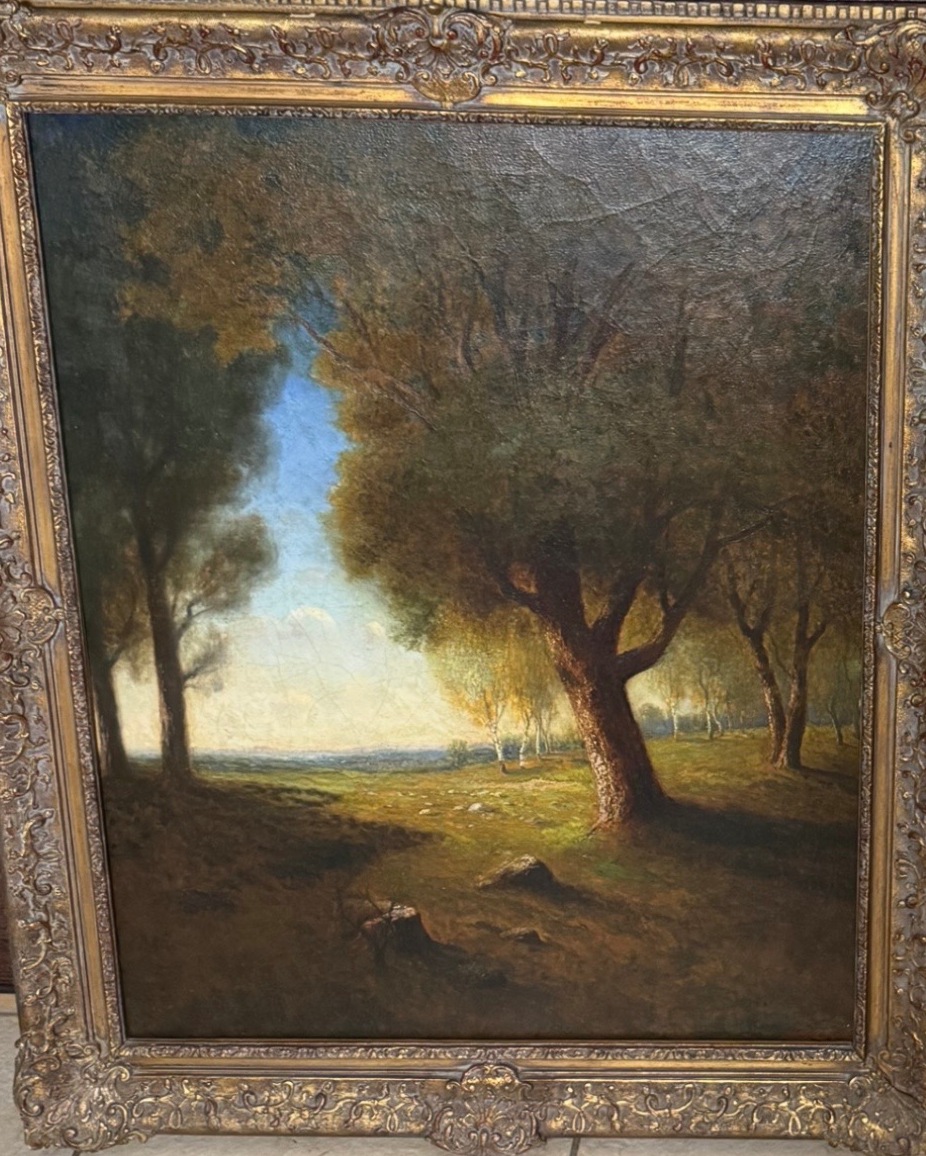
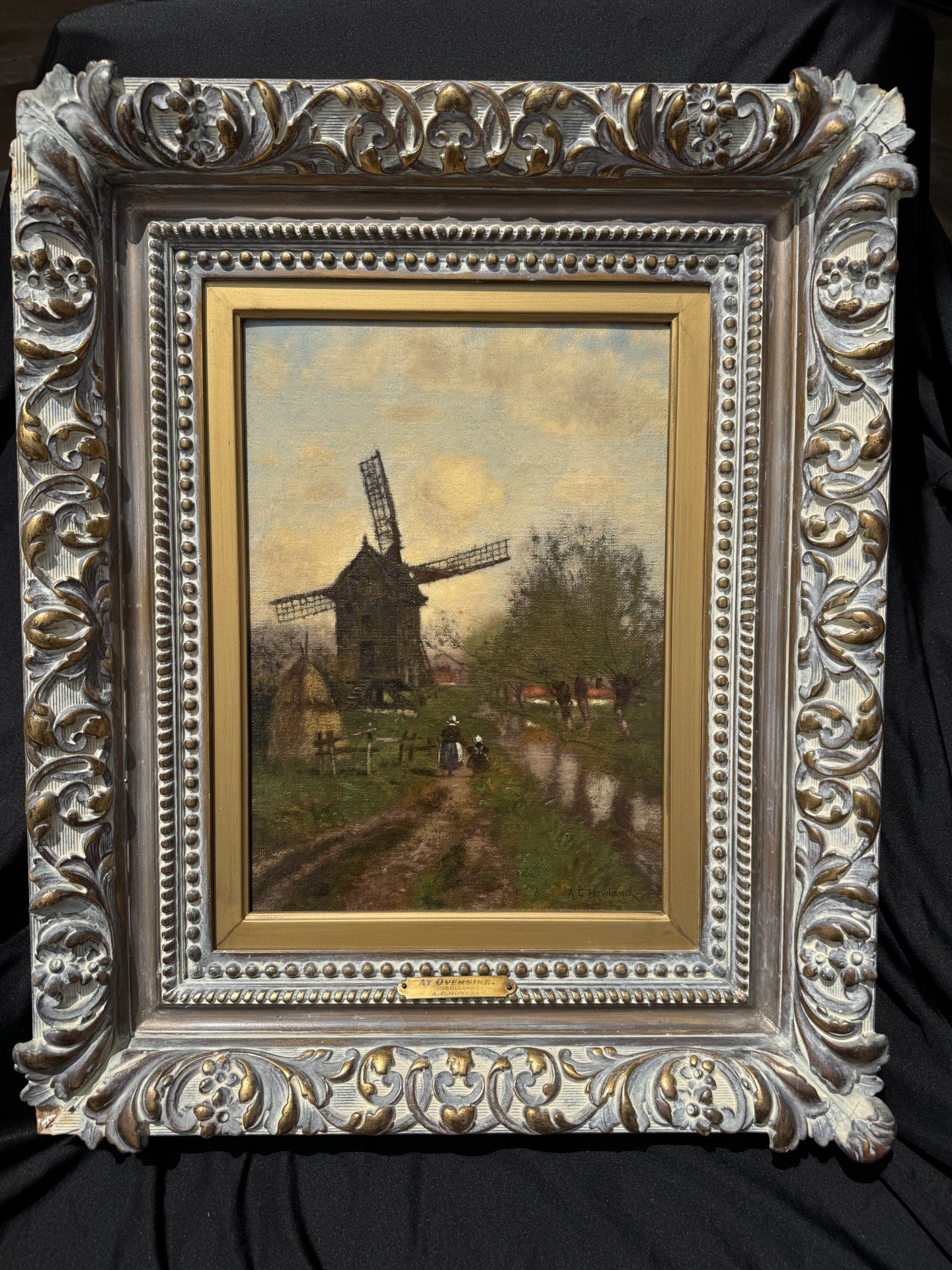
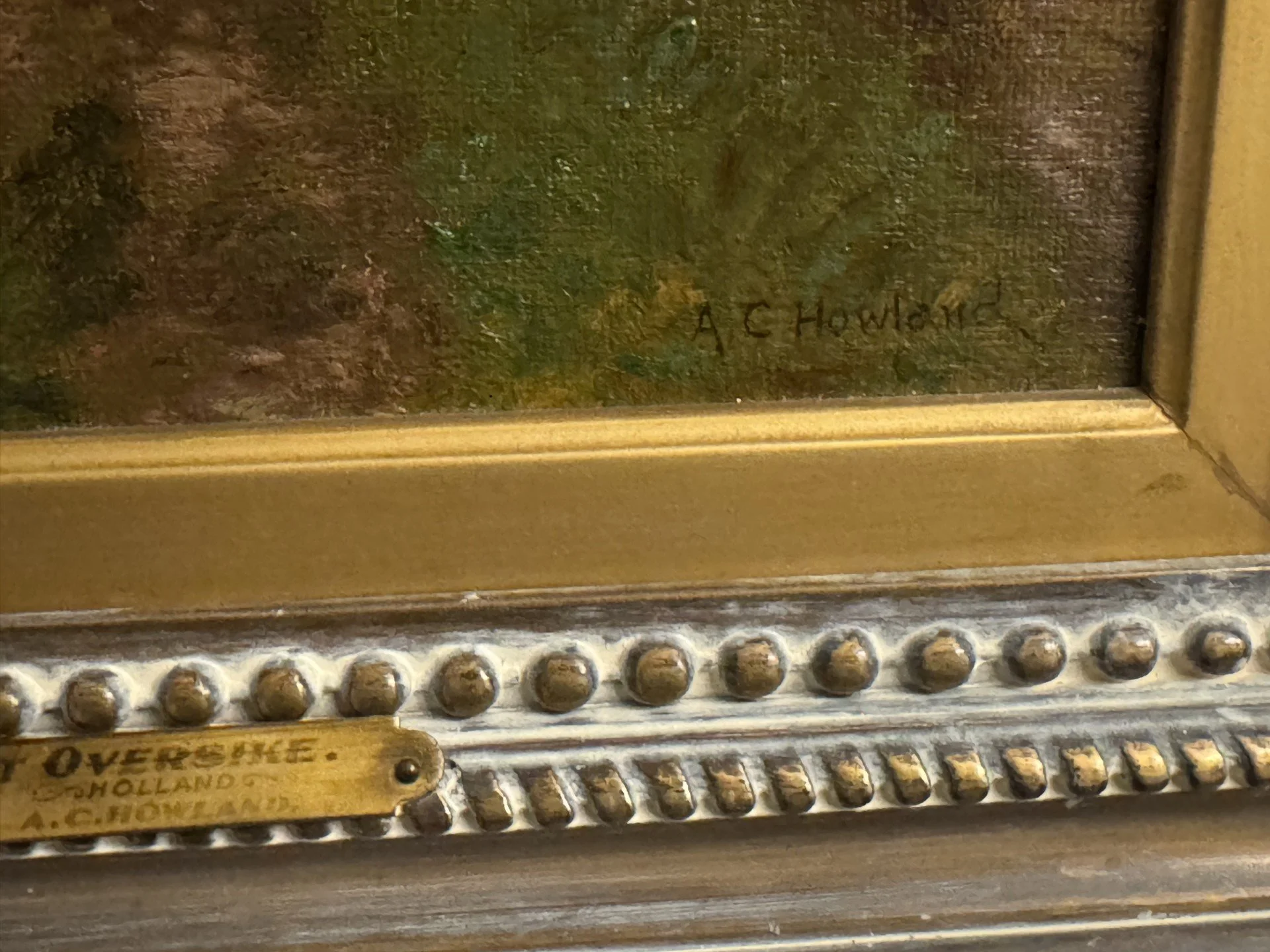
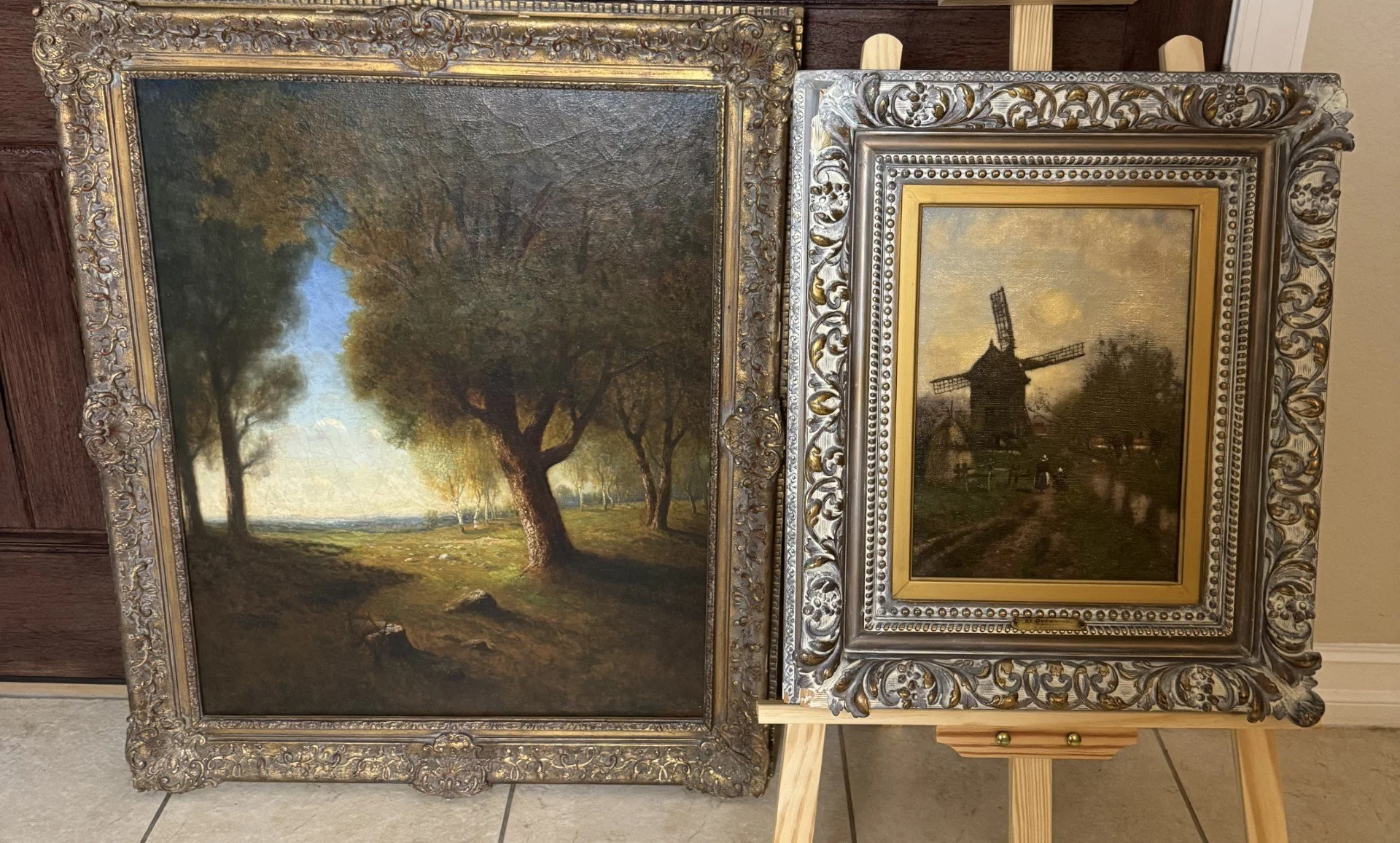
The Mayflower Descendants Museum holds paintings by both teacher and student, offering an unusual opportunity to consider their work side by side. Robert Crannell Minor’s Catskill Landscape and Alfred Cornelius Howland’s Dutch landscape At Oversike, Holland allow viewers to compare two artists connected not only through instruction, but also through their engagement with the European landscape traditions of the nineteenth century.
Placed together, the paintings invite viewers to compare the two artists directly—to look closely at their treatment of landscape, atmosphere, light, color, composition, distance, brushwork, and overall mood. Because Howland taught Minor before Minor traveled to Europe, the pairing also allows viewers to consider whether any elements of the teacher’s approach can be detected in the student’s work. At the same time, viewers can look for the ways Minor developed his own artistic language after studying in Europe and at Barbizon. The comparison therefore offers a rare opportunity to examine both influence and independence: what may have passed from teacher to student, what both artists absorbed from European landscape traditions, and where their work ultimately diverged.
Both Alfred Cornelius Howland (1838–1909) and Robert Crannell Minor (1839–1904) were Mayflower descendants who became nationally recognized American artists.
Howland descended from Mayflower passengers John Howland and Elizabeth Tilley. The Pilgrim John Howland Society identifies Alfred Cornelius Howland as a sixth-generation descendant of the couple.
John Howland’s own journey aboard the Mayflower adds another dimension to the artist’s family story. He did not cross the Atlantic as the head of a household. He traveled as a servant in the household of fellow passenger John Carver, who became Plymouth Colony’s first governor. The Smithsonian American Art Museum describes Howland’s earliest New England ancestor as having arrived aboard the Mayflower as an indentured servant. During the Atlantic crossing, John Howland was famously swept overboard during a severe storm and survived after catching hold of a line trailing from the ship until the crew could pull him aboard. He later married fellow Mayflower passenger Elizabeth Tilley and became an established landholder and public figure in Plymouth Colony.
Robert Crannell Minor descended from another Mayflower passenger, Elder William Brewster, the longtime spiritual leader of the Plymouth congregation.
The pairing is therefore particularly interesting: the Museum holds paintings by two nineteenth-century American artists whose family histories reach back to different passengers aboard the same ship—Howland through John Howland and Elizabeth Tilley, and Minor through Elder William Brewster—and whose own lives later intersected through the relationship of teacher and student.
Alfred Cornelius Howland (1838–1909)
Alfred Cornelius Howland was born in Walpole, New Hampshire, in 1838. His artistic education began in the graphic arts. He moved to Boston in 1857 to study drawing and lithography with Max Eppendorff and Paul Schulze and later relocated to New York, where he worked as a lithographer while studying at the National Academy of Design.
In 1860, Howland traveled to Europe. He studied at the Düsseldorf Akademie under Andreas Müller and later worked in the private studio of landscape painter Albert Flamm. He subsequently moved to Paris, where he studied with French landscape painter Émile Lambinet.
The Paris period proved particularly important to Howland’s development. While in France, he met Camille Corot, who introduced him to painters associated with the Barbizon School. The National Academy of Design states that the influence of those artists remained evident in Howland’s work throughout his career. The Smithsonian American Art Museum similarly identifies Corot, Théodore Rousseau, and Jean-François Millet as important influences on his treatment of light, landscape, and rural life.
The Barbizon School developed around the village of Barbizon near the Forest of Fontainebleau outside Paris. Its painters emphasized direct observation of nature—forests, fields, rural labor, changing weather, and atmospheric light—rather than idealized or highly staged landscapes. Their approach helped reshape nineteenth-century landscape painting and influenced later movements including Impressionism and American Tonalism. This is especially important to the Howland–Minor story because Howland encountered Barbizon artists in France, while Minor later traveled to Barbizon and studied directly within that tradition.
Howland therefore returned to America carrying not simply European academic training, but firsthand experience with one of the most influential landscape traditions of the nineteenth century.
After returning to New York, Howland began exhibiting at the National Academy of Design and taught at Cooper Union. Many of his later subjects came from Massachusetts, Vermont, New Hampshire, Long Island, and upstate New York.
Although he painted landscapes and portraits, Howland became particularly known for genre scenes depicting rural New England life. His work combined carefully observed figures and landscapes with the attention to natural light he had encountered among European painters.
One of his best-known compositions, Fourth of July Parade, looked back to Independence Day celebrations in his hometown of Walpole. A version dating to about 1886 is held by the High Museum of Art.
Howland achieved substantial professional recognition. He was elected an Associate of the National Academy of Design in 1873 and a full National Academician in 1882. He later served on the Academy Council.
Robert Crannell Minor (1839–1904)
Robert Crannell Minor was born in New York City in 1839. Unlike Howland, Minor did not initially pursue art as his profession. He worked in business before deciding in adulthood to devote himself seriously to painting.
One of his earliest teachers was Alfred Cornelius Howland.
The Smithsonian American Art Museum identifies Minor as having studied painting in New York under Howland and specifically notes that Howland knew several of the Barbizon artists firsthand.
Accounts differ regarding the exact length of Minor’s study with Howland. Older biographical sources describe a longer period of instruction, while research using Minor’s surviving papers indicates that Minor himself recalled receiving only a few lessons from Howland before leaving for Europe.
Whatever its duration, the sequence is significant.
Howland had returned from Europe with firsthand connections to Corot and the Barbizon painters. Minor then studied with Howland before traveling to Europe and entering that artistic world himself.
After leaving the United States, Minor eventually joined the artists’ colony at Barbizon, where he studied with Narcisse-Virgile Diaz de la Peña, one of the important artists associated with the Barbizon School. He later studied at the Antwerp Academy under Joseph Van Luppen and traveled extensively in Europe.
Minor exhibited at the Paris Salon in 1872 and later at the Royal Academy and Grosvenor Gallery in London. After returning to the United States, he established a studio in New York and spent considerable time painting in northern New York, particularly the Adirondacks, before settling in Waterford, Connecticut.
Minor became especially known for forest interiors, quiet rural landscapes, sunset and twilight effects, and atmospheric treatments of light. His work reflects the influence of the Barbizon painters, particularly Rousseau and Diaz, while later paintings also became associated with American Tonalism.
The Smithsonian specifically connects Minor’s landscapes to the Barbizon tradition and notes that his painting October is probably a view of the Forest of Fontainebleau—the landscape surrounding Barbizon itself.
Minor was elected an Associate of the National Academy of Design in 1888 and became a full National Academician in 1897.
From Teacher to Student — Following the Barbizon Thread
The relationship between Howland and Minor becomes particularly revealing when their European experiences are placed beside one another.
Howland traveled to Düsseldorf and Paris, met Camille Corot, and became acquainted with artists associated with the Barbizon School.
He returned to New York and taught.
Minor then studied painting with Howland.
Minor subsequently traveled to Europe and went to Barbizon, where he studied directly with Narcisse Diaz.
The connection should not be interpreted to mean that Howland alone formed Minor’s mature style. Much of Minor’s professional artistic training occurred after he left the United States. Instead, their relationship provides an early link in a much larger artistic chain: Howland had direct knowledge of the French landscape tradition that Minor would soon pursue for himself.
The Museum’s paintings make that relationship tangible.
Howland’s At Oversike, Holland represents an artist who had absorbed European landscape traditions firsthand. Minor’s Catskill Landscape represents the student who later traveled to Europe, studied at Barbizon, and brought those influences back to the American landscape.
Because the Mayflower Descendants Museum holds paintings by both men, the works can be examined together rather than their relationship being understood only through biography.
Viewers can consider similarities and differences in their treatment of natural light, atmospheric depth, trees and vegetation, horizon and sky, tonal relationships, brushwork, and the organization of the landscape itself. The pairing also raises a particularly interesting question: how did artistic ideas encountered by Howland in Europe change as they passed through another American artist who ultimately experienced Barbizon for himself?
Another Museum Holds Both Teacher and Student
The Mayflower Descendants Museum is not the only institution to preserve works by both Howland and Minor.
The Smithsonian American Art Museum in Washington, D.C., holds paintings by both artists.
Its collection includes Alfred Cornelius Howland’s Friendly Neighbors, painted about 1909. The oil-on-canvas scene entered the Smithsonian collection as a gift of William T. Evans.
The Smithsonian also holds multiple works by Robert Crannell Minor, including October and A Hillside Pasture. The museum uses these works in discussing Minor’s relationship to the French Barbizon tradition.
That shared institutional representation is particularly meaningful in the context of their relationship: a major national museum preserves work by both the teacher who personally encountered the Barbizon circle and the student who later trained at Barbizon himself.
The Mayflower Descendants Museum offers a different opportunity. Here, Howland’s At Oversike, Holland and Minor’s Catskill Landscape can be presented intentionally as teacher and student, allowing their works, biographies, Mayflower ancestry, and interconnected artistic histories to be interpreted together.
Alfred Cornelius Howland in Other American Museum Collections
Howland’s work is preserved in a number of major American institutions.
The Metropolitan Museum of Art holds Peasant Girl, dating to about 1864 and executed in graphite and white chalk.
The National Gallery of Art holds The Old Soldier — Berncastel, a graphite drawing dating to 1861–62 and made during Howland’s European period.
The High Museum of Art holds Fourth of July Parade, c. 1886, one of the compositions most closely associated with Howland’s career.
His work is also documented in collections including the Smithsonian American Art Museum, Brooklyn Museum, Milwaukee Art Museum, and Yale University Art Gallery.
Robert Crannell Minor in Other American Museum Collections
Minor’s landscapes are similarly represented in significant American public collections.
The Brooklyn Museum holds On the Upper Thames, Connecticut, an oil landscape that entered the collection through the bequest of Charles A. Schieren.
The Yale University Art Gallery holds several works by Minor, including Scene in Devonshire.
The Smithsonian American Art Museum holds October and A Hillside Pasture, among other material associated with Minor’s career.
Important Minor paintings are also preserved at Marsh-Billings-Rockefeller National Historical Park, whose collection of Barbizon-related art includes his work.
Together these holdings demonstrate the continuing place of Minor’s landscapes within the history of American Barbizon and Tonalist painting.
Two Mayflower Descendants, One Artistic Line
The careers of Alfred Cornelius Howland and Robert Crannell Minor intersect at an unusually revealing point in American art history.
Howland descended from John Howland and Elizabeth Tilley. John Howland had crossed the Atlantic aboard the Mayflower as a servant in John Carver’s household before establishing his own family and life in Plymouth Colony.
Minor descended from Elder William Brewster.
More than two centuries later, descendants of those different Mayflower passengers encountered one another within the American art world.
Howland had traveled to Europe, studied in Düsseldorf and Paris, met Camille Corot, and encountered the Barbizon circle. Minor then studied with Howland in New York before traveling to Europe and entering the Barbizon tradition himself.
Both eventually achieved recognition from the National Academy of Design. Both became landscape painters shaped by European artistic traditions. And works by both are now preserved within the Smithsonian American Art Museum as well as the Mayflower Descendants Museum.
The Mayflower Descendants Museum’s At Oversike, Holland and Catskill Landscape therefore preserve more than two individual examples of nineteenth-century American painting. Together, they preserve a documented relationship between teacher and student and offer the opportunity to examine, side by side, how artistic ideas could move from Europe to America, from teacher to student, and ultimately back into the American landscape.
Sources and Further Reading
Smithsonian American Art Museum — Alfred Cornelius Howland. Biography discussing Howland’s Mayflower ancestry, European training, Barbizon influences, and New England subjects.
Smithsonian American Art Museum — Alfred Cornelius Howland
Smithsonian American Art Museum — Robert C. Minor. Biography documenting Minor’s study with Howland, European training, Barbizon experience, exhibitions, and Smithsonian holdings.
Smithsonian American Art Museum — Robert C. Minor
Smithsonian American Art Museum — Alfred Cornelius Howland, Friendly Neighbors, c. 1909.
Smithsonian American Art Museum — Friendly Neighbors
National Academy of Design — Alfred Cornelius Howland. Detailed biography documenting his early training, study in Düsseldorf and Paris, meeting with Camille Corot, Barbizon connections, teaching career, and National Academy membership.
National Academy of Design — Alfred Cornelius Howland
The Metropolitan Museum of Art — Alfred Cornelius Howland, Peasant Girl, c. 1864.
The Metropolitan Museum of Art — Peasant Girl
National Gallery of Art — Alfred Cornelius Howland, The Old Soldier — Berncastel, 1861–62.
National Gallery of Art — Alfred Cornelius Howland
Brooklyn Museum — Robert Crannell Minor, On the Upper Thames, Connecticut.
Brooklyn Museum — On the Upper Thames, Connecticut
Yale University Art Gallery — Robert Crannell Minor, Scene in Devonshire, c. 1880–90.
Yale University Art Gallery — Scene in Devonshire
Archives of American Art, Smithsonian Institution — Robert Crannell Minor Papers, 1896–1904. Includes Minor’s biographical material, sketches, photographs, exhibition material, and information concerning his artistic training.
Archives of American Art — Robert Crannell Minor Papers