
An 1834 Portrait Believed to Depict 8th President Martin Van Buren
Cousin of 32nd President and Mayflower Descendant Franklin Delano Roosevelt
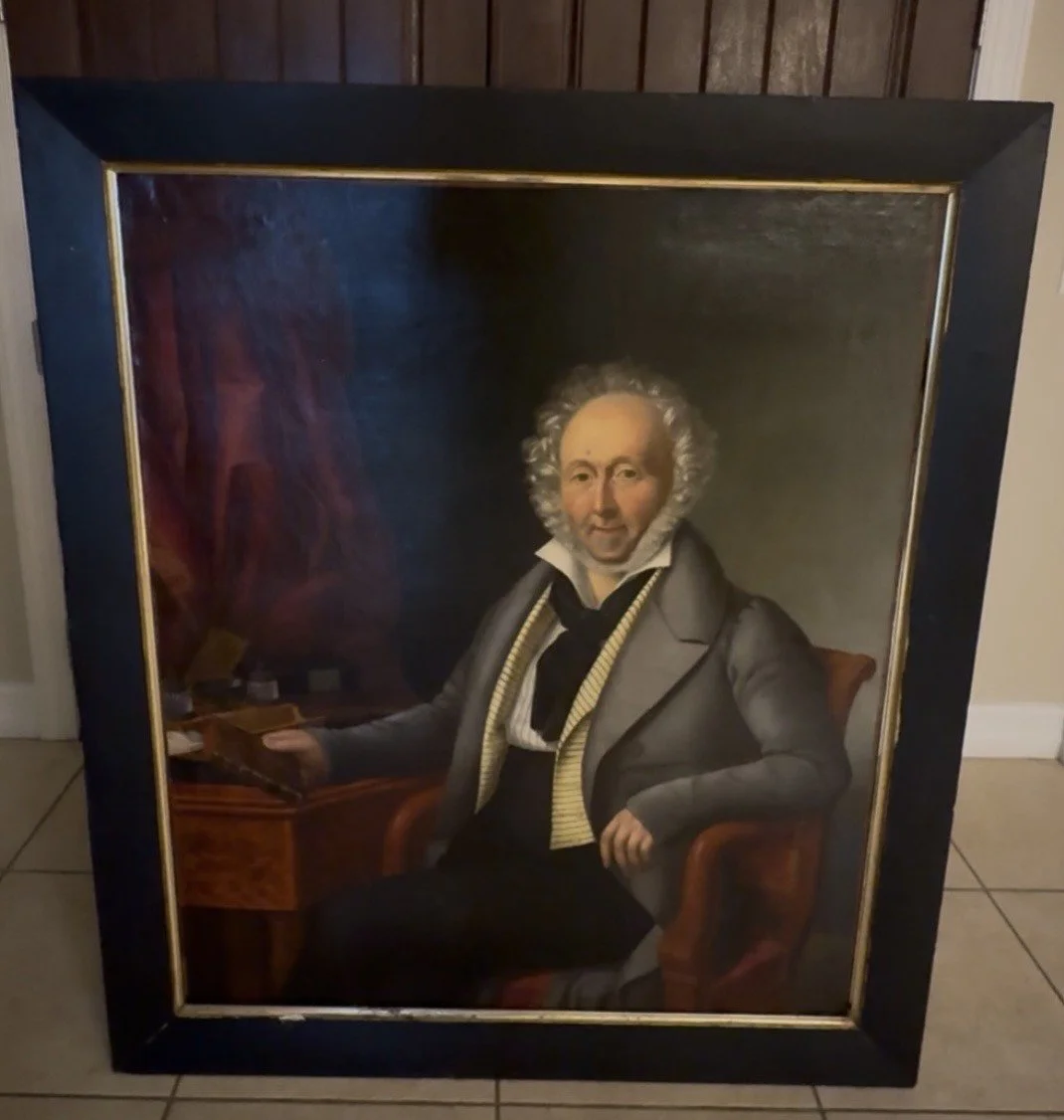
This large oil portrait, signed and dated 1834 by French artist Charles Pierre Cior (1769–after 1838), is believed to depict Martin Van Buren (1782–1862). The identification has not been confirmed, and the Mayflower Descendants Museum presents Van Buren as the believed sitter while research into the portrait’s provenance, commission, and original identity continues.
Mayflower Connection
Our research did not find that Martin Van Buren was a Mayflower descendant; however, he was related to a president who was. American Ancestors identifies Martin Van Buren and Franklin Delano Roosevelt as third cousins four times removed through their shared descent from Teuwis Abrahamsz van Deursen and Helena Robberts of Albany, New York. That particular relationship comes through their shared Dutch New York ancestry rather than through a Mayflower line. (Vita Brevis)
Franklin D. Roosevelt separately descended from multiple Mayflower passengers, including Isaac Allerton, Francis Cooke, John Howland, Degory Priest, John Tilley, and Richard Warren. (Vita Brevis)
The connection places Van Buren within one of the Museum’s broader areas of interpretation: not only Mayflower descendants themselves, but also the presidents, artists, families, and historical figures connected to them.
The 1834 date places the portrait at a particularly interesting moment in Van Buren’s life. He was then serving as Vice President of the United States under President Andrew Jackson, having previously served as Jackson’s Secretary of State from 1829 to 1831. During Van Buren’s tenure at the State Department, he and Jackson secured a settlement with France providing reparations for American property seized during the Napoleonic Wars. The dispute over French payment continued afterward, and in 1834 Jackson urged Congress to consider measures against French property if the payments were not released. (Office of the Historian)
The artist also makes the possible identification noteworthy. Charles Pierre Cior was not simply a local portrait painter. The Cleveland Museum of Art identifies him as the official miniaturist to the King of Spain and a court painter in Russia. His known sitters included Prince Alexander Bezborodko, a prominent Russian statesman who became Grand Chancellor of the Russian Empire. The Louvre records Cior as a Paris-born painter and miniaturist who exhibited at the Paris Salon from 1796 through 1838. (Cleveland Museum of Art)
Martin Van Buren as President
Martin Van Buren served as the eighth President of the United States from 1837 to 1841. A major architect of the emerging Democratic Party and a close political ally of Andrew Jackson, Van Buren entered the presidency after serving as Secretary of State and Vice President.
Only weeks after his inauguration, the nation entered the severe financial crisis known as the Panic of 1837. Bank failures, unemployment, and a prolonged economic depression dominated much of his presidency. Van Buren responded by advocating an Independent Treasury system that would separate federal funds from private banks; Congress ultimately enacted the system in 1840.
His administration also continued federal Indian-removal policies inherited from the Jackson administration. During Van Buren’s presidency, the forced removal of the Cherokee people was carried out and military efforts against the Seminole continued in Florida.
Van Buren also confronted major foreign-policy questions involving Britain, Mexico, Canada, and the continuing consequences of the earlier French indemnity dispute. He lost his bid for reelection in 1840 to William Henry Harrison, but remained politically active and later ran for president in 1848 as the candidate of the Free Soil Party.
Martin Van Buren, Slavery, and a Later Political Shift
Martin Van Buren’s record on slavery was complex and changed over the course of his political life.
He was born into a New York household that used enslaved labor, and surviving evidence indicates that he personally owned at least one enslaved man, known as Tom, during the 1810s. A surviving 1824 letter discusses the possibility of recovering Tom, who had left Van Buren years earlier.
While serving as Secretary of State, Van Buren also relied on a household that included enslaved laborers. The 1830 census recorded four enslaved women living at Decatur House, although historians have not established that Van Buren personally owned them. During his presidency, enslaved people also worked in the White House household.
Politically, Van Buren was not an abolitionist while president. In his 1837 inaugural address, he pledged to oppose congressional efforts to abolish slavery in Washington, D.C., and to resist federal interference with slavery in states where it already existed.
His position later shifted in an important, though limited, way. In 1848, after leaving the presidency, Van Buren became the presidential candidate of the Free Soil Party, which opposed the expansion of slavery into new U.S. territories. The National Park Service notes that his opposition to the extension of slavery had already contributed to his loss of support among Southern Democrats by 1844.
That later position did not make Van Buren an abolitionist in the broader sense, and his views remained inconsistent. National Park Service research notes that he later endorsed the Dred Scott decision’s denial of Black citizenship.
Taken together, Van Buren’s record reflects both participation in and political accommodation of slavery earlier in his life, followed by later opposition to its territorial expansion. That evolution is an important part of understanding his presidency and political career.
Why the Museum Is Investigating Martin Van Buren as the Sitter
The Museum’s working attribution is not based on resemblance alone. Several visual, historical, and physical clues have led us to investigate Van Buren as a possible identification:
• The 1834 date. The portrait was painted while Van Buren was Vice President of the United States, three years before he became president. (Office of the Historian)
• The horticulture book at the desk scene. Van Buren later devoted significant attention to farming and horticulture at Lindenwald, his Kinderhook, New York, estate. The National Park Service documents extensive orchards, a large garden, a greenhouse, grapes and other fruit, and his active management of a 220-acre farm. (National Park Service)
• A distinctive facial feature. The sitter has a conspicuous raised skin growth above the eyebrow. The Museum has been comparing this feature, along with the sitter’s facial structure, forehead, eyes, nose, mouth, hair, and overall proportions, with documented likenesses of Van Buren.
Not every painted portrait of Van Buren depicts small facial details in the same way. That variation should be considered within the conventions of portraiture. A painted portrait was not necessarily intended to function as a completely neutral record of every physical characteristic. Artists could flatter, soften, idealize, or deemphasize aspects of a sitter’s appearance. The Metropolitan Museum of Art notes that artists historically improved or idealized facial features for their sitters. In modern terms, this could function somewhat like retouching: the individual remained recognizable while particular characteristics might be minimized. This does not establish that Van Buren’s eyebrow feature was intentionally omitted from any specific portrait, but it helps explain why the absence of such a detail from another painted likeness would not, by itself, settle the identification. (The Metropolitan Museum of Art)
• An unusually valuable 1833 life mask. Sculptor John Henri Isaac Browere created a life mask of Martin Van Buren in 1833—only one year before the date on this portrait. The Smithsonian National Portrait Gallery records both plaster and bronze versions of Browere’s 1833 likeness and specifically identifies the work as a life mask. Because a life mask records the three-dimensional contours of an actual sitter rather than relying solely upon an artist’s interpretation, it provides an unusually valuable near-contemporary reference for comparing facial shape and proportions and also shows the same raised skin growth above the eyebrow . (National Portrait Gallery)
View the Smithsonian National Portrait Gallery record for Martin Van Buren’s 1833 life mask
The timing makes this comparison particularly interesting:
1833 — Browere creates Van Buren’s life mask.
1834 — Cior dates the Museum’s portrait.
Rather than comparing the painting only with likenesses produced many years later, the Museum can therefore study it against a three-dimensional likeness of Van Buren created at essentially the same point in his life.
• Cior’s clientele. An identification as a prominent statesman would not be inconsistent with Cior’s professional background. He served as official miniaturist to the King of Spain and as a court painter in Russia, portraying figures at the highest levels of European political and aristocratic society. (Cleveland Museum of Art)
• The French connection. As Secretary of State, Van Buren had worked with Jackson to secure reparations from France for American property losses associated with the Napoleonic Wars. In 1834—the year of this portrait—the execution of that settlement became a serious diplomatic issue between the United States and France. Cior was French. This does not establish a meeting or commission between the two men, but the convergence of date, nationality, and diplomatic circumstances provides another historical avenue for investigation. (Office of the Historian)
None of these clues independently proves that the sitter is Martin Van Buren. What makes the portrait compelling for continued research is their convergence: the date, the horticultural reference, the distinctive facial characteristics, the nearly contemporaneous life mask, Cior’s history of portraying prominent individuals, and the Franco-American historical context.
A Later Paris Chapter: Maison Berville
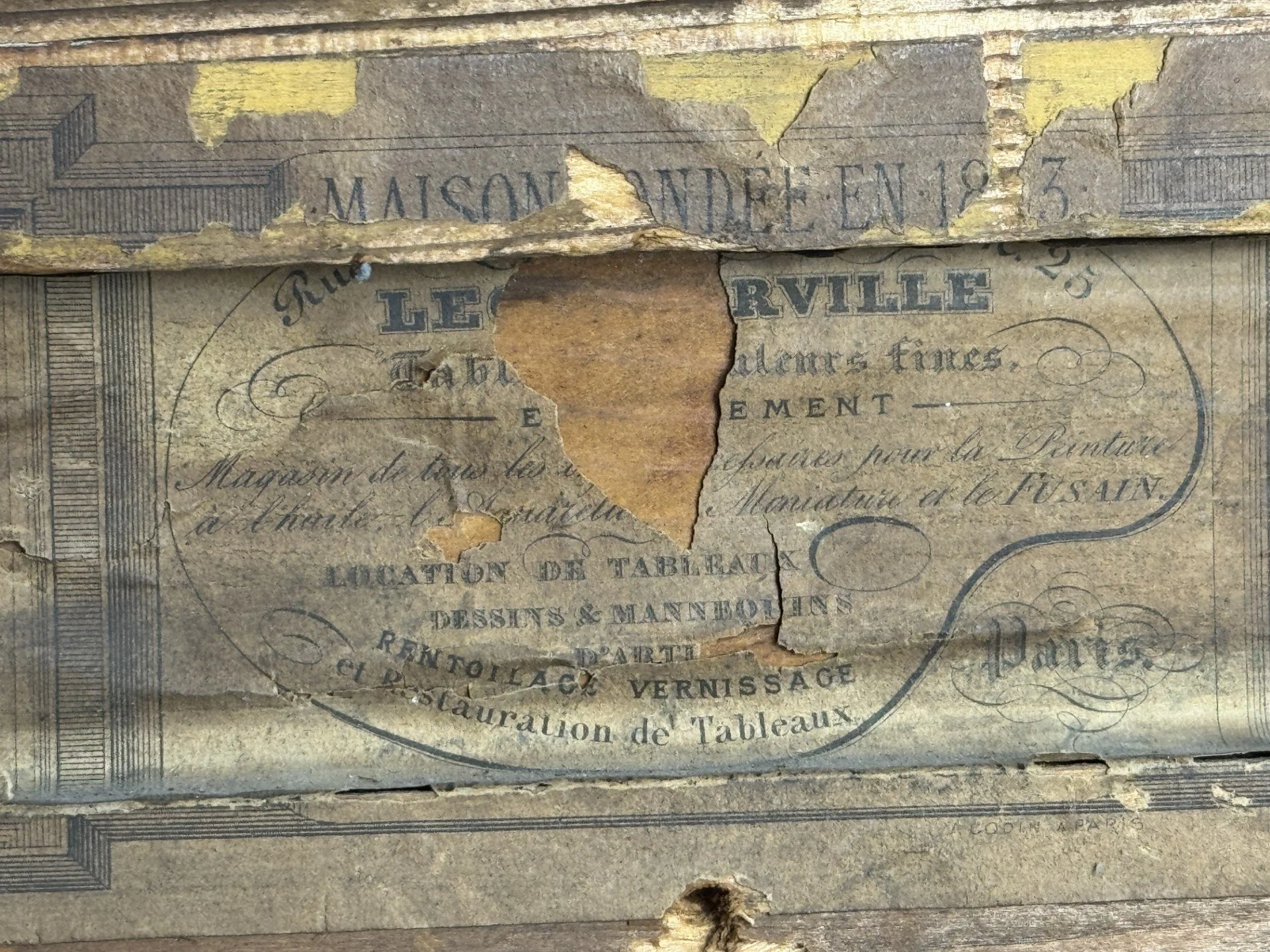
The reverse of the portrait contains another important piece of its history: a damaged label from Léon Berville at 25 rue de la Chaussée d’Antin in Paris.
Maison Berville was founded by Jules Berville in 1833. French archival records state that his son Léon directed the family business at 25 rue de la Chaussée d’Antin from 1870 to 1895. The establishment supplied artists and art enthusiasts with drawing and painting materials, canvases, colors, and frames while also providing restoration and other services and renting drawings and paintings. (Archives Portal Europe)
This means the Berville label represents a later chapter in the painting’s history, several decades after its 1834 creation. It is not evidence that Cior purchased his original canvas there. Rather, it indicates that the painting subsequently passed through, or had some connection with, a significant Paris art establishment during the later nineteenth century.
The Berville identification can be compared with documented material in museum collections. The Musée Carnavalet records a Léon Berville label from the same 25 rue de la Chaussée d’Antin address on Aimé Morot’s 1888 Portrait de Maurice de Féraudy. The Louvre also documents artists’ sketchbooks bearing the supplier stamp “L. Berville, 25 rue de la Chaussée d’Antin, Paris,” including a sketchbook by Henri-Edmond Cross. (Paris Musées Collections)
The Van Gogh Connection
The Berville label also connects the painting’s later history with the broader world of nineteenth-century Parisian artists.
Research concerning Vincent van Gogh’s Paris period reports that two of his drawings were made on paper bearing the Berville watermark. Van Gogh later referred to Berville while seeking Armand Théophile Cassagne’s Guide de l’alphabet du dessin, an instructional book he wished to use while teaching drawing. (Van Gogh Route)
Read about Vincent van Gogh and Berville
This does not suggest that Van Gogh ever encountered this portrait. Rather, it helps establish Maison Berville’s place within the nineteenth-century Paris art-supply network. The surviving label connects the Cior portrait to an establishment whose materials were used by artists working in the same Paris art world and whose marks remain documented on objects preserved in major museum collections.
Evidence of Restoration and Preservation
The Berville label becomes even more interesting when considered alongside the physical history of the Museum’s painting. Maison Berville offered restoration services, and surviving Berville labels advertise services associated with the care of paintings.
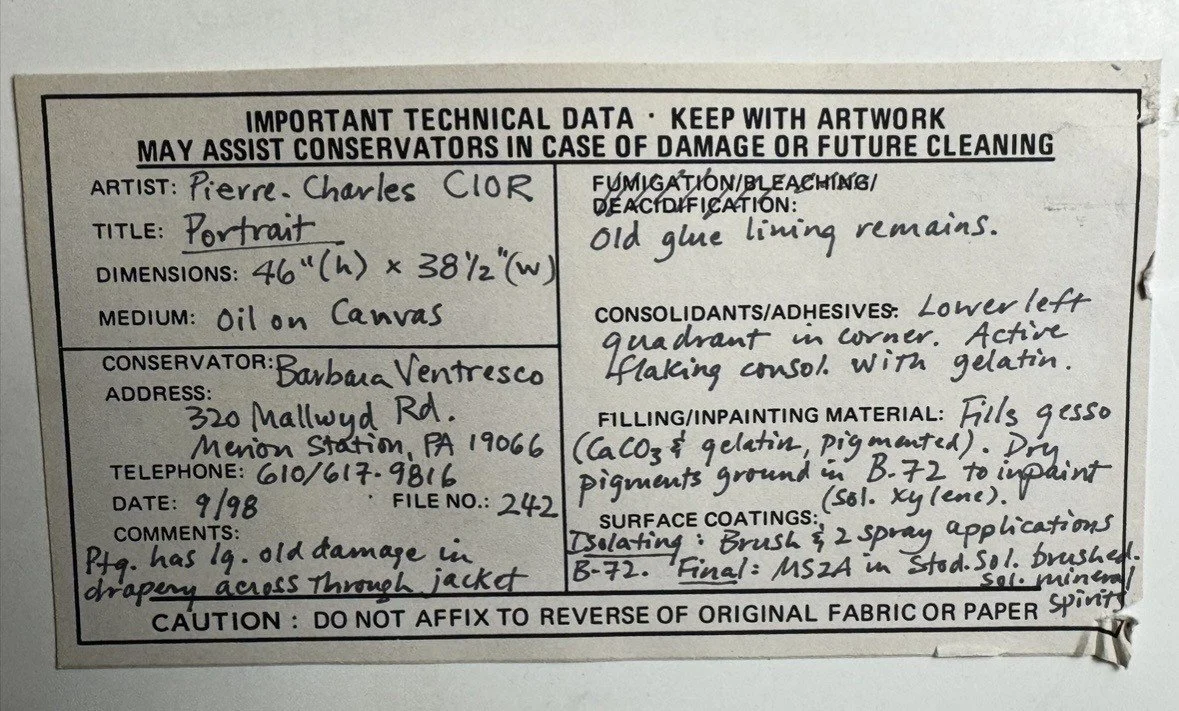
A professional conservation report dated September 1998 records that an “old glue lining remains” on the portrait. Because canvas relining was among the services advertised by Berville, it is possible that the painting received treatment through the firm during its later nineteenth-century Paris history.
At present, however, the label does not prove that Berville performed the lining. The painting could have passed through the establishment for restoration, framing, handling, sale, rental, or another service. The connection remains an important subject for further research.
The 1998 conservation documentation provides another significant piece of the object’s history: the artist was recorded at that time as “Pierre Charles CIOR.” This demonstrates that the Cior identification existed by September 1998, decades before the painting entered the Museum’s collection. A conservator’s notation does not independently authenticate an attribution, but it establishes that the Museum did not originate the identification.
Three Documented Layers of the Portrait’s History
1834 — The portrait is signed and dated during Charles Pierre Cior’s documented period of activity. The Louvre records Cior exhibiting at the Paris Salon through 1838. (Louvre Arts Graphiques)
Approximately 1870–1895 — The surviving Léon Berville label connects the painting with Maison Berville at 25 rue de la Chaussée d’Antin during the period in which Léon Berville directed the establishment. (Archives Portal Europe)
1998 — Professional conservation documentation identifies the artist as Pierre Charles Cior and records the presence of an older glue lining.
These layers allow the Museum to reconstruct portions of the portrait’s physical history across more than a century, even while the identity of its sitter remains unresolved.
The Mayflower Descendants Museum continues to investigate the portrait’s sitter, original commission, provenance, Paris history, and later ownership. Until documentary evidence establishes an identification, the work is presented as believed to depict Martin Van Buren.
The portrait also provides an opportunity to share the research process itself: beginning with an object, examining its physical evidence, comparing it with historical records and authenticated likenesses, following clues across collections and archives, and carefully distinguishing what is documented from what remains possible or unknown.
Object Information
Oil on canvas
Signed and dated 1834
Artist: Charles Pierre Cior (1769–after 1838)
Believed sitter: Martin Van Buren (1782–1862)
Later label: Léon Berville, 25 rue de la Chaussée d’Antin, Paris, approximately 1870–1895
Professional conservation documented September 1998
Holdings of the Mayflower Descendants Museum
Sources & Further Reading
American Ancestors, “The Closest Presidential Kinships.”
Documents the genealogical relationship between Martin Van Buren and Franklin Delano Roosevelt as third cousins four times removed through Teuwis Abrahamsz van Deursen and Helena Robberts of Albany, New York. (Vita Brevis)
American Ancestors — The Closest Presidential Kinships
American Ancestors, Christopher C. Child, discussion of presidential Mayflower ancestry.
Documents Franklin D. Roosevelt’s descent from Mayflower passengers including Isaac Allerton, Richard Warren, John Howland, John Tilley, Francis Cooke, and Degory Priest. (Vita Brevis)
American Ancestors — Presidential Mayflower Connections
Smithsonian Institution, National Portrait Gallery, “Martin Van Buren,” John Henri Isaac Browere, 1833.
The National Portrait Gallery catalogs Browere’s plaster sculpture as a life mask of Martin Van Buren, created in 1833, only one year before the date of the Museum’s portrait. (National Portrait Gallery)
Smithsonian National Portrait Gallery — Martin Van Buren Life Mask
Cleveland Museum of Art, “Portrait of Prince Alexander Bezborodko,” Pierre-Charles Cior.
The museum identifies Cior as official miniaturist to the King of Spain and a court painter in Russia and documents his portrait of Russian statesman Prince Alexander Bezborodko. (Cleveland Museum of Art)
Cleveland Museum of Art — Pierre-Charles Cior
Musée du Louvre, “Charles Pierre Cior.”
The Louvre identifies Cior as a Paris-born painter and miniaturist who exhibited at the Paris Salon between 1796 and 1838. (Louvre Arts Graphiques)
U.S. Department of State, Office of the Historian, “Martin Van Buren.”
Documents Van Buren’s service as Secretary of State and Vice President and his involvement with Andrew Jackson in obtaining a settlement with France for American property seized during the Napoleonic Wars. (Office of the Historian)
U.S. Department of State — Martin Van Buren
U.S. National Park Service, Martin Van Buren National Historic Site, “Life at Lindenwald.”
Documents Van Buren’s extensive agricultural and horticultural activities at Lindenwald, including his orchards, large garden, greenhouse, fruit cultivation, and farming. (National Park Service)
National Park Service — Life at Lindenwald
The Metropolitan Museum of Art, “How to Read Portraits.”
Discusses the role of idealization and flattering representation in portraiture and the fact that painted likenesses need not reproduce every physical characteristic of a sitter literally. (The Metropolitan Museum of Art)
The Metropolitan Museum of Art — How to Read Portraits
Archives Portal Europe / Archives départementales des Hautes-Pyrénées, Léon Berville archival record.
Documents the founding of Maison Berville in 1833, Léon Berville’s direction of the establishment at 25 rue de la Chaussée d’Antin from 1870 to 1895, and the firm’s art-supply, framing, restoration, stationery, and picture-rental activities. (Archives Portal Europe)
Archives Portal Europe — Léon Berville
Musée Carnavalet / Paris Musées, Aimé Morot, Portrait de Maurice de Féraudy, 1888.
Documents a Léon Berville supplier label from 25 rue de la Chaussée d’Antin on the reverse of another nineteenth-century painting. (Paris Musées Collections)
Paris Musées — Berville Label on the Morot Portrait
Musée du Louvre, Henri-Edmond Cross sketchbook.
The Louvre records the Berville supplier stamp “L. Berville, 25 rue de la Chaussée d’Antin, Paris” on a sketchbook by Henri-Edmond Cross. (Louvre Arts Graphiques)
Van Gogh Route, “Van Gogh in Berville.”
Discusses Van Gogh’s connection with the Berville establishment, including two Paris-period drawings on Berville-watermarked paper and Van Gogh’s later reference to Berville while seeking a drawing manual. (Van Gogh Route)