
18th President and Mayflower Descendant Ulysses S. Grant
Early 20th-Century Patriotic Postcard
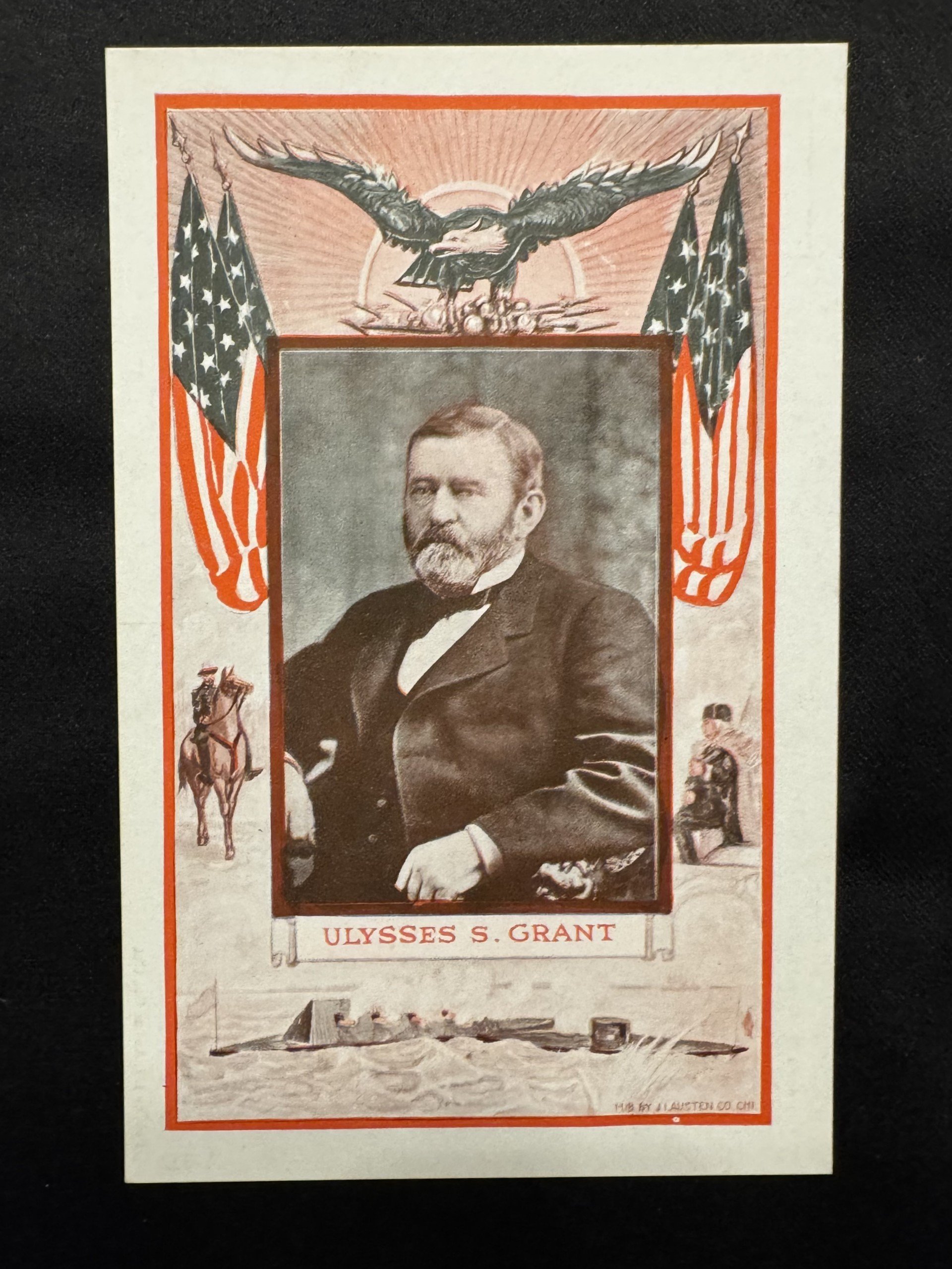
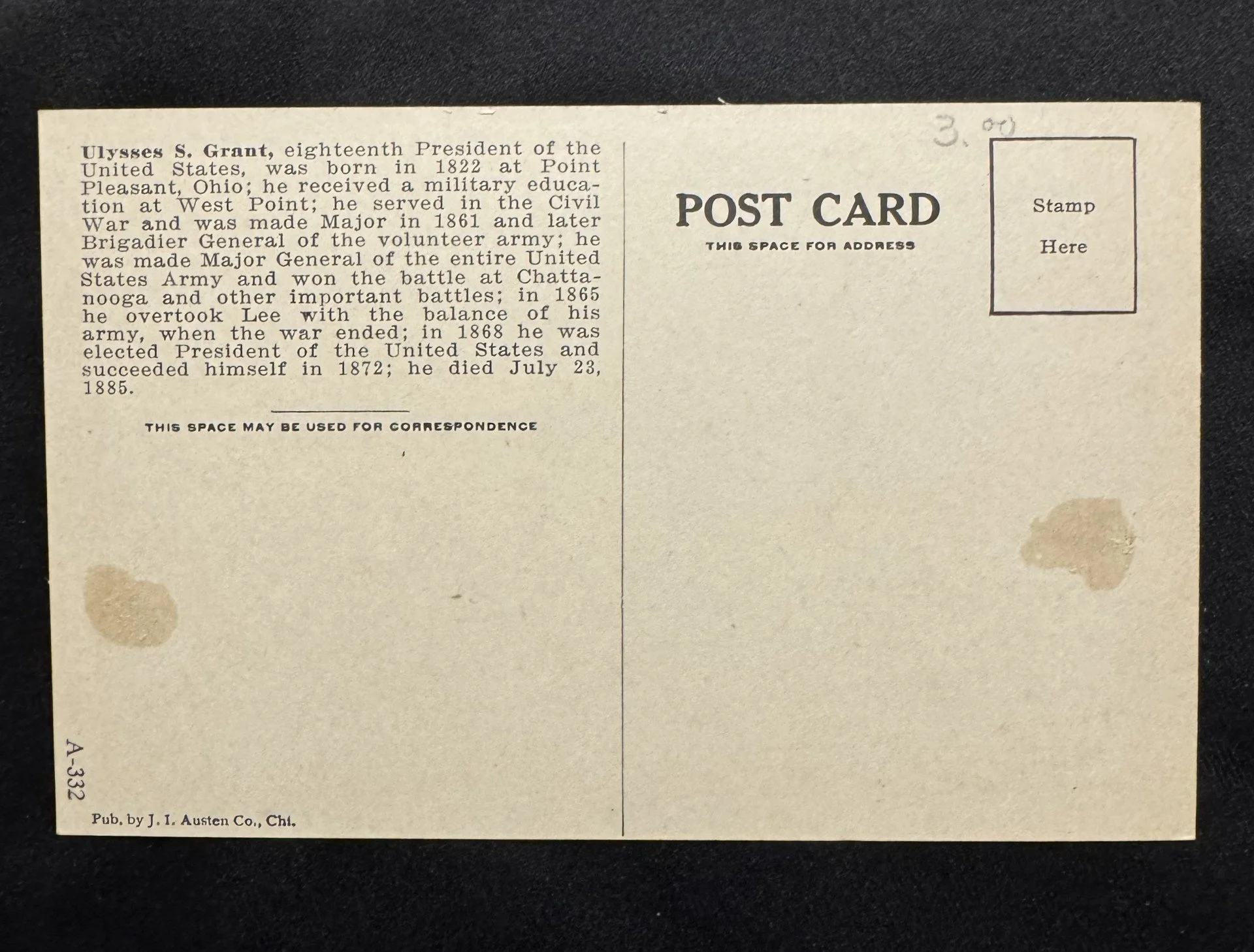
This early twentieth-century patriotic postcard depicts Ulysses S. Grant (1822–1885), the 18th President of the United States and a documented descendant of Mayflower passenger Richard Warren.
Published in Chicago by J. I. Austen Co. as series number A-332, the card combines Grant’s portrait with American flags, an eagle, military imagery, and a naval scene. Rather than functioning simply as a photographic portrait, the design presents Grant through the public memory of both the Civil War and the presidency.
The reverse contains a short printed biography describing Grant’s Ohio birth, West Point education, Civil War service, military victories, election to the presidency in 1868, reelection in 1872, and death in 1885.
The postcard is unused and unposted, with no stamp, cancellation, address, or written correspondence.
Dating the Postcard
The divided back helps establish a useful date range.
Beginning in 1907, privately produced American postcards could place correspondence on the left side of the reverse and the address on the right. The Smithsonian Institution Archives identifies 1907–1915 as the Divided Back Period, also known as the “Golden Age of Postcards.”
The design, printing style, publisher, and divided-back format are consistent with that period. The Museum therefore currently dates the postcard to approximately c. 1907–1915, pending identification of a more precisely dated example from the same J. I. Austen series.
The two areas of old residue on the reverse may indicate that the card was once mounted or preserved in an album or scrapbook, although the Museum has not established that history definitively.
Mayflower Connection
Ulysses S. Grant was a documented descendant of Mayflower passenger Richard Warren and Warren’s wife, Elizabeth Walker Warren.
The General Society of Mayflower Descendants identifies Grant as the 18th President of the United States and a descendant of Richard and Elizabeth (Walker) Warren.
The connection continued to be formally recognized within Grant’s family. American Ancestors records that Grant’s son Frederick Dent Grant and grandson Ulysses S. Grant III were both members of the Mayflower Society through their descent from Richard Warren.
Grant’s inclusion in the Museum therefore represents a direct connection between the Mayflower generation and one of the most prominent military and political figures of nineteenth-century America.
Ulysses S. Grant as President
Grant was elected the 18th President of the United States in 1868 and served two terms from 1869 to 1877. His presidency unfolded during Reconstruction, when the country was attempting to reunify after the Civil War while confronting fundamental questions surrounding citizenship, voting rights, racial violence, and the status of formerly enslaved Americans.
Grant supported ratification of the Fifteenth Amendment, which prohibited denial of the right to vote on the basis of race, color, or previous condition of servitude. His administration also supported the creation of the Department of Justice and used federal laws and authority against Ku Klux Klan violence and political intimidation in the South.
His presidency also included major controversies. His administration faced corruption scandals, and federal policies toward Native peoples remained coercive and assimilationist despite Grant’s stated desire to reduce warfare. National Park Service scholarship notes both his civil-rights efforts and the damaging consequences of federal Indian policy during his presidency.
From Slaveholding to Reconstruction and Black Civil Rights
Grant was not an abolitionist before the Civil War, and his personal relationship with slavery was complicated.
Although Grant’s parents opposed slavery, he lived for a period at White Haven, the Missouri plantation of his father-in-law, Frederick Dent, where enslaved African Americans performed much of the agricultural and domestic labor. Grant himself became the owner of one enslaved man known to have been held by him, William Jones.
On March 29, 1859, Grant legally freed Jones at the St. Louis Courthouse. The National Park Service notes that Grant was experiencing serious financial difficulties at the time and could potentially have sold Jones for a substantial sum, but instead chose to emancipate him.
Grant’s views evolved during the Civil War. As the conflict progressed, he came to support emancipation and the enlistment of African American soldiers in the Union Army.
As president, his policies placed him much more directly within the struggle over Black citizenship and civil rights during Reconstruction. Grant supported Black male suffrage, backed federal enforcement legislation intended to protect voters from racial terrorism, authorized action against the Ku Klux Klan, and signed the Civil Rights Act of 1875, which sought to prohibit racial discrimination in public accommodations and jury service.
His life therefore reflects a significant evolution: from a man who had personally participated in a slaveholding society to a president whose administration used federal authority to protect the citizenship and political rights of formerly enslaved Americans. That evolution is an important part of understanding Grant rather than reducing his life to either his prewar circumstances or his later presidency alone.
A Postcard About Historical Memory
The postcard is significant not only because it depicts Grant, but because it shows how Americans were remembering him a generation after his death.
The publisher surrounded Grant with explicitly patriotic and military imagery: American flags, an eagle, cavalry imagery, and a naval scene. These elements connect the former president with ideas of Union, military victory, national identity, and public service.
The printed biography on the reverse functions similarly. It compresses a complicated life into the achievements an early twentieth-century publisher believed buyers would most readily associate with Grant: West Point, the Civil War, major military victories, the presidency, and national leadership.
For the Mayflower Descendants Museum, the card adds another layer to the continuing history of Mayflower descendants. More than two centuries after Richard Warren crossed the Atlantic aboard the Mayflower, one of his descendants became commanding general of the Union armies and later President of the United States. By the early twentieth century, Grant himself had become part of American historical memory, reproduced and circulated through popular objects such as this postcard.
Object Information
Patriotic portrait postcard
Sitter: Ulysses S. Grant (1822–1885)
18th President of the United States
Documented descendant of Mayflower passenger Richard Warren
Publisher: J. I. Austen Co., Chicago
Series: A-332
Date: Approximately c. 1907–1915
Divided back
Unused and unposted
Holdings of the Mayflower Descendants Museum
Sources & Further Reading
General Society of Mayflower Descendants, “President’s Day 2021: Is Our New Commander-in-Chief a Mayflower Descendant?”
Identifies Ulysses S. Grant as the 18th President and a descendant of Richard and Elizabeth (Walker) Warren.
https://themayflowersociety.org/news-events/presidents-day-2021/
American Ancestors, Christopher C. Child, “fka Ulysses Simpson Grant.”
Discusses Grant family genealogy and records that Frederick Dent Grant and Ulysses S. Grant III were members of the Mayflower Society through descent from passenger Richard Warren.
https://vitabrevis.americanancestors.org/2022/05/fka-ulysses-simpson-grant
U.S. National Park Service, “Presidency,” Ulysses S. Grant and Julia Dent Grant Exhibit.
Provides an overview of Grant’s two presidential terms, Reconstruction, African American civil rights, the Fifteenth Amendment, Ku Klux Klan prosecutions, federal Indian policy, and controversies within his administration.
https://www.nps.gov/subjects/ulyssesgrantexhibit/presidency.htm
U.S. National Park Service, “A Short Overview of the Reconstruction Era and Ulysses S. Grant’s Presidency.”
Discusses Grant’s support for Black voting rights, creation of the Department of Justice, federal action against racial terrorism, and the Civil Rights Act of 1875.
U.S. National Park Service, “Slavery at White Haven.”
Documents slavery at the Dent family plantation, Grant’s ownership of William Jones, and Jones’s emancipation in 1859.
https://www.nps.gov/articles/slavery-at-white-haven.htm
U.S. National Park Service, “William Jones.”
Provides biographical information about the enslaved man owned by Grant and documents Grant’s March 29, 1859 manumission of Jones.
https://www.nps.gov/people/william-jones.htm
Smithsonian Institution Archives, “Postcard History.”
Explains the development of divided-back postcards in the United States and identifies 1907–1915 as the Divided Back Period and “Golden Age of Postcards.”
https://siarchives.si.edu/history/featured-topics/postcard/postcard-history