
Familiar Birds and What the Poets Sing of Them
Fidelia Bridges, Nature, and an Artistic Circle
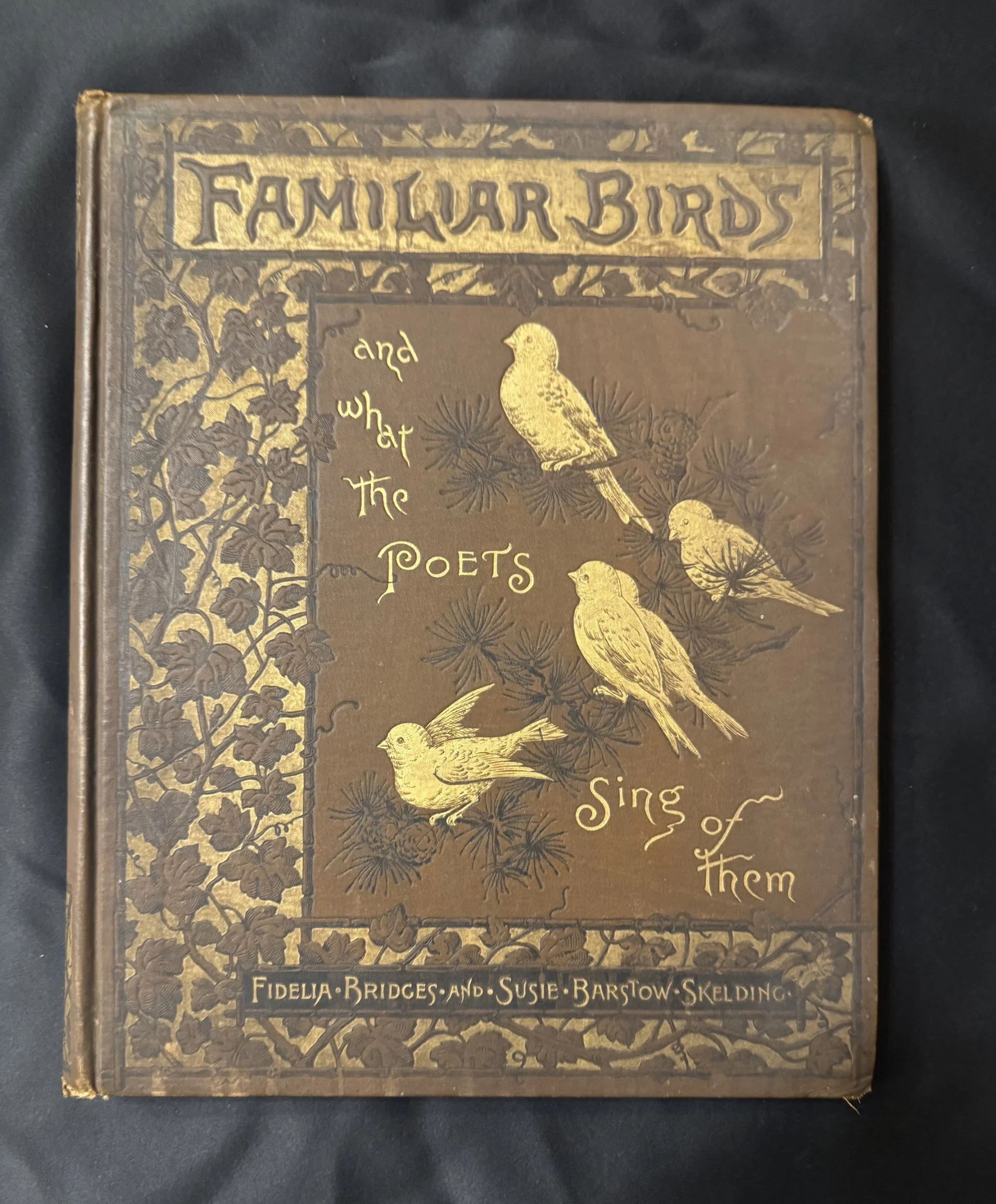
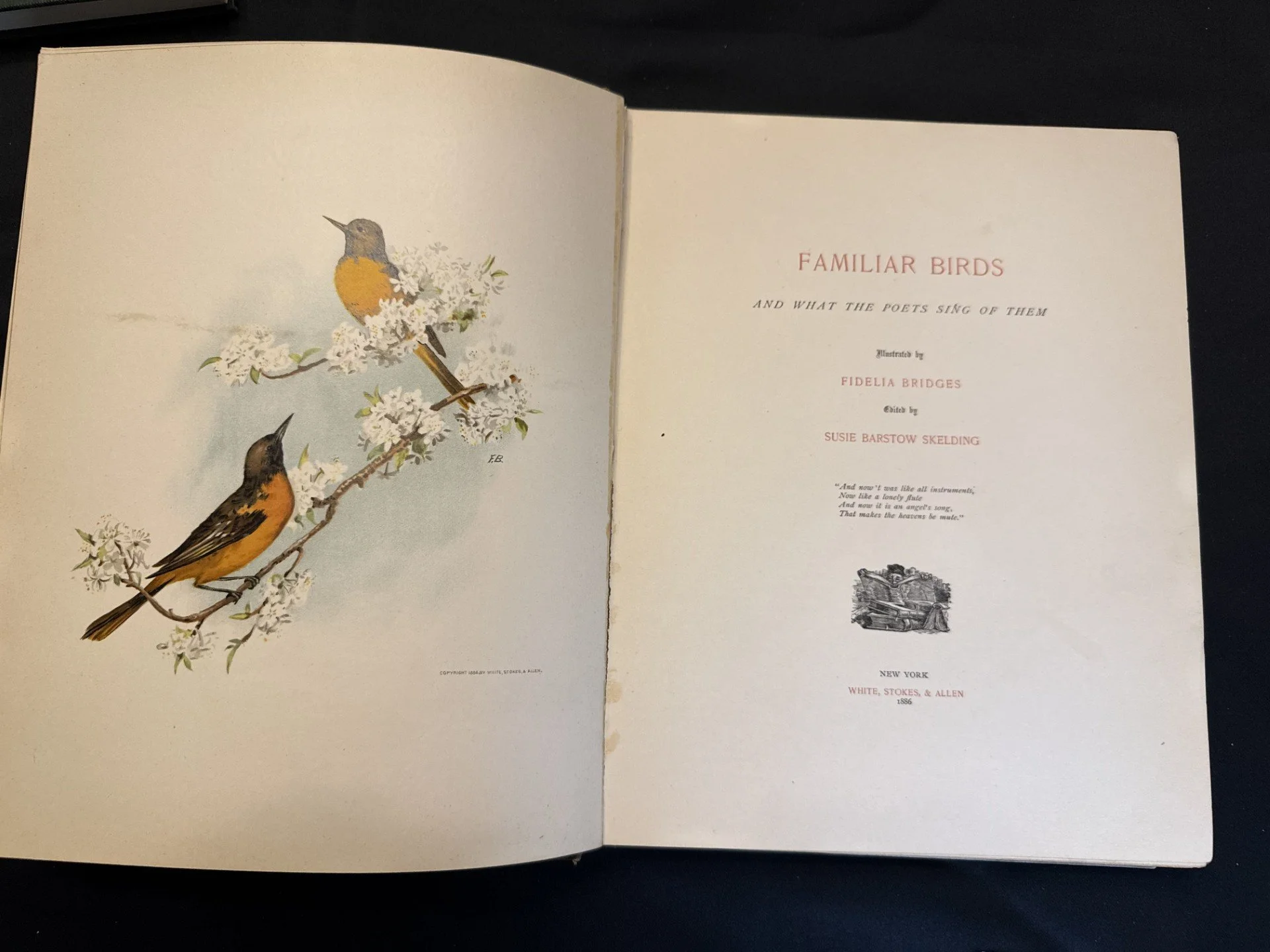
Published in New York in 1886 by White, Stokes & Allen, Familiar Birds and What the Poets Sing of Them brings together the work of American artist Fidelia Bridges (1834–1923) and editor Susie Barstow Skelding (1857–1934). Skelding selected poetry inspired by familiar birds, while Bridges supplied the natural-history illustrations.
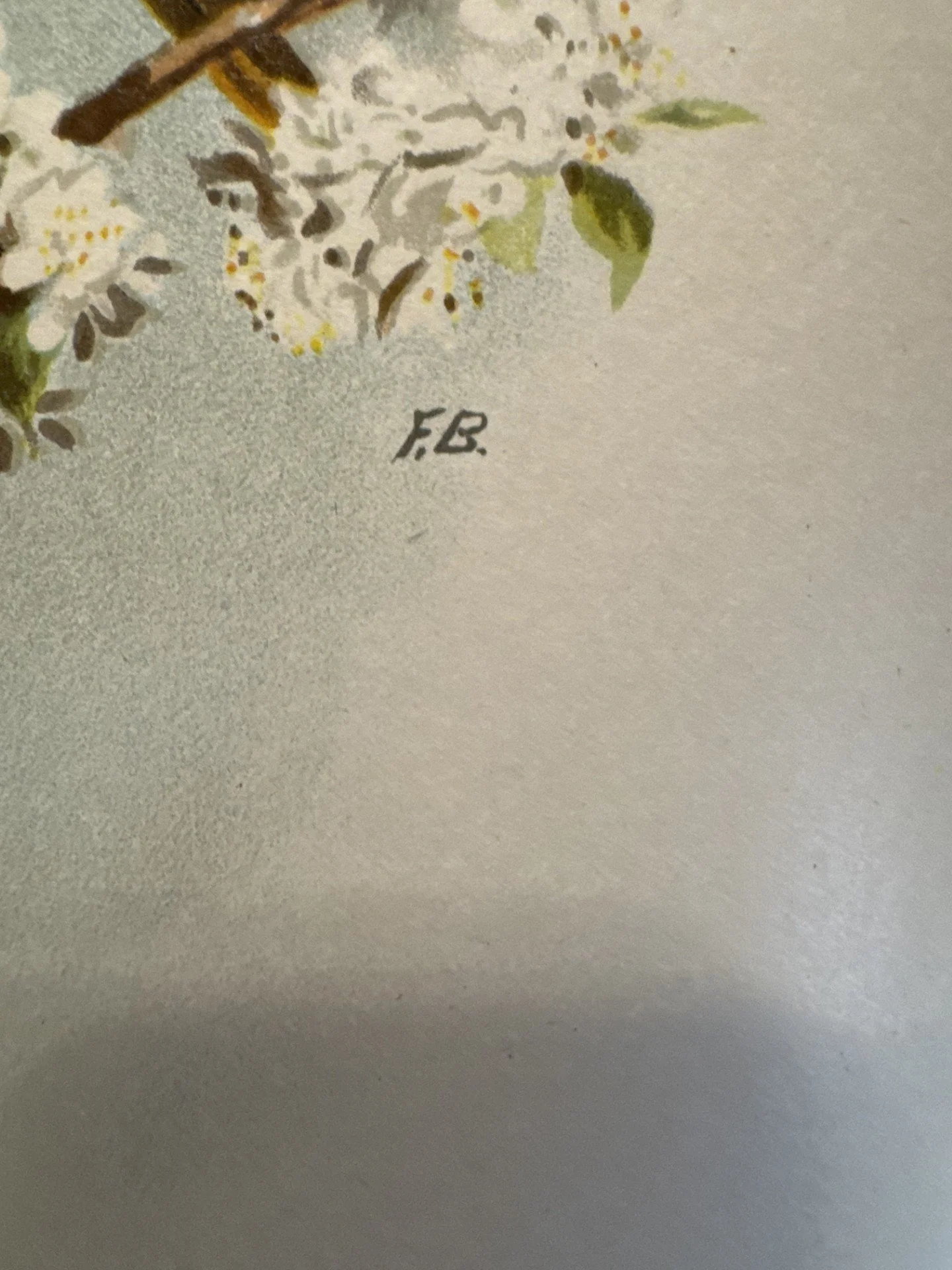
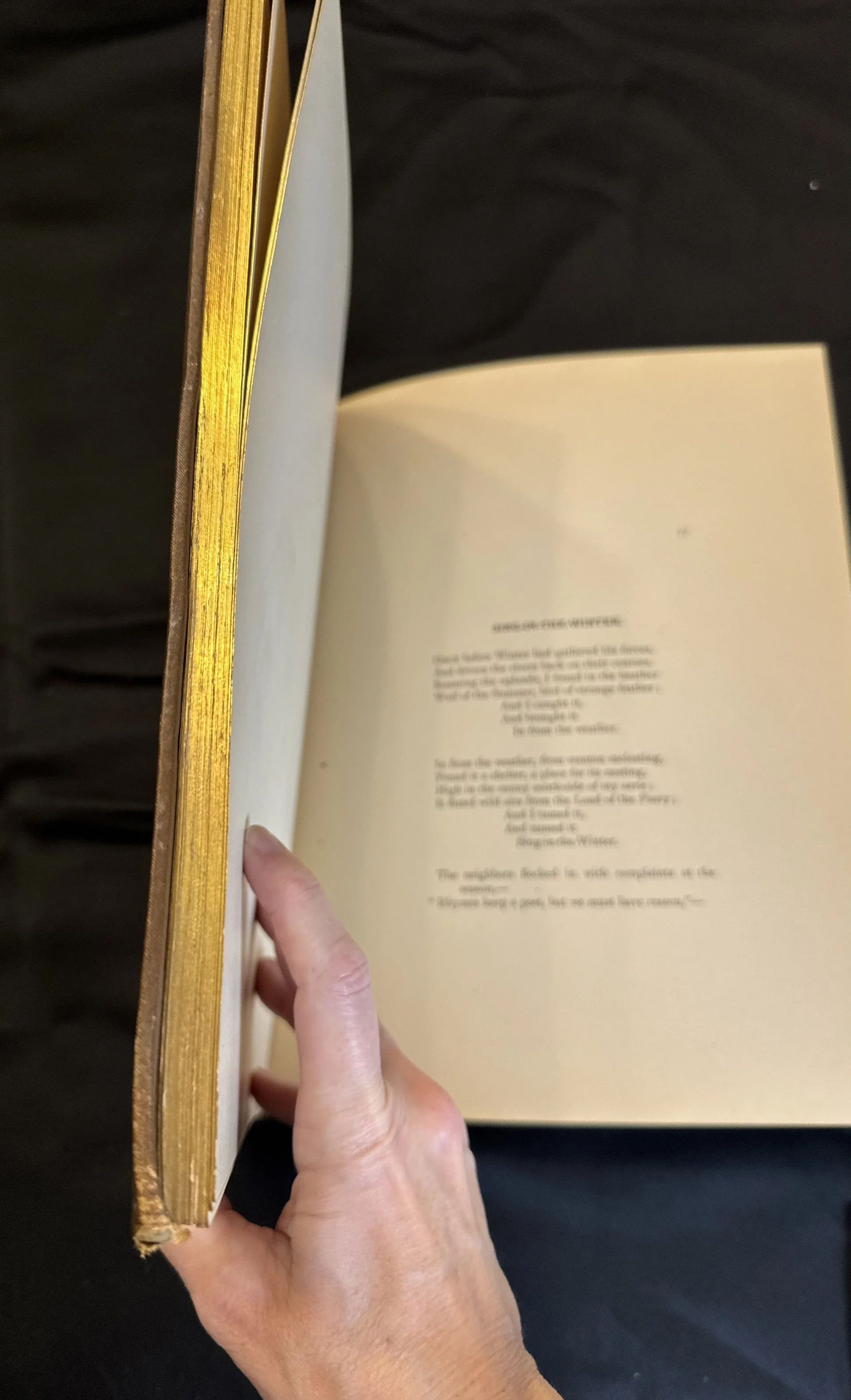
The Mayflower Descendants Museum’s copy retains its elaborate gilt-decorated cloth binding, gilt page edges, and richly colored bird illustrations, several of which bear Bridges’s “F.B.” monogram.
The first edition contains 134 pages and twelve full-page chromolithographs by Bridges, protected by tissue guards, along with three facsimile pages of handwritten poetry. (AbeBooks)
A contemporary 1886 advertisement described it as a “large, handsome volume,” richly bound in cloth and full gilt and sold in a presentation box for $5. The same publisher advertised smaller bird books for $1, making Familiar Birds a substantially more elaborate and expensive gift-book production. (Wikimedia Commons)
That $5 price would equal roughly $178 in 2026 purchasing power using a CPI-based comparison, giving a better sense of how substantial a purchase the book represented at the time. (Official Data)
Who Was Fidelia Bridges?
Fidelia Bridges was one of the relatively few American women of the nineteenth century to establish a sustained professional career as an artist. She became particularly known for detailed watercolors of birds, flowers, grasses, meadows, and other elements of the natural world.
In the 1860s, Bridges studied painting in Philadelphia in the studio of William Trost Richards (1833–1905). She later traveled to Rome with a group of women artists and, after returning to the United States, established a studio in New York. Her work was strongly influenced by the Pre-Raphaelite emphasis on close observation of nature. (Smithsonian Institution)
Bridges also found considerable commercial success. In the 1870s, Louis Prang & Company reproduced her designs as chromolithographs for greeting cards and calendars, and she illustrated books and magazines as well. (Smithsonian Institution)
A Remarkable Connection to the Lay Family
Bridges had a particularly close relationship with the Lay family, Mayflower descendants already represented elsewhere in the Mayflower Descendants Museum.
She met painter Oliver Ingraham Lay (1845–1890) around the time she was living in Brooklyn, and the Smithsonian describes Bridges as a lifelong friend of both Oliver and his son, landscape architect and artist Charles Downing Lay. (Smithsonian Institution)
The relationship survives in remarkable archival depth. Bridges’s own papers are preserved as an entire series within the Smithsonian Archives of American Art’s Oliver Ingraham Lay, Charles Downing Lay, and Lay Family Papers. The collection includes her letters to Oliver Lay, Charles and Laura Lay, and other family members and friends. Those letters discuss her painting, travels, personal life, and relationships with other artists. (Archives of American Art)
Oliver Ingraham Lay also painted Bridges’s portrait. That work is now in the Smithsonian American Art Museum and was given in memory of Charles Downing Lay and Laura Gill Lay by their children. (Smithsonian American Art Museum)
The Smithsonian also holds a circa-1876 watercolor by Bridges that came through the Lay family, further demonstrating how closely her artistic legacy became intertwined with theirs. (Smithsonian American Art Museum)
The Richards, Brewster, and Price Connections
Bridges’s teacher William Trost Richards connects this book to another artistic family represented in the Museum’s collections.
Richards was also the father and first painting teacher of artist Anna Richards Brewster (1870–1952). Anna began painting with her father when she was young and continued her formal training at the Cowles Art School, the Art Students League, and the Académie Julian before developing a distinguished career of her own. (UGA OIR)
Anna later married Columbia and Barnard professor William Tenney Brewster, a direct paternal-line descendant of Mayflower passenger William Brewster. Additional information about William and Anna Brewster appears in the Museum’s Mayflower Descendants in Love collection.
The artistic line continued into another generation through Richards’s granddaughter, Edith Ballinger Price (1897–1997), an artist, illustrator, and author. Price later recalled the influence of her grandfather on her early drawing and went on to study at the School of the Museum of Fine Arts, Boston, the Art Students League, and the National Academy of Design. (Expo at UOregon)
The Mayflower Descendants Museum also holds paintings by Edith Ballinger Price, extending this interconnected artistic story from William Trost Richards to his daughter Anna Richards Brewster and granddaughter Edith Ballinger Price.
Price herself helped preserve her grandfather’s legacy. In 1994 she gave the Chrysler Museum of Art a major group of works and studio materials by William Trost Richards, including his paint box and palette. (Chrysler Museum of Art)
How Rare Is the Book? The Mayflower Descendants Museum Has Not Identified Another Museum Collection Holding This Historic and Rare 1886 Book
The Museum’s 1886 copy is a first edition. Complete examples retain all twelve chromolithographs, tissue guards, and the decorative gilt binding. Modern antiquarian booksellers describe the volume as scarce, and complete copies appear only periodically on the market.
The Museum has not yet verified, through publicly accessible online catalogs, how many museums or institutional libraries hold this exact 1886 edition, so additional institutional research is continuing.
One Book, Many Connections
Familiar Birds is much more than an attractive Victorian bird book.
It preserves the work of an important American woman artist whose career crossed watercolor painting, chromolithography, publishing, and commercial design. At the same time, it leads directly into a remarkable network of American artists already represented in the Museum’s collections: Fidelia Bridges, Oliver Ingraham Lay, Charles Downing Lay, William Trost Richards, Anna Richards Brewster, and Edith Ballinger Price.
The relationships surrounding the book illustrate the kind of invisible thread the Museum seeks to follow: one object leading outward into friendships, teachers, students, families, archives, and American art history.
Pictured: the Mayflower Descendants Museum’s 1886 first edition of Familiar Birds and What the Poets Sing of Them, illustrated by Fidelia Bridges and edited by Susie Barstow Skelding.
Sources & Further Reading
Smithsonian Archives of American Art — Oliver Ingraham Lay, Charles Downing Lay, and Lay Family Papers, including the Fidelia Bridges Papers.
Smithsonian Archives of American Art — Lay Family Papers
Smithsonian American Art Museum — Oliver Ingraham Lay’s Portrait of Fidelia Bridges.
Smithsonian American Art Museum — Portrait of Fidelia Bridges
Smithsonian Archives of American Art — letters by Fidelia Bridges referencing William Trost Richards, Anna Richards Brewster, and members of the Lay family.
Smithsonian — Fidelia Bridges Letters
University of Georgia — biographical information on Anna Richards Brewster and her early painting with her father, William Trost Richards. (UGA OIR)
University of Oregon — Edith Ballinger Price, her artistic training, and the influence of her grandfather William Trost Richards.
University of Oregon — Edith Ballinger Price
Chrysler Museum of Art — William Trost Richards collection donated by his granddaughter Edith Ballinger Price.
Chrysler Museum — Seascapes by William Trost Richards
Royoung Bookseller / AbeBooks — bibliographic description of the 1886 first edition with twelve chromolithographs.
1886 First Edition — AbeBooks
PBA Galleries — auction record for an 1886 copy of Familiar Birds and What the Poets Sing of Them.
PBA Galleries — Familiar Birds