
Jennie Augusta Brownscombe
Painting Her Own Mayflower Ancestor
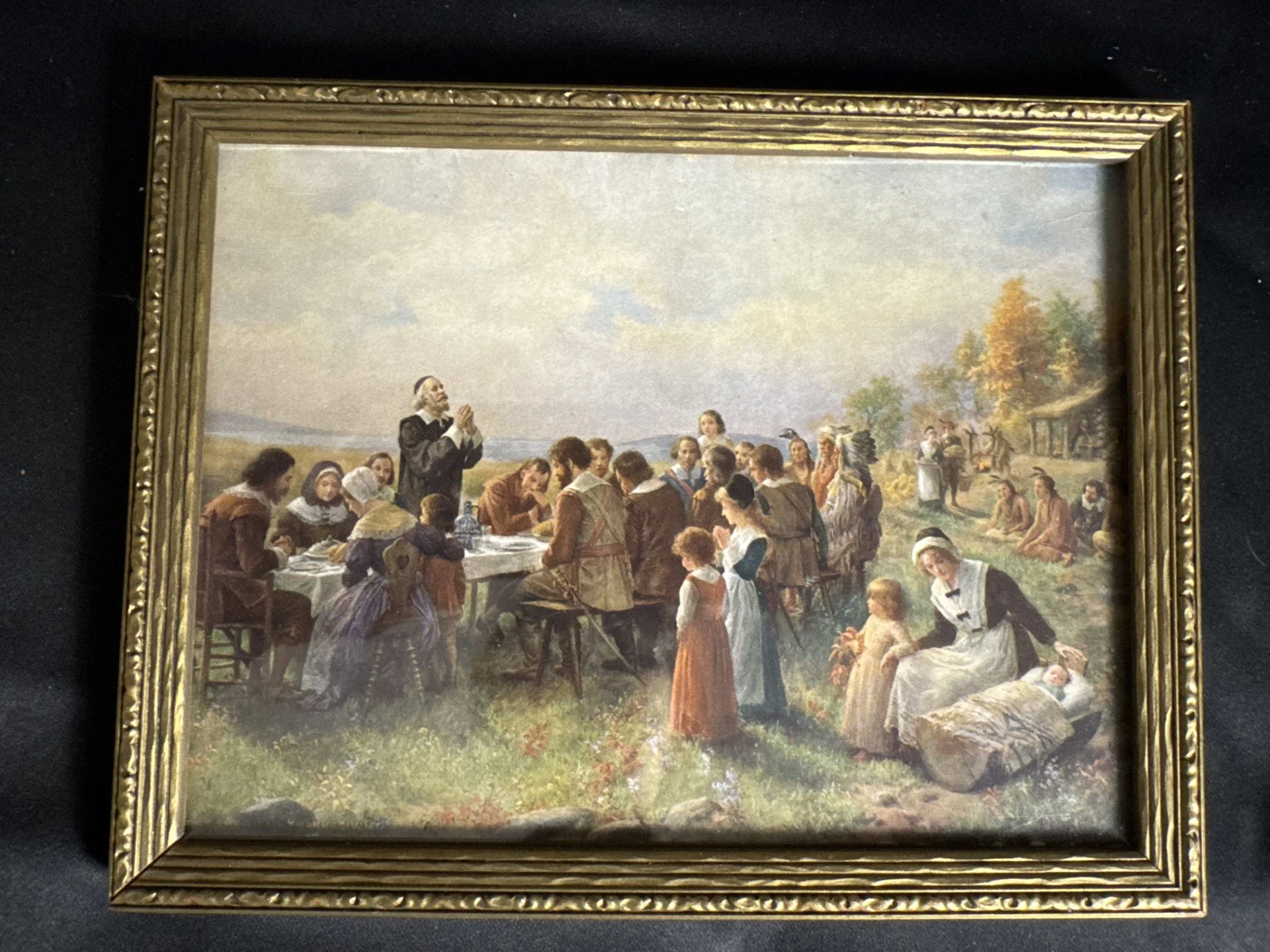
This framed antique print in the Mayflower Descendants Museum collection reproduces Jennie Augusta Brownscombe’s celebrated 1914 painting The First Thanksgiving at Plymouth, one of the best-known artistic interpretations of the 1621 harvest gathering at Plymouth.
At the center of Brownscombe’s composition, an elderly Pilgrim stands in prayer. The figure is identified as Elder William Brewster (c. 1566–1644), the religious elder of the Plymouth congregation. A contemporary description of the painting preserved in later reporting likewise identifies Brewster as the man leading the group in prayer. (Los Angeles Times)
That identification makes the painting especially meaningful: Brownscombe was not simply painting a famous Mayflower passenger. She was painting her own ancestor.
A Mayflower Descendant Painting Her Ancestor
Jennie Augusta Brownscombe (1850–1936) was herself a Mayflower descendant through her mother, Elvira Kennedy Brownscombe. Research from the Wayne County Historical Society identifies Elvira as a descendant of Elder William Brewster and records that Jennie was proud of this maternal heritage, joining the Mayflower Society through that line. (Creative Circle Media)
The connection creates a remarkable relationship between artist and subject. In The First Thanksgiving at Plymouth, Brownscombe placed her own Mayflower ancestor near the visual center of the scene, standing above the gathered company and leading the prayer.
For Brownscombe, therefore, Plymouth history was also family history.
Her choice of Brewster is particularly appropriate to the religious character of the composition. Brewster served as elder of the Separatist congregation and was one of the surviving Mayflower passengers present at the 1621 harvest gathering. Pilgrim Hall Museum includes William Brewster, his wife Mary, their sons Love and Wrestling, and their ward Richard More among those present. (Pilgrim Hall Museum)
William Brewster and Prayer
Brownscombe made prayer one of the principal visual elements of the painting. Brewster stands while the surrounding figures gather around the table, making the religious act an important focal point within the larger scene of food, family, community, and landscape.
The historical distinction is important. The event remembered today as the “First Thanksgiving” was a harvest celebration rather than a formally proclaimed religious day of thanksgiving. Pilgrim Hall Museum notes, however, that the Plymouth colonists were deeply religious and that prayer would have been consistent with the gathering, although the exact prayers spoken are unknown. (Pilgrim Hall Museum)
Brownscombe’s painting should therefore be understood as a later artistic interpretation rather than a literal visual record of the 1621 event.
But within this Museum collection, the religious connection is unusually direct: a Mayflower-descendant artist portrayed her own ancestor, Elder William Brewster, in the act for which his role in Plymouth’s spiritual life made him particularly well suited—prayer.
Creating an American Image of Plymouth
Brownscombe became known for historical and genre paintings that appealed strongly to American audiences. She studied at the Cooper Institute School of Design for Women and the National Academy of Design and was a founding member of the Art Students League of New York. Her paintings were also widely reproduced as prints, calendars, cards, and illustrations. The National Museum of Women in the Arts notes that reproduction helped distribute more than one hundred of her images into homes across the country. (National Museum of Women in the Arts)
The Museum’s print is therefore significant in its own right. It represents the way Brownscombe’s paintings moved beyond the original canvas and became part of American popular visual culture.
The First Thanksgiving at Plymouth was painted in 1914, almost three centuries after the event it depicts. Brownscombe researched historical subjects, but the painting also reflects assumptions and visual conventions of the early twentieth century. Among its best-known inaccuracies are the log cabin and the use of Plains-style Native American dress rather than clothing appropriate to the seventeenth-century Wampanoag. (Smithsonian Magazine)
Those inaccuracies are now part of the painting’s interpretive importance. The work tells two stories at once: one about how Brownscombe imagined Plymouth in 1621 and another about how Americans in the early twentieth century were constructing a visual memory of the Pilgrims.
Religion, Family History, and Art
Within the Mayflower Descendants Museum, this print intersects several areas of interpretation at once.
It depicts Mayflower history through the work of a Mayflower descendant. It places Elder William Brewster and prayer prominently within the scene. And, most unusually, the artist herself descended from the man she chose to portray in that central religious role.
The relationship between artist and subject therefore adds a deeply personal layer to one of Brownscombe’s most famous historical compositions:
Jennie Augusta Brownscombe was painting her own family history.
Sources and Further Reading
Wayne County Historical Society — research on Jennie Augusta Brownscombe and her family. Brownscombe’s mother, Elvira Kennedy Brownscombe, was a descendant of Elder William Brewster, and Jennie joined the Mayflower Society through her maternal heritage. (Creative Circle Media)
Wayne County Historical Society — Jennie Brownscombe
National Museum of Women in the Arts — Jennie Augusta Brownscombe. Biography covering her artistic training, historical subjects, and the widespread reproduction of her paintings. (National Museum of Women in the Arts)
Read the artist biography
Pilgrim Hall Museum — Who Was at the “First Thanksgiving” at Plymouth? Identifies William Brewster and members of his family among the surviving Mayflower passengers present at the 1621 harvest gathering. (Pilgrim Hall Museum)
Read about those present in 1621
Pilgrim Hall Museum — Religious Roots of Thanksgiving. Discusses the distinction between the 1621 harvest celebration and formal religious days of thanksgiving, as well as the importance of prayer in Pilgrim life. (Pilgrim Hall Museum)
Read Religious Roots of Thanksgiving
National Museum of Women in the Arts — Thanksgiving at Plymouth, 1925. Brownscombe’s later treatment of the subject, with discussion of her historical research and the idealized elements in her depiction. (National Museum of Women in the Arts)
View Brownscombe’s 1925 Thanksgiving painting