
Wilber Henry Lansil
Landscape, Church, and an Artistic Brotherhood
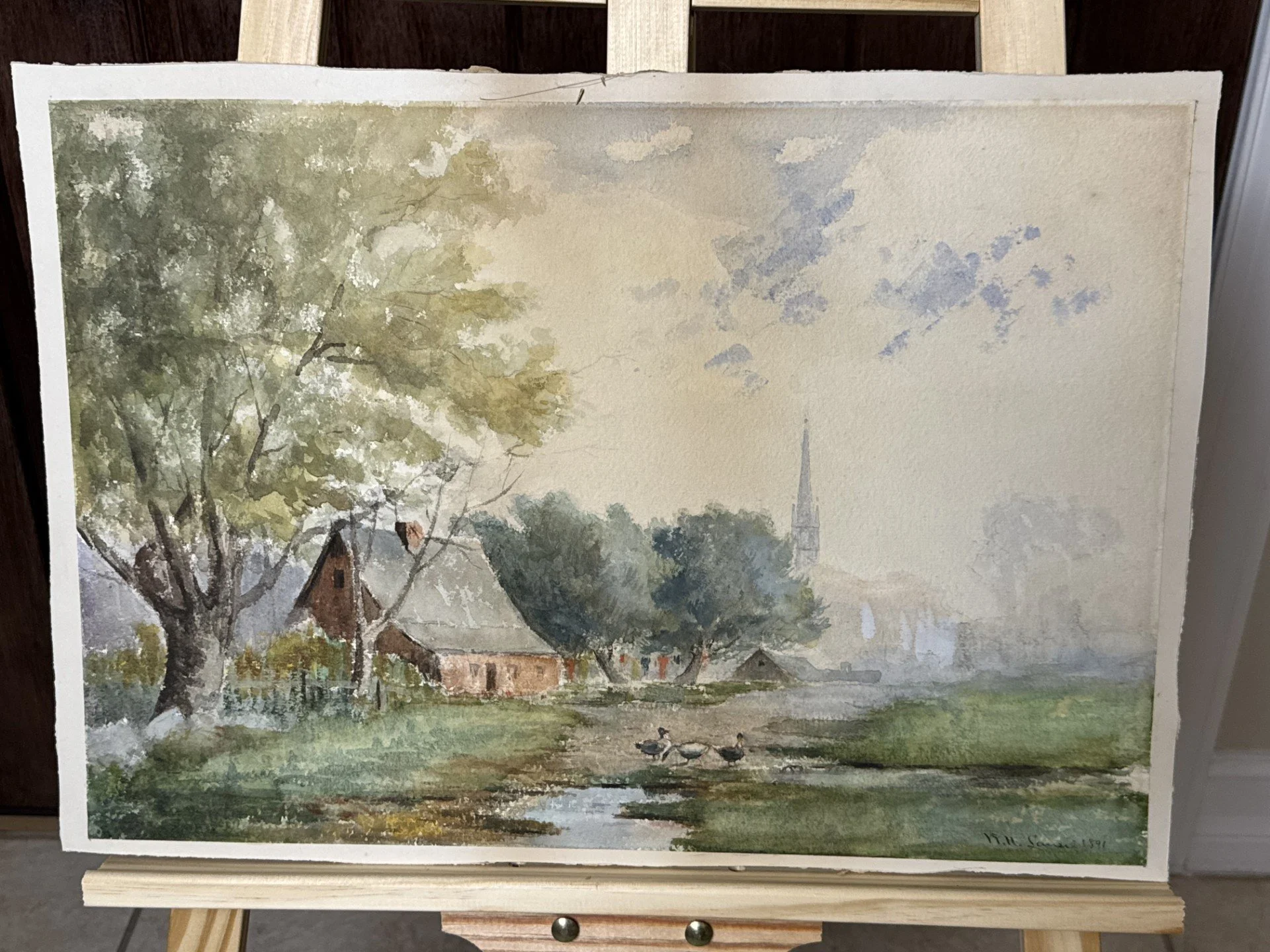
This 1891 watercolor by American artist Wilber Henry Lansil (1855–1897) presents a quiet rural landscape of trees, buildings, animals, and water. Rising in the distance is the slender steeple of a church, placing religion subtly within the visual fabric of the community rather than making the church itself the central subject.
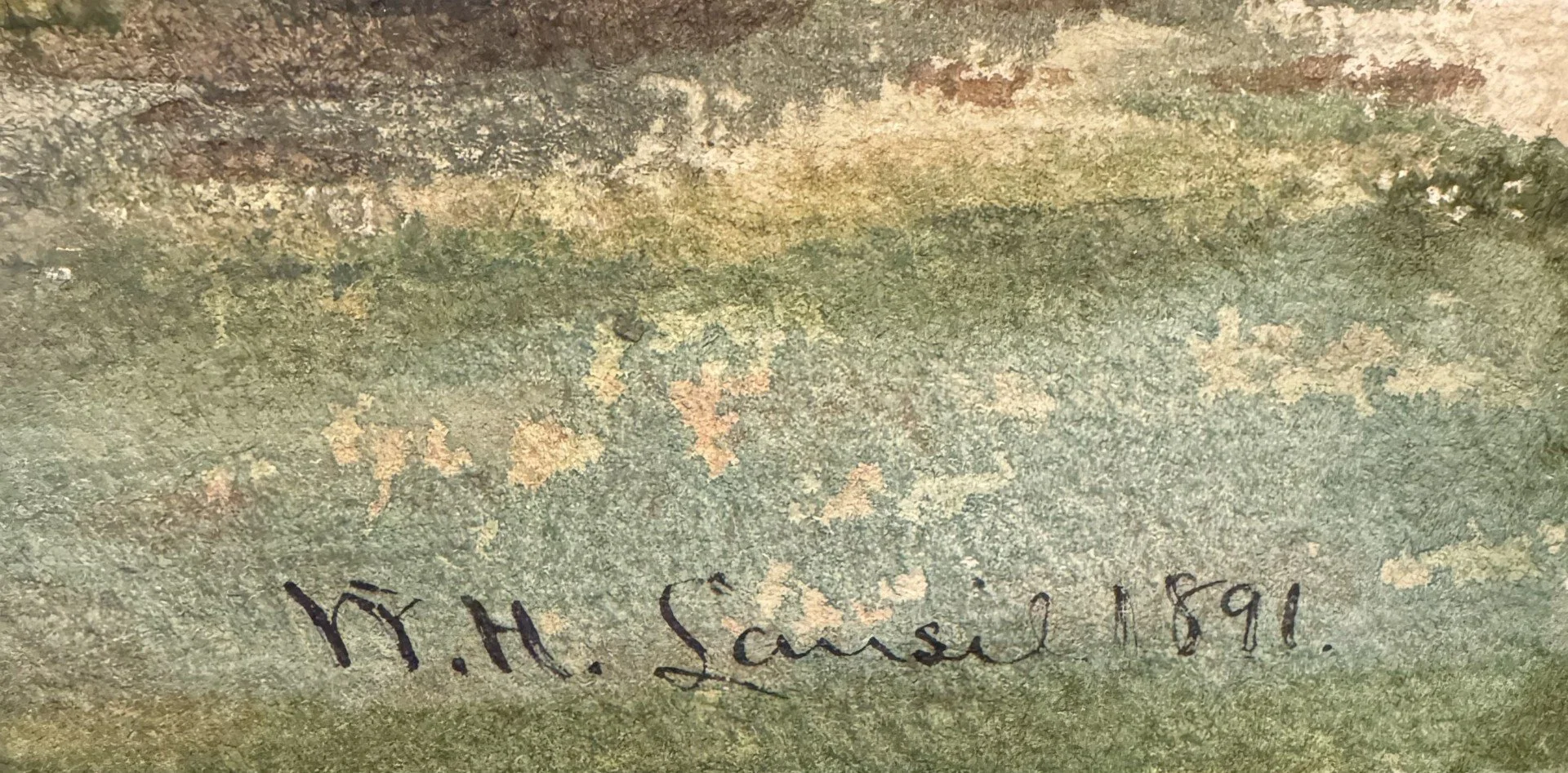
Signed and dated “W. H. Lansil 1891,” the watercolor reveals the landscape side of an artist who became particularly known during his lifetime for paintings of cattle and rural subjects.
Wilber was born in Bangor, Maine, on February 24, 1855, and later moved to Boston. Contemporary accounts remembered him as an accomplished cattle painter. His 1897 obituary in The New York Times described him as a “well-known cattle painter” and noted the composition, careful drawing, color, and lifelike movement found in his animal subjects.
A longer obituary published in The Inter Ocean described him as “one of the most promising cattle painters in this country” and recorded that, although he initially entered business, his ambitions ultimately turned toward a professional artistic career.
Two Brothers, Two Specialties
Wilber’s artistic story was closely intertwined with that of his brother Walter Franklin Lansil, who became especially known for marine and Venetian scenes.
Their relationship extended well beyond family ties. The brothers studied, traveled, exhibited, and worked within many of the same artistic circles.
In 1884, Wilber traveled to Europe in company with Walter. A contemporary Bangor newspaper reported shortly before their departure that Walter was visiting the city with his brother Wilber and that the two planned to leave for Europe, where Wilber intended to study painting.
Wilber’s later obituary provides more detail. It records that the brothers sailed together in August 1884 and that Wilber first traveled to France, where he studied with the cattle painter Eugène van Marcke. He later studied in Holland and visited Belgium, Germany, and Italy before returning to the United States.
A decade later, the brothers were still presenting their work together.
In March 1894, the Boston Evening Transcript reported an “Exhibition of Paintings by the Lansil Brothers” held in their studio at 46 Studio Building in Boston. The exhibition included approximately twenty-two works and illustrates the developing distinction between their artistic specialties: Walter’s works centered on marine subjects, while Wilber’s included landscapes and cattle paintings.
That distinction makes this 1891 watercolor particularly interesting. Although Wilber became well known for cattle paintings, the Museum’s work is fundamentally a landscape. The distant church steeple, almost absorbed into the atmospheric background, provides a small but unmistakable architectural focal point.
Wilber Lansil in Boston’s Art World
Wilber also exhibited independently within Boston’s established artistic community. In 1894, his work appeared in the annual exhibition of the Boston Art Club. Contemporary reporting from that exhibition places him among a broad group of professional artists working and exhibiting in Boston during the period.
The Boston Globe also reported on Wilber’s work during the 1894 Boston Art Club exhibition season, further documenting his presence within the city’s active art community.
The relationship between the Lansil brothers remained visible even after Wilber’s death. In August 1898, the Boston Globe reported on an exhibition at the Poland Spring Art Gallery in South Poland, Maine, listing works by both Walter F. Lansil and Wilber H. Lansil among those shown. Because Wilber had died the previous year, his inclusion demonstrates that his paintings continued to circulate and be exhibited after his death.
A Career Cut Short
Wilber died in 1897 at only forty-two years old.
Contemporary obituaries emphasized both the reputation he had already established and the promise of a career that ended early. His brother Walter, by contrast, lived for several more decades and continued painting.
Together, the Lansil brothers provide an especially interesting example of two artists from the same family developing different but complementary artistic identities: Walter looking repeatedly toward the sea, ships, harbors, and Venice, and Wilber toward the countryside, animals, farms, and landscapes.
The Museum’s 1891 watercolor belongs to that second world.
The church does not dominate the composition. Instead, its steeple rises quietly beyond the rural buildings and trees, becoming one element within the landscape of everyday life. Its presence allows the work to be considered not simply as a pastoral view, but also as an image in which architecture, community, landscape, and religion occupy the same visual space.
Holdings of the Mayflower Descendants Museum
Sources and Further Reading
Bangor Daily Whig and Courier, July 17, 1884, p. 3. Contemporary report documenting Walter F. Lansil’s visit to Bangor with his brother Wilber and their plans to travel to Europe, where Wilber intended to study painting. Research accessed through Newspapers.com.
Boston Evening Transcript, March 26, 1894, p. 5. “The Fine Arts.” Includes coverage of an “Exhibition of Paintings by the Lansil Brothers” in Boston and distinguishes Walter F. Lansil’s marine subjects from Wilber H. Lansil’s landscapes and cattle paintings. Research accessed through Newspapers.com.
The Boston Globe, January 28, 1894, p. 28. Coverage of the annual exhibition of the Boston Art Club, documenting Wilber H. Lansil among the artists represented. Research accessed through Newspapers.com.
The Boston Globe, February 25, 1894, p. 29. Art coverage documenting Wilber Lansil’s activity within Boston’s exhibition community during the 1894 Boston Art Club season. Research accessed through Newspapers.com.
The New York Times, June 28, 1897, p. 7. “Wilbur H. Lansil.” Obituary identifying Wilber as a well-known cattle painter and as the brother of Walter F. Lansil, known for Venetian painting. Research accessed through Newspapers.com.
The Inter Ocean, Chicago, June 28, 1897, p. 1. “Wilber H. Lansil Dead.” Detailed obituary documenting Wilber’s birth in Bangor, move to Boston, 1884 European journey with Walter, artistic study in France and Holland, European travels, and reputation as a cattle painter. Research accessed through Newspapers.com.
The Boston Globe, August 7, 1898, p. 26. Report on the exhibition at the Poland Spring Art Gallery in South Poland, Maine, listing works by both Walter F. Lansil and the late Wilber H. Lansil among the paintings shown. Research accessed through Newspapers.com.