
The Elder Brewster Teapot and Tea Set
A Mayflower Relic at the Center of a 19th-Century Debate That Has Spilled into Modern Times
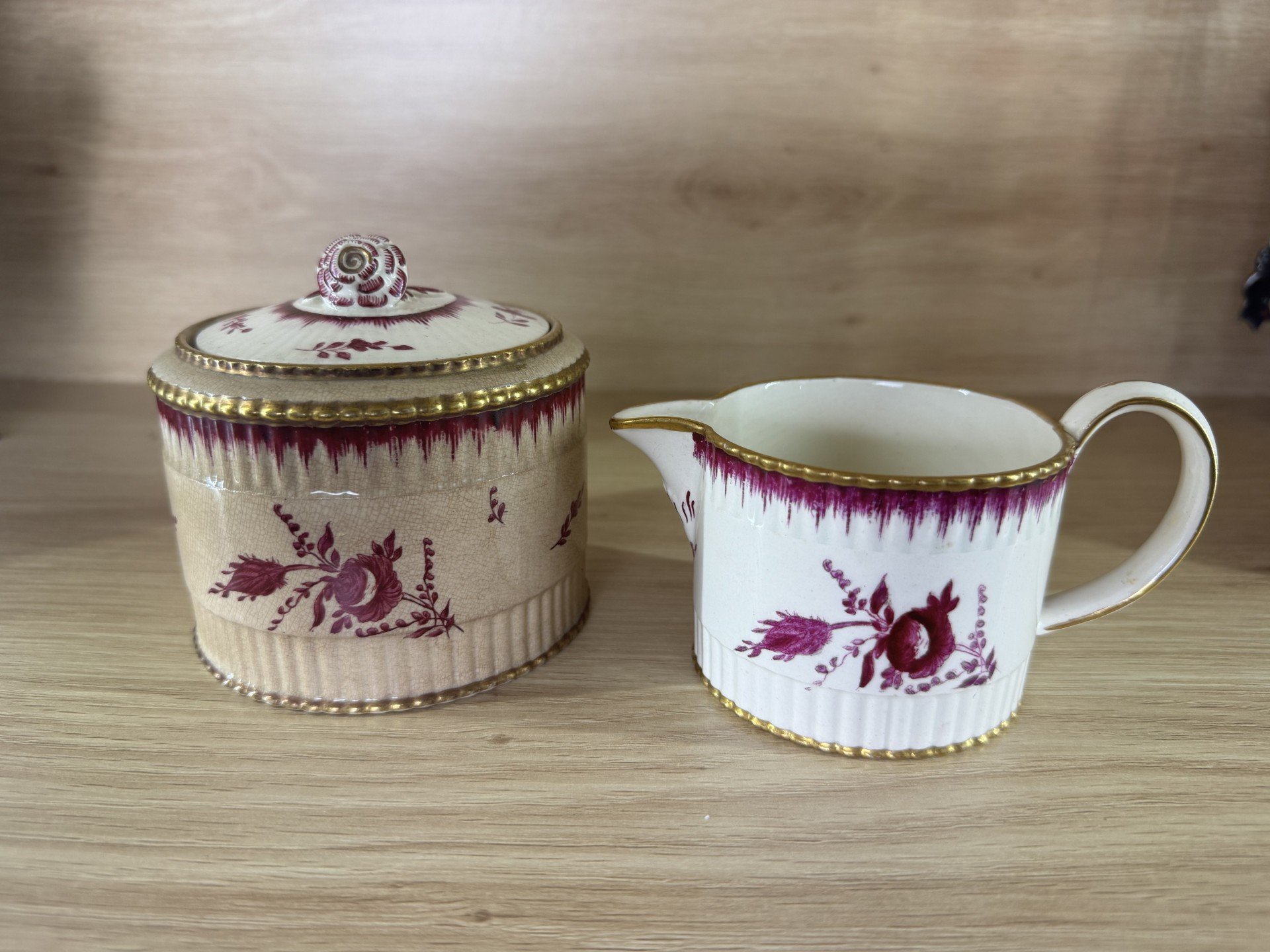
Few objects demonstrate the power of Mayflower memory quite like the object long known as the Elder Brewster Teapot. Pictured: a cream and sugar from the Elder Brewster tea service.
In the nineteenth century, a ceramic teapot in the collection of former territorial governor and collector Caleb Lyon was said to have belonged to Mayflower passenger Elder William Brewster and to have crossed the Atlantic aboard the Mayflower in 1620. Boston retailer Richard Briggs & Co. subsequently commissioned reproductions of the teapot from Josiah Wedgwood & Sons in England and expanded the design into a coordinated tea service. Surviving examples bear an inscription stating that the original had been brought to America on the Mayflower and had been “exactly copied and reproduced” from Governor Lyon’s ceramic collection. The Preservation Society of Newport County dates its surviving Wedgwood service to about 1871. (Wikimedia Commons)
The Mayflower Descendants Museum holds pieces from this nineteenth-century Elder Brewster tea service.
But almost from the beginning, the story surrounding the original teapot inspired debate.
Where Did Governor Caleb Lyon (1822–1875) Get the Teapot?
One of the most intriguing—and unresolved—parts of the story concerns the teapot’s provenance before it entered Caleb Lyon’s collection.
Alice Morse Earle wrote in China Collecting in America that Lyon obtained the teapot from an elderly woman in Vermont, but only after repeated visits, considerable persuasion, repeated refusals, and payment of what Earle described as a substantial price.
Yet Earle did not identify the woman or provide documentation tracing the teapot from William Brewster to her possession. That leaves important questions unanswered: What information was Lyon given when he purchased it? Did he possess documentation that has since disappeared? Did he believe a family tradition conveyed with the object? Or was the Brewster attribution added or strengthened later?
Lyon himself was a prominent but complicated nineteenth-century figure. A former New York legislator and U.S. representative, he was appointed Governor of Idaho Territory by President Abraham Lincoln in 1864. His territorial career was also marked by controversy, including disputes surrounding the relocation of the territorial capital and serious questions concerning federal funds entrusted to him as superintendent of Indian affairs.
None of that proves or disproves the history Lyon gave for the teapot. It does, however, reinforce the importance of treating the Brewster attribution as a provenance question requiring documentary evidence rather than relying on Lyon’s status or reputation alone.
A modern study published by the Chipstone Foundation likewise notes that Lyon was vague about the teapot’s provenance and characterized his source simply as an anonymous woman in Vermont. (Chipstone)
In the sources reviewed by the Mayflower Descendants Museum so far, no additional information has been found identifying this woman or documenting how the teapot supposedly passed from Elder Brewster or his descendants into her possession.
That missing history is important. Even if a teapot of this type could theoretically have existed during Brewster’s lifetime, the surviving provenance currently leaves a substantial gap between William Brewster and Governor Lyon’s nineteenth-century acquisition.
The Argument Against the Mayflower Tradition
One of the principal historical objections was chronological. Critics argued that tea was not known to the Pilgrims in 1620 and that the teapot itself appeared stylistically too late to have belonged to Brewster.
A lengthy article published in the Boston Evening Transcript in 1881 reviewed the controversy and argued strongly against the traditional attribution. The writer discussed the relatively late spread of tea drinking in northern Europe and maintained that the ware, decoration, glaze, and style of the original teapot belonged to a considerably later period. The article also noted that Governor Lyon’s supposed Brewster teapot had sold for only $45 at the dispersal of his ceramic collection, while English-made reproductions were already being sold for approximately $50 each.
Alice Morse Earle later discussed the controversy in her 1892 book China Collecting in America. She reported that before Richard Briggs had reproductions manufactured, the original was shown to Mr. Townsend, a ceramics expert at the South Kensington Museum—the institution that later became the Victoria and Albert Museum. According to Earle, Townsend considered the piece to be old Delft and showed Briggs other similarly decorated examples. Earle herself treated its supposed Mayflower provenance with considerable skepticism. (Reading Roo)
But Was a Teapot in Holland in 1620 Actually Impossible?
Not everyone accepted the chronological objection.
An 1896 Standard-Times article revisited the controversy and specifically challenged the claim that Brewster could not possibly have possessed such a vessel. The newspaper cited Appleton’s Cyclopaedia as stating that tea had been imported into Holland early in the seventeenth century and noted that 1610 was given by some authorities.
The article then made an important connection: William Brewster had gone to Holland in 1608 and remained there until sailing with the Pilgrims in 1620. The writer reasoned that if tea was available to the Dutch during Brewster’s years there, then the existence of vessels used for preparing or serving tea before 1620 was not inherently impossible.
That was an argument being made in print as early as 1896.
Modern museum collections make that nineteenth-century counterargument even more interesting. The Rijksmuseum today catalogs a Chinese porcelain vessel as a teapot, dating it to approximately 1610–1630. Other early seventeenth-century Chinese porcelain vessels reached the Dutch world through maritime trade. These objects do not prove that Brewster owned Governor Lyon’s disputed teapot, but they complicate the once-common argument that a teapot-like vessel simply could not have existed in Holland during the years Brewster lived there. (The Mayflower Society)
The distinction is important: evidence that such vessels existed does not establish the provenance of this particular teapot.
A significant unresolved issue remains the chain of ownership: what evidence, if any, connects Governor Lyon’s nineteenth-century teapot to William Brewster? And what evidence, if any, connected her possession of it to William Brewster?
From Controversial Relic to Fashionable Reproduction
Whatever nineteenth-century Americans believed about the original, the Elder Brewster reproductions became desirable objects in their own right.
In April 1875, the Rochester Journal and the Post Express reported that a facsimile Elder Brewster tea set was displayed beneath a floral arch at a charitable event. William H. Vanderbilt purchased the set for $100. The newspaper reported that the set had been donated by Richard Briggs of Boston and repeated the inscription declaring that the original had been carried to America on the Mayflower and reproduced from Governor Lyon’s ceramic collection.
The Vanderbilt purchase is significant because it demonstrates just how desirable these reproductions had become. They were not inexpensive novelty souvenirs. They appealed to some of the wealthiest and most socially prominent Americans of the period.
By 1878, the reproductions had entered the commercial art market more broadly. The New York Herald, reporting on the newly opened art pottery and porcelain rooms of R. H. Macy & Co., specifically mentioned a copy of the Elder Brewster teapot accompanied by its cream jug, sugar bowl, and basin among the ceramics on display.
And the Brewster teapot was not an isolated effort. An 1888 Chicago Tribune article discussed Richard Briggs reproducing another ceramic object associated with Elder Brewster—a fruit dish said to have been brought over on the Mayflower—showing that nineteenth-century demand for reproductions of supposed Pilgrim relics extended beyond this single tea service.
The Debate Continues into Modern Times
The controversy surrounding the teapot did not end with the nineteenth century.
In 2022, Peggy M. Baker revisited the object in an article titled “The Tangled Tale of the ‘Brewster Teapot’” for The Mayflower Quarterly Magazine, published by the General Society of Mayflower Descendants.
Baker rejects the traditional Mayflower attribution and argues that Brewster did not bring a teapot aboard the Mayflower. Her article provides another important chapter in a debate that had already been taking place in newspapers, books, collecting circles, and ceramics scholarship for well over a century. (The Mayflower Society)
During research for this preview, the Mayflower Descendants Museum compared that modern interpretation with nineteenth-century sources—including the 1896 article that cited early Dutch tea consumption—and with surviving early-seventeenth-century ceramics now cataloged by European museums.
The result is not proof that the Brewster tradition is correct.
Rather, it demonstrates why the history is more complicated than a simple verdict of “real” or “fake.”
The Controversy Itself Became Part of the Object’s History
Whether Governor Lyon’s original teapot actually belonged to William Brewster remains unresolved by the surviving provenance.
The tea service preserves another history: the extraordinary desire of nineteenth-century Americans to possess tangible connections to the Mayflower past. The sets were commissioned from Wedgwood, sold by prominent retailers, discussed in newspapers, exhibited publicly, debated by collectors and ceramics experts, and purchased by people as wealthy and prominent as William H. Vanderbilt.
More than 150 years after Richard Briggs reproduced the famous teapot, the questions remain fascinating:
Was the traditional Brewster story possible?
Can an object’s age be separated from its provenance?
Who was the unidentified Vermont woman from whom Governor Lyon obtained it?
And why did nineteenth-century Americans so strongly desire objects that connected them physically to the Mayflower past?
Sources & Further Reading
Alice Morse Earle, China Collecting in America, 1892 — discussion of the Elder Brewster Teapot, Governor Lyon’s acquisition from an unidentified Vermont woman, and the nineteenth-century controversy. (Reading Roo)
Preservation Society of Newport County — Wedgwood/Richard Briggs Elder Brewster tea service, c. 1871.
General Society of Mayflower Descendants, Peggy M. Baker, “The Tangled Tale of the ‘Brewster Teapot,’” The Mayflower Quarterly Magazine, Summer 2022. (The Mayflower Society)
Rochester Journal and the Post Express, April 16, 1875 — William H. Vanderbilt’s purchase of an Elder Brewster facsimile tea set.
New York Herald, December 8, 1878 — Elder Brewster tea service displayed in R. H. Macy & Co.’s art pottery rooms.
Boston Evening Transcript, February 28, 1881 — contemporary argument against the Brewster provenance.
Chicago Tribune, September 21, 1888 — Richard Briggs’s reproduction of another supposed Brewster relic, a fruit dish associated with the Mayflower.
The Standard-Times, March 19, 1896 — contemporary counterargument citing early-seventeenth-century tea in Holland and questioning whether Brewster’s ownership of a teapot was inherently impossible.
Chipstone Foundation, Ceramics in America — discussion of Caleb Lyon, his collecting history, and the vague provenance he supplied for the Elder Brewster Teapot. (Chipstone)