
James W. Tufts Salt and Pepper Set
A Mayflower Descendant, Victorian Silver Plate, and American Art Glass
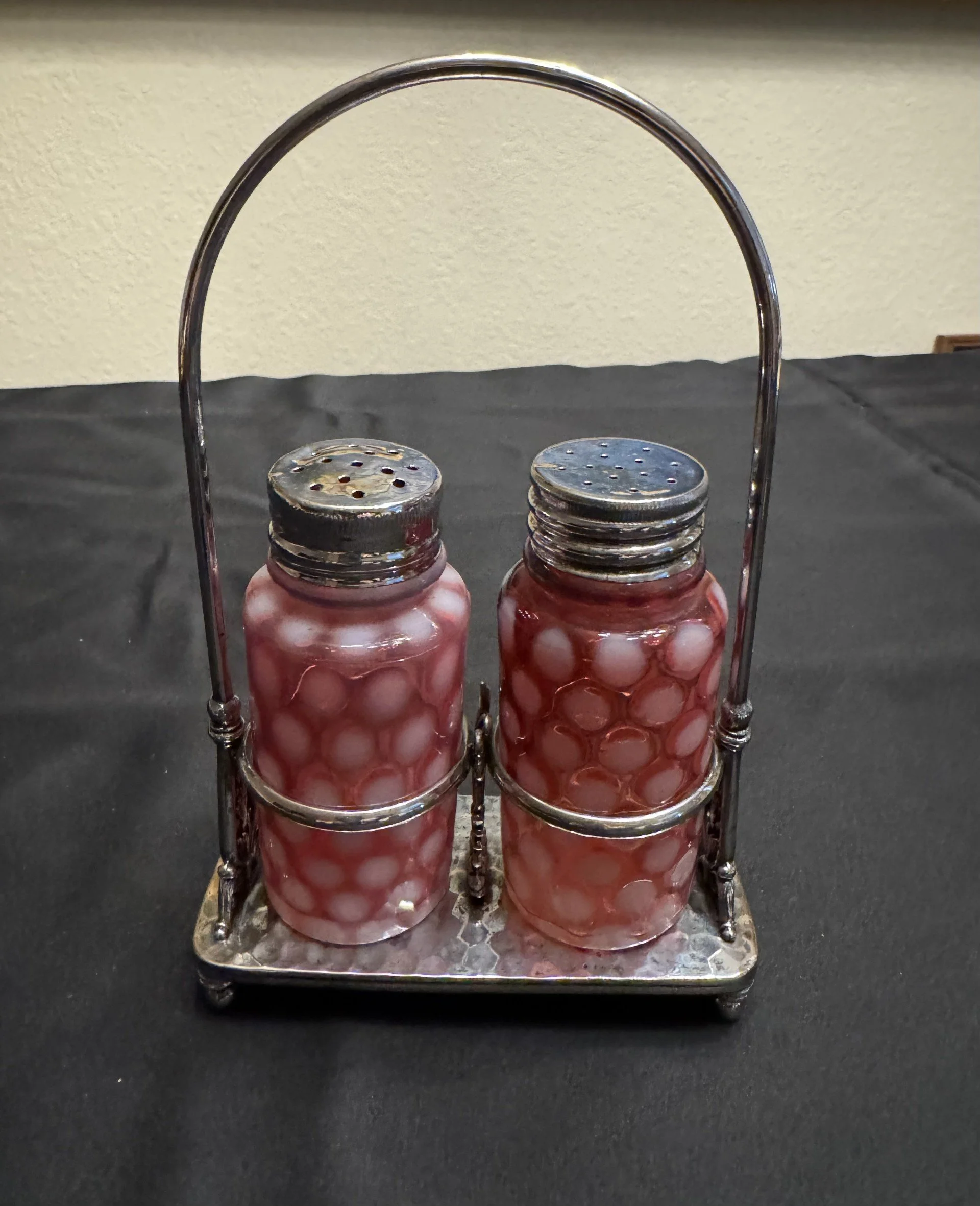
Pictured: cranberry opalescent glass salt and pepper shakers in a James W. Tufts silver-plated holder. The glass appears consistent with late-nineteenth-century Hobbs, Brockunier & Co. production.
This late-nineteenth-century salt and pepper set in the holdings of the Mayflower Descendants Museum combines a James W. Tufts silver-plated carrying stand with two cranberry-pink opalescent glass shakers fitted with perforated metal tops.
The maker behind the metalwork, James Walker Tufts (1835–1902) of Massachusetts, has a particularly direct connection to Mayflower history. Biographical sources identify Tufts as a descendant of Mayflower passenger Elder William Brewster. He would later become best known nationally as the founder of Pinehurst, North Carolina, but before Pinehurst he built a highly successful manufacturing career in Massachusetts.
Tufts began as a pharmacist and developed his own soda-fountain apparatus. His business eventually produced elaborate soda fountains incorporating Italian marble and silver-plated fixtures. According to the Dictionary of North Carolina Biography, the manufacture of silver-plated household goods—including pitchers, dishes, and other decorative wares—grew out of this larger manufacturing enterprise.
Dating the Museum’s Set
The Museum currently dates this salt and pepper set to approximately the late 1880s, probably c. 1887–1891, based in part on the appearance of its glass.
The cranberry opalescent shakers display a circular “window” or coin-spot effect that appears consistent with glass produced by Hobbs, Brockunier & Co. of Wheeling, West Virginia, one of the important American glasshouses of the Victorian period. The Early American Pattern Glass Society dates Hobbs’s Windows Opalescent pattern to about 1887, while specialist research on Victorian shakers documents Hobbs producing Windows shakers in cranberry, blue, and white opalescent glass during the company’s late period.
The attribution of the Museum’s glass to Hobbs should presently be regarded as probable rather than confirmed. Victorian glass pieces were frequently unmarked, and related opalescent and coin-spot effects were produced by more than one manufacturer. Further pattern comparison and catalog research may allow the Museum to refine the attribution.
Silver and Glass — Two Industries at One Victorian Table
The combination of decorative glass with silver-plated metal was characteristic of the period.
Victorian silver manufacturers produced elaborate frames and holders designed to accommodate glass vessels made by specialist glass companies. A particularly useful surviving comparison is in the Corning Museum of Glass: a Hobbs, Brockunier & Co. glass sugar bowl dating to 1875–1890 survives with a silver-plated frame made by Webster Manufacturing Company. The object documents the way two different American industries—glassmaking and silver plating—could meet within a single finished table object.
Tufts likewise produced numerous objects combining his silver-plated metalwork with glass. Heritage Auctions, for example, has documented a James W. Tufts silver-plated and glass pickle stand dating to about 1880 and a Tufts silver-plated pitcher incorporating enameled cranberry glass dating to about 1885.
The Museum’s salt and pepper set appears to belong to this same Victorian tradition: a manufactured silver-plated framework enhanced by colorful American art glass.
What Did “Quadruple Plate” Mean?
Tufts became particularly associated with silver-plated wares. Silver plate was not solid sterling silver. Instead, a relatively inexpensive base-metal object received a surface layer of genuine silver through electroplating.
When a Tufts object is marked “Quadruple Plate,” the wording refers to a heavier grade of silver plating rather than to sterling silver. Historically, the term indicated a substantially greater silver deposit than ordinary or standard plate; it should not simply be interpreted as an object literally dipped into silver four separate times.
That distinction mattered enormously to the nineteenth-century consumer.
Electroplating allowed manufacturers to offer tablewares with much of the brilliance, visual richness, and social association of silver at a fraction of the cost of solid sterling. Museum sources note that silver plating made silver-like objects affordable to many middle-class families and that ownership of elaborate plated household goods itself could function as a marker of status.
This opened an important new market. Decorative tablewares that once would have required the resources to purchase solid silver could now appear in the dining rooms of an expanding and increasingly prosperous American middle class.
The result was not simply inexpensive imitation silver. Manufacturers competed through elaborate design, specialized serving pieces, engraving, figural decoration, and combinations with fashionable colored glass. Silver plate became a major category of Victorian decorative art in its own right.
A Mayflower Descendant in the Age of American Manufacturing
James W. Tufts descended from Elder William Brewster, but his significance was not based simply on ancestry. More than two and a half centuries after Brewster crossed the Atlantic aboard the Mayflower, his descendant was participating in a very different chapter of American history: industrialization, invention, expanding consumer culture, and the democratization of decorative luxury.
Tufts used new manufacturing methods to produce objects that brought the appearance of fashionable silver tableware within reach of a much broader segment of American society. At the same time, glassmakers were developing increasingly colorful and technically ambitious wares to accompany them.
Sources & Further Reading
NCpedia / Dictionary of North Carolina Biography — James Walker Tufts, including his Brewster ancestry and manufacturing career.
James Walker Tufts — NCpedia
Corning Museum of Glass — Hobbs, Brockunier & Co. glass sugar bowl fitted with a Webster silver-plated frame, 1875–1890.
Tree-of-Life Sugar Bowl — Corning Museum of Glass
Early American Pattern Glass Society — Hobbs, Brockunier & Co. patterns, including Windows Opalescent, introduced c. 1887.
Hobbs Pattern Index — EAPGS
Antique Glass Salt & Sugar Shaker Club — research on Hobbs Victorian shakers, including cranberry opalescent Windows examples.
Hobbs Shakers Research — Antique Glass Salt & Sugar Shaker Club
Heritage Auctions — James W. Tufts silver-plated and glass tablewares, including a c. 1880 pickle stand and c. 1885 cranberry-glass pitcher.
James W. Tufts Pickle Stand — Heritage Auctions
James W. Tufts Cranberry Glass Pitcher — Heritage Auctions
Herbert F. Johnson Museum of Art, Cornell University — silver plating and its affordability for middle-class households.
Christopher Dresser Spoon Warmer — Cornell Johnson Museum
SFO Museum — Eclectic Taste: Victorian Silver Plate, discussing silver plate as a more affordable alternative to solid silver and as a marker of Victorian social and economic status.
Eclectic Taste: Victorian Silver Plate — SFO Museum