
Louis Comfort Tiffany Favrile Cordial Glass
A Mayflower Descendant and American Art Glass
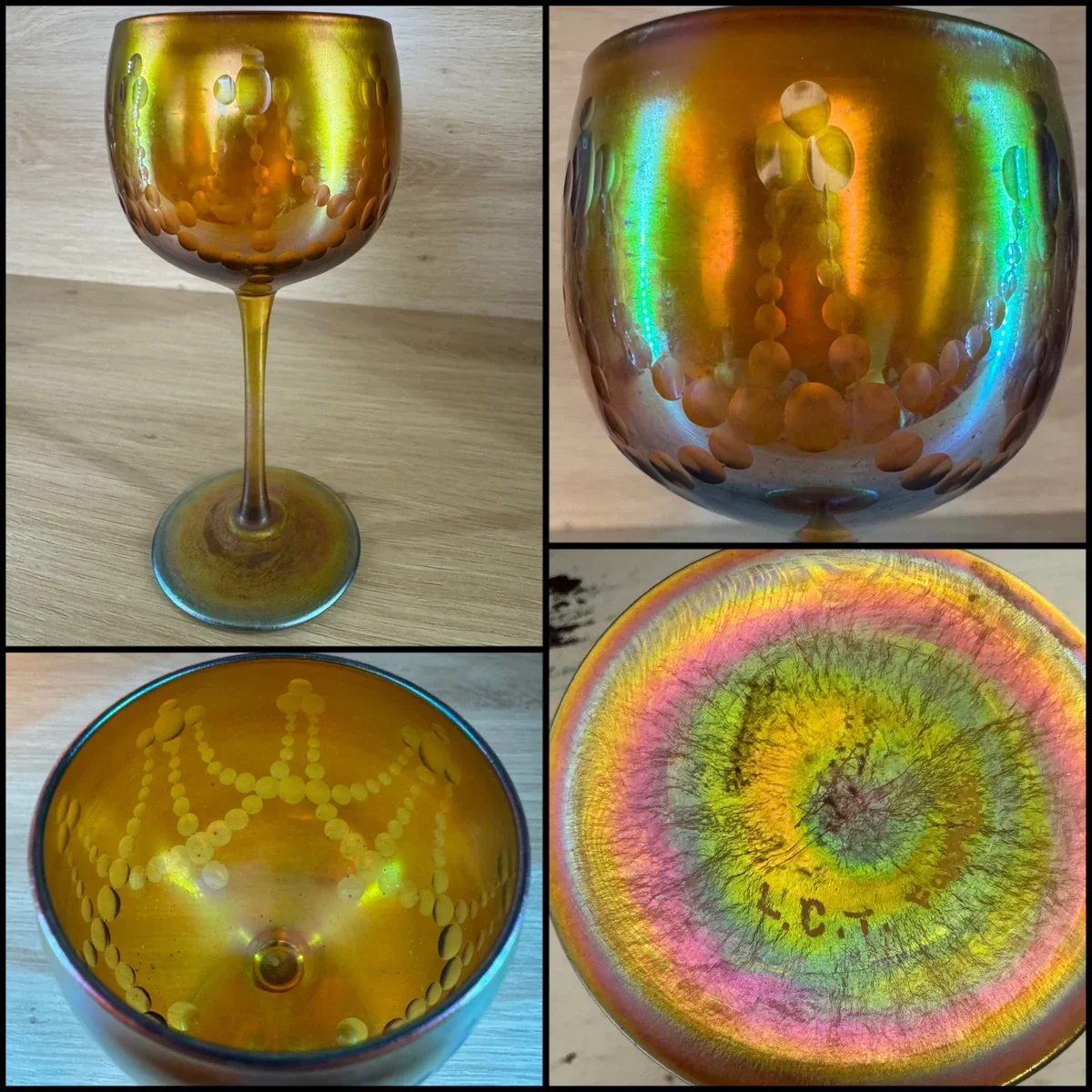
This iridescent stemmed cordial glass in the holdings of the Mayflower Descendants Museum is signed on the underside “L.C.T.” and “Favrile,” marks associated with glass produced under the direction of Louis Comfort Tiffany (1848–1933). Its golden surface flashes green, blue, rose, and violet as the light changes, while applied glass decoration forms looping garlands around the bowl.
The Museum currently dates the glass broadly to approximately c. 1900–1910, pending further research. Comparable Tiffany Favrile drinking glasses signed simply “L.C.T.” have been dated to this period. Christie’s, for example, has documented an L.C.T.-engraved Favrile wine goblet from about 1900, while Heritage Auctions has cataloged gold Favrile goblets marked “L.C.T.” and decorated with applied prunts to about 1910. (Christie's)
The engraved initials visible on the bottom of the Museum’s glass can be seen in the accompanying photograph.
What Was Favrile Glass?
Louis Comfort Tiffany began producing decorative blown glass in the early 1890s at his glassworks in Corona, Queens, New York. The Metropolitan Museum of Art explains that Tiffany and his glassworkers developed techniques for blending different colors in the molten glass itself, creating subtle variations of color and texture. Tiffany called this glass Favrile, drawing on an Old English word associated with something handmade or hand-wrought. (The Metropolitan Museum of Art)
The Corning Museum of Glass notes that Tiffany trademarked the name Favrile in 1894. The glass became particularly famous for its rich colors and brilliant iridescent surfaces. (Corning Museum of Glass)
That iridescence is especially visible in this object. Depending upon the angle of light, the bowl can appear amber-gold, green, turquoise, pink, or violet. This changing surface was not simply painted onto ordinary glass; it was part of the sophisticated glassmaking processes that made Tiffany’s Favrile wares internationally recognizable.
The applied circular decoration is also characteristic of Tiffany’s experimentation with molten glass. Related Tiffany goblets survive with applied dots, trails, and what collectors call prunts—small pieces of hot glass applied to a vessel while it was being made. Comparable L.C.T.-marked goblets with such decoration have been dated to approximately 1910. (Heritage Auctions)
Because Tiffany glass was handmade, variations in form, decoration, and iridescence were part of its character rather than manufacturing flaws. Even objects belonging to the same general design could differ from one another.
Louis Comfort Tiffany and the Mayflower
The General Society of Mayflower Descendants identifies Tiffany as a Mayflower descendant through passengers Francis Cooke, Richard Warren, Isaac Allerton, and Stephen Hopkins. (The Mayflower Society)
That connection became especially visible in Plymouth itself.
In 1897, Tiffany’s firm created stained glass for the First Parish Church in Plymouth—today the Mayflower Meetinghouse. The General Society of Mayflower Descendants states that Tiffany designed its historic Mayflower Society ship emblem in stained glass above the church’s window depicting the signing of the Mayflower Compact. (The Mayflower Society)
The Society still uses that historic ship imagery as part of its identity today.
This creates a particularly interesting connection for the Museum: Tiffany was not merely an important American designer who happened to descend from Mayflower passengers. His work also became physically incorporated into the later commemoration of Mayflower history in Plymouth.
From Monumental Windows to a Drinking Glass
Tiffany is often remembered for monumental stained-glass windows and elaborate leaded-glass lamps, but his artistic ambitions extended far beyond those forms.
The Metropolitan Museum of Art (MET) notes that the Havemeyer family gave more than forty examples of Tiffany Favrile glass to the MET in 1896, only a few years after Tiffany began producing decorative blown glass. It was the first American glass to enter the Met’s collection. (The Metropolitan Museum of Art)
Tiffany applied the same attention to color, light, and surface to relatively small domestic objects.
That is what makes this cordial glass interesting. It transforms an ordinary functional form—a drinking vessel—into a miniature study of light. Its shape is simple, but the iridescent surface changes constantly as it is turned, while the applied glass decoration catches and reflects additional light.
Even at this scale, the object reflects one of Tiffany’s central artistic concerns: glass was not simply a transparent material through which light passed; it could itself become color, texture, and light.
A Mayflower Descendant in American Decorative Arts
Placed beside the Elder Brewster tea service and the James W. Tufts salt-and-pepper set, this glass helps tell another part of the Museum’s story.
The three objects span very different moments in American decorative arts: a nineteenth-century reproduction of a debated Mayflower relic; silver-plated tableware manufactured by Brewster descendant James W. Tufts for an expanding consumer market; and Favrile glass created under the direction of Louis Comfort Tiffany, himself descended from multiple Mayflower passengers.
Together, they demonstrate that the story of Mayflower descendants did not end with genealogy. Later generations participated in American manufacturing, design, collecting, entrepreneurship, and the decorative arts.
Sources & Further Reading
General Society of Mayflower Descendants — identifies Louis Comfort Tiffany as a descendant of Mayflower passengers Francis Cooke, Richard Warren, Isaac Allerton, and Stephen Hopkins, and discusses the Tiffany Mayflower window in Plymouth.
General Society of Mayflower Descendants — Tiffany and the Mayflower
General Society of Mayflower Descendants — Mayflower Meetinghouse and Tiffany stained glass.
Mayflower Meetinghouse Project
The Metropolitan Museum of Art — Louis Comfort Tiffany and the development of Favrile glass. (The Metropolitan Museum of Art)
Corning Museum of Glass — Favrile glass, trademarked in 1894, and Tiffany’s use of rich color and iridescence. (Corning Museum of Glass)
Christie’s — Tiffany Studios Favrile wine goblet, c. 1900, engraved “L.C.T.” (Christie's)
Heritage Auctions — Tiffany Studios gold Favrile goblets, c. 1910, marked “L.C.T.,” including an example with applied pigtail prunts. (Heritage Auctions)
The Charles Hosmer Morse Museum of American Art — Tiffany art glass and historic Tiffany markings, including “L.C.T.” and “L. C. Tiffany–Favrile.” (morsemuseum.org)