
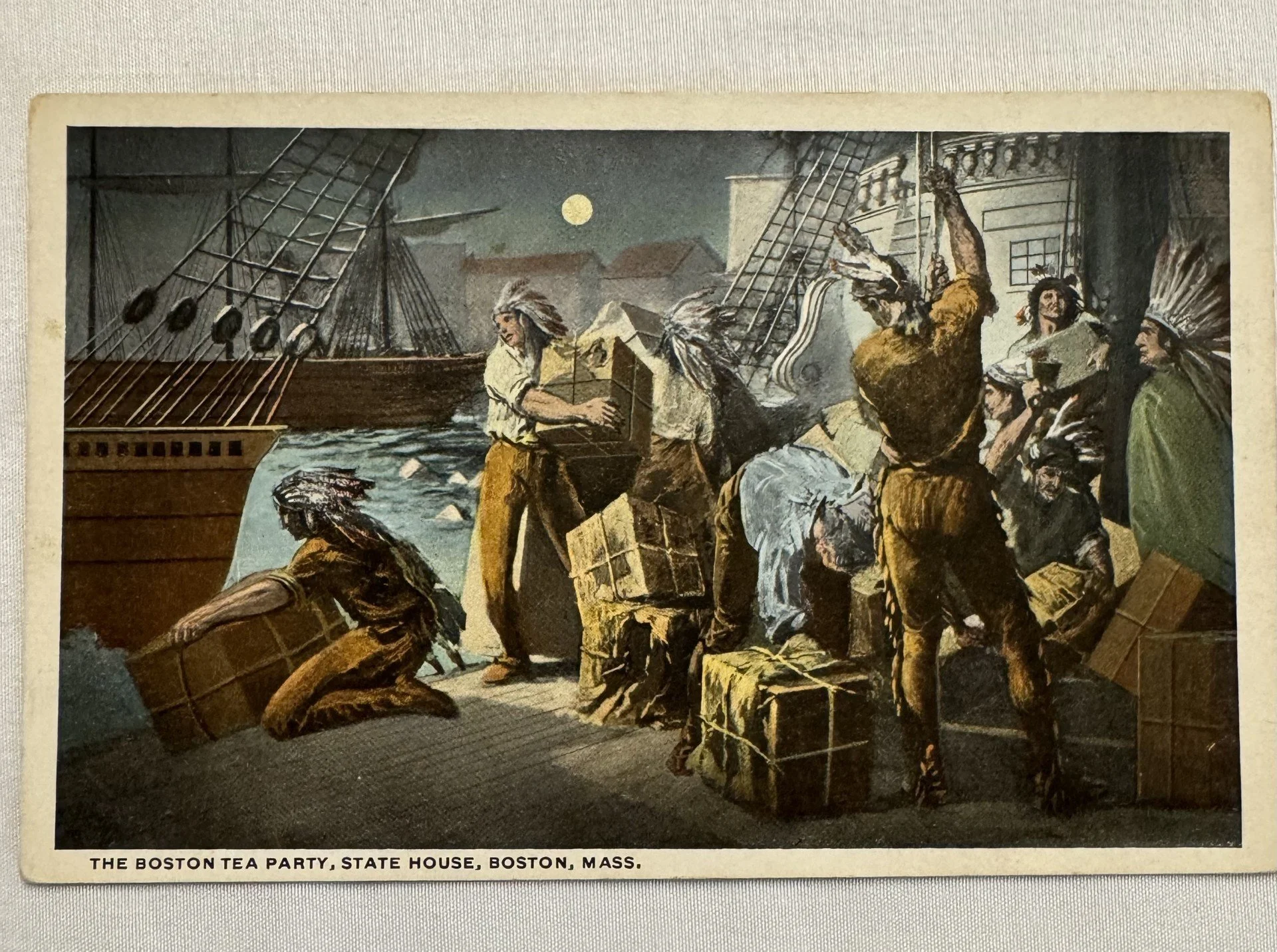
Mayflower Descendants a Part of the Boston Tea Party
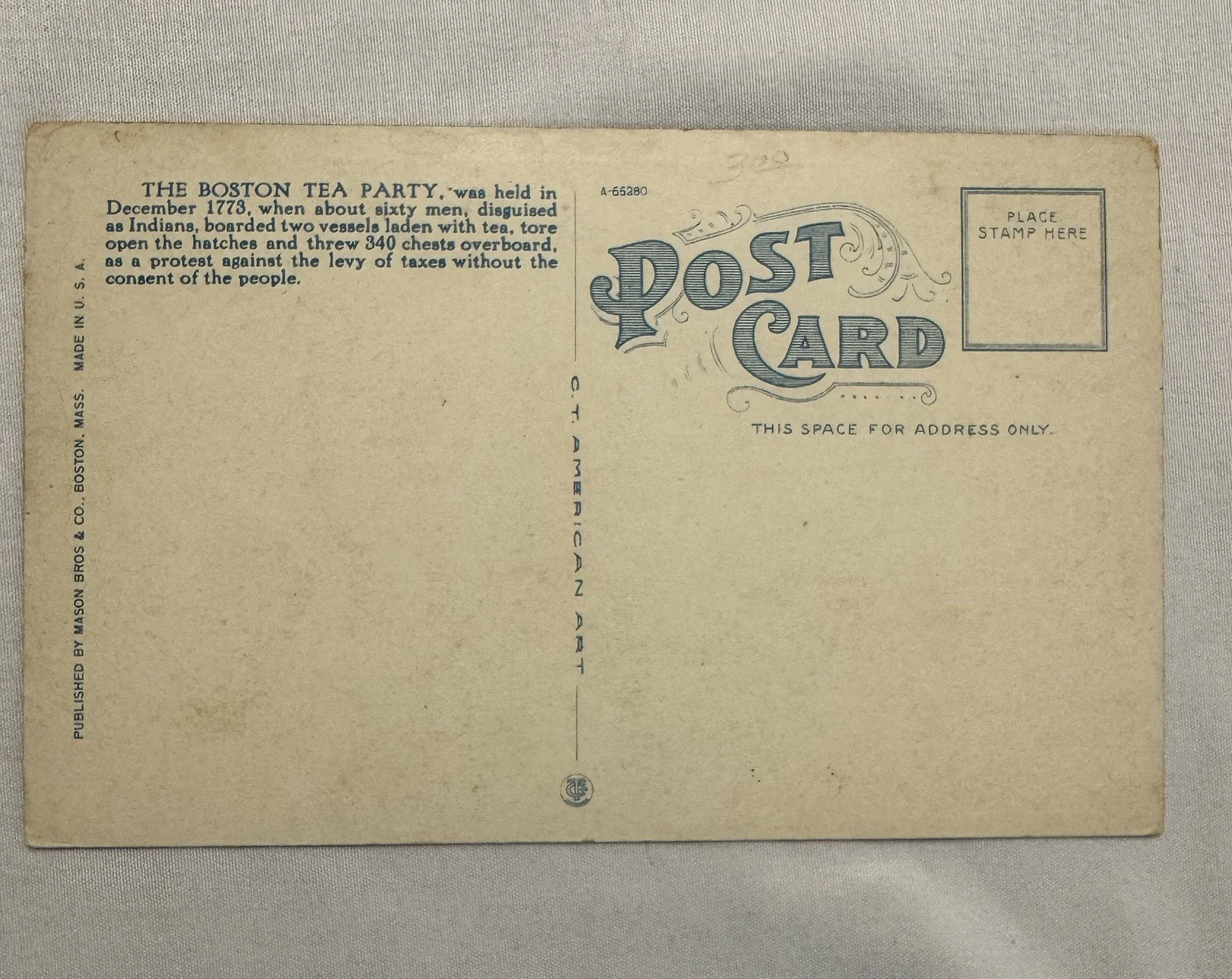
Pictured: Postcard of the Boston Tea Party
Among the men connected with the Boston Tea Party of December 16, 1773 were descendants of passengers who had arrived aboard the Mayflower more than 150 years earlier.
Two examples are Samuel Sprague (1753–1844) and Henry Bass (1740–1813). Their stories illustrate how descendants of Plymouth Colony families continued to appear in later chapters of American history.
Samuel Sprague
Samuel Sprague was twenty years old when he participated in the Boston Tea Party.
He later served during the American Revolution from 1775 to 1777 and participated in engagements at White Plains, Trenton, and Princeton. Research by the Hingham Historical Society notes that Sprague’s Revolutionary War pension states that he crossed the Delaware with George Washington.
Sprague was also a descendant of Mayflower passenger Richard Warren.
His life therefore connects two defining moments separated by generations: the arrival of the Mayflower in 1620 through his Warren ancestry, and the growing movement for American independence more than a century and a half later.
Samuel’s son, Charles Sprague (1791–1875), became a prominent Boston poet and banker, sometimes known as the “Banker Poet of Boston.”
Several generations later, Samuel Sprague’s family also entered the American and international art world. His great-grandsons Charles Sprague Pearce (1851–1914) and William Houghton Sprague Pearce (1864–1935) both became artists.
Charles established an important career in France, studied with Léon Bonnat, exhibited at the Paris Salon, received appointment as a Chevalier of the French Legion of Honor, and created monumental work for the Library of Congress.
William remained more closely associated with Massachusetts, painting landscapes, cattle scenes, coastal subjects, and portraits. Family records preserve decades of correspondence between the brothers in which they discussed painting, composition, technique, light, and the business of art.
The Pearce brothers are therefore a later chapter in Samuel Sprague’s family story rather than the beginning of it.
Henry Bass
Samuel Sprague was not the only Mayflower descendant associated with the Boston Tea Party.
Henry Bass (1740–1813) was a Boston merchant, member of the Loyal Nine, and prominent Son of Liberty. He participated in the destruction of the tea and helped guard the tea ships at Griffin’s Wharf in the weeks leading up to December 16, 1773.
Bass had already been involved in resistance to British policies during the Stamp Act crisis and later testified concerning the British soldiers involved in the Boston Massacre.
His connection to the Mayflower came through the Alden and Mullins families.
Bass descended from John Alden and Priscilla Mullins through their daughter Ruth Alden, who married John Bass. Through Priscilla, he also descended from her parents, William Mullins and Alice Mullins.
Henry Bass was therefore a descendant of four Mayflower passengers:
John Alden
Priscilla Mullins
William Mullins
Alice Mullins
Across Generations
Samuel Sprague and Henry Bass represent two different Mayflower family lines converging on the same historic event in Boston in 1773.
Their presence also demonstrates why Mayflower history does not end at Plymouth.
Descendants of those seventeenth-century families continued to participate in the political, military, literary, cultural, and artistic history of the country for generations afterward.
In Samuel Sprague’s family alone, that thread can be followed from Mayflower passenger Richard Warren, to a Boston Tea Party participant and Revolutionary soldier, to the celebrated Boston poet Charles Sprague, and eventually to artist brothers Charles Sprague Pearce and William Houghton Sprague Pearce.
The Mayflower Descendants Museum continues to research these intersections and the connections of these families to additional Mayflower passengers.
The Postcard
At the center of this preview is an early twentieth-century postcard from the Mayflower Descendants Museum collection, depicting the Boston Tea Party.
The image reproduces Robert Reid’s monumental Boston Tea Party mural in the Massachusetts State House. Reid’s oil-on-canvas mural was completed in 1904, with assistance from Edward Trumbull, and installed in Nurses Hall at the State House. It was unveiled on December 3, 1904.
The postcard itself adds another layer to that history. Printed across the bottom of the image is:
“THE BOSTON TEA PARTY, STATE HOUSE, BOSTON, MASS.”
The reverse identifies the publisher as Mason Bros. & Co., Boston, Massachusetts, and states “Made in U.S.A.”
That Boston connection is significant. The postcard was produced in the same city where the Tea Party occurred and where Reid’s monumental interpretation of the event had been installed as part of the Massachusetts State House art collection.
In this small object, several different periods of history intersect. An event that occurred in 1773 was interpreted by an American artist in a monumental public mural in 1904, and that image was subsequently reproduced by a Boston publisher as a postcard that could be purchased, carried, mailed, and seen far beyond the State House.
The postcard is unused and undated, but its divided-back format and subject place it within the early twentieth-century postcard era. A period photograph of Reid’s mural preserved by the Library of Congress has been dated to approximately 1904–1912, demonstrating how quickly the newly completed State House mural began to circulate through reproduced imagery.
The reverse of the Museum’s postcard also contains a brief contemporary description of the Tea Party, providing another example of how the event was interpreted and presented to the American public during the early twentieth century.
Sources and Further Reading
Boston Tea Party Ships & Museum — Samuel Sprague
Biographical profile of Boston Tea Party participant Samuel Sprague (1753–1844), including his role in the events of December 16, 1773, and his later Revolutionary War service.
Read the Samuel Sprague biography
Boston Tea Party Ships & Museum — Henry Bass
Biographical profile of Henry Bass (1740–1813), a Boston merchant, member of the Loyal Nine and Sons of Liberty, and documented participant in the Boston Tea Party.
Read the Henry Bass biography
Hingham Historical Society / Hingham Heritage Museum — The Sprague Family
Research on the Sprague family, including Samuel Sprague’s Revolutionary War service and evidence from his pension record concerning his military experiences.
Explore the Hingham Historical Society research
William Houghton Sprague Pearce — Family Biography
A family-supplied biography of artist William Houghton Sprague Pearce, documenting his relationship to his brother Charles Sprague Pearce, his descent from Mayflower passenger Richard Warren, and the family’s connections to Boston Tea Party participant Samuel Sprague and poet Charles Sprague.
Read the William Houghton Sprague Pearce biography
Mayflower DNA — Bass Family Genealogy
Genealogical research tracing the Bass family through Ruth Alden, daughter of Mayflower passengers John Alden and Priscilla Mullins. The page cites the General Society of Mayflower Descendants’ Mayflower Families Through Five Generations, Volume 16, including the section devoted to descendants of Ruth (Alden) Bass.
Explore the Bass family genealogy
Alden Kindred of America — Mayflower Families Through Five Generations
Background on the General Society of Mayflower Descendants’ Five Generations Project, including Volume 16, devoted to the descendants of John Alden.
Read about the Five Generations Project