Rare 19th Century Child’s Tea Service
Mayflower Descendant James W. Tufts
More than a century after tea was thrown into Boston Harbor, tea had become so firmly embedded in American domestic life that even children were given miniature versions of the services used by adults.
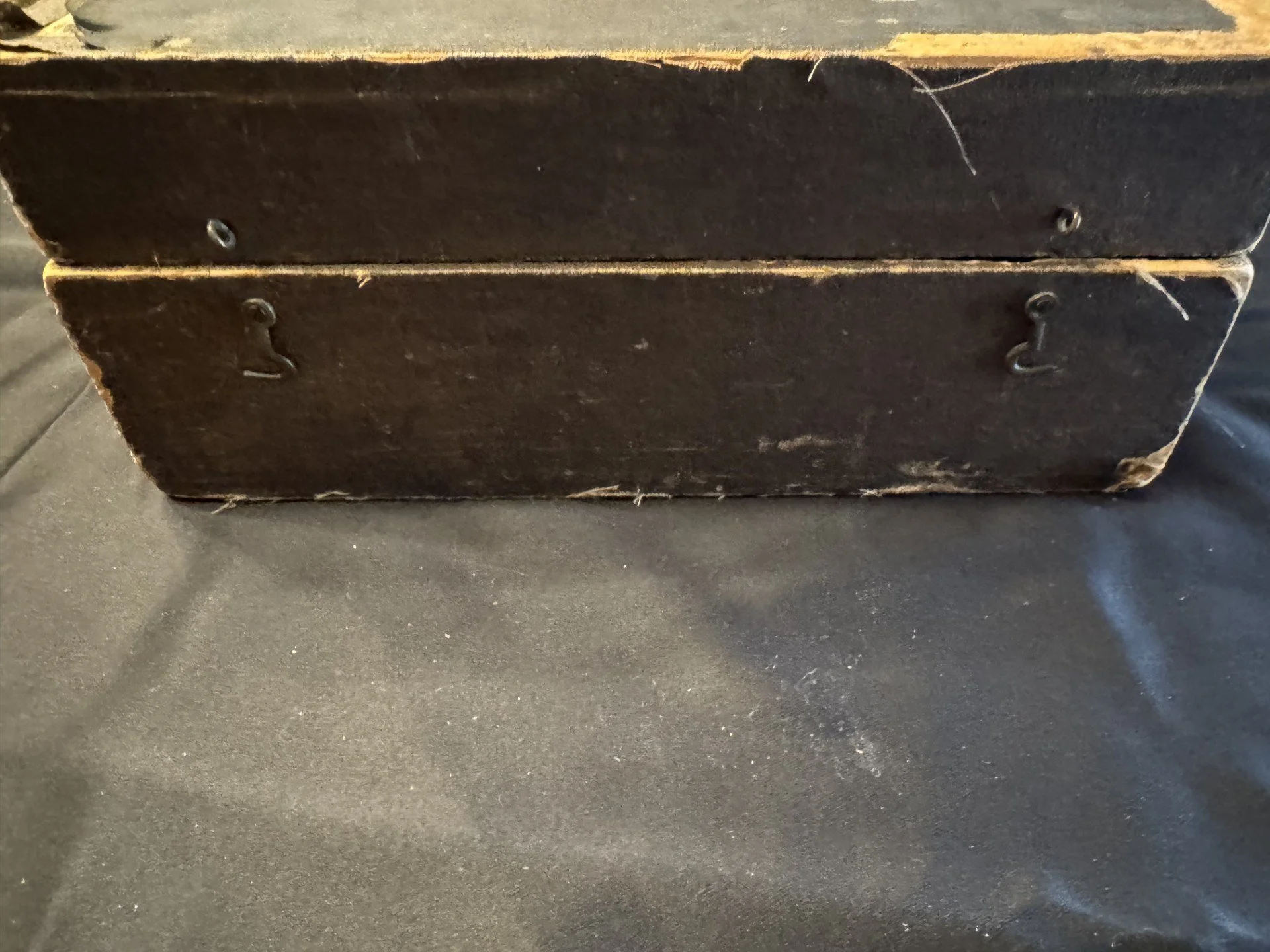
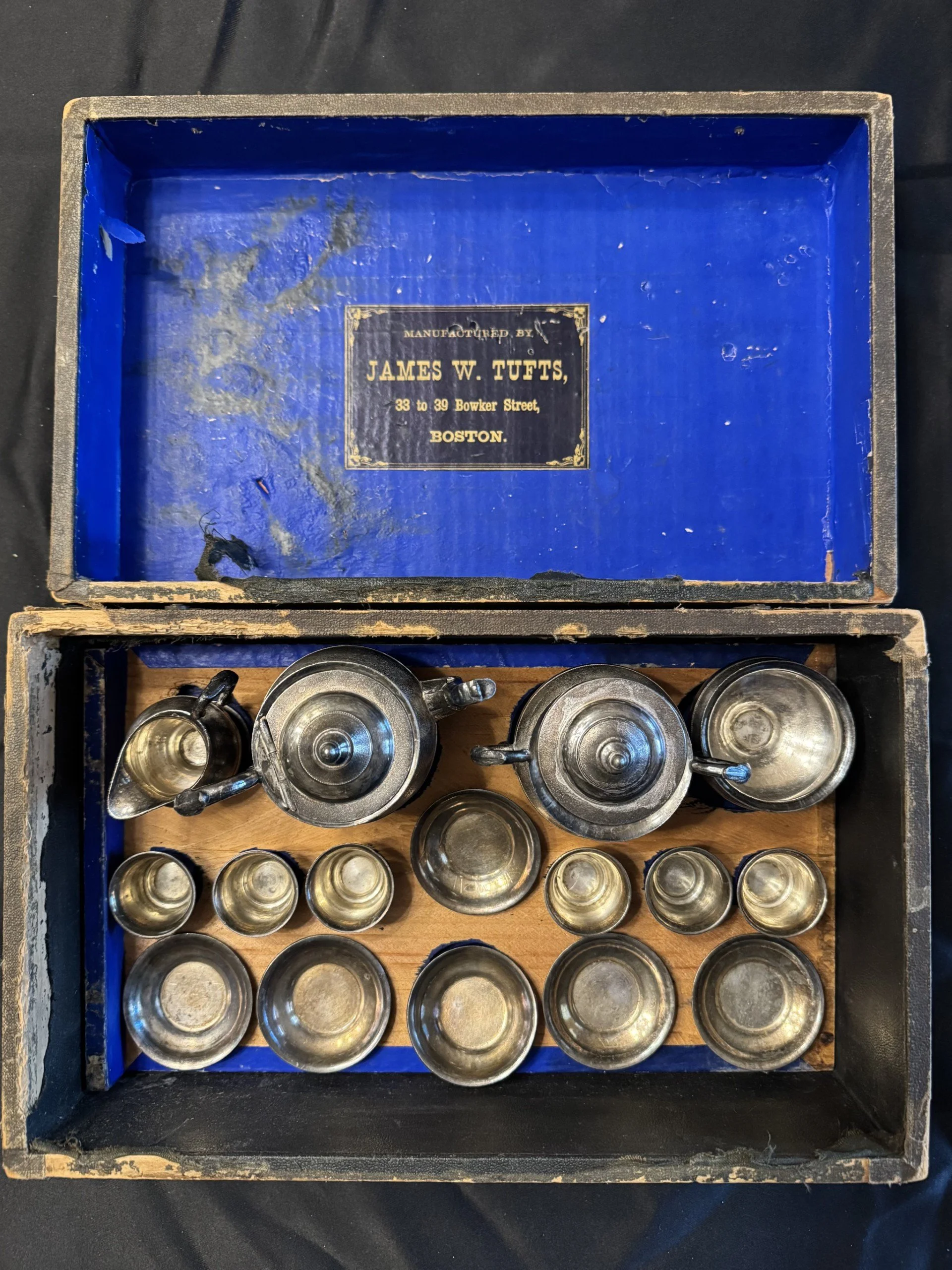
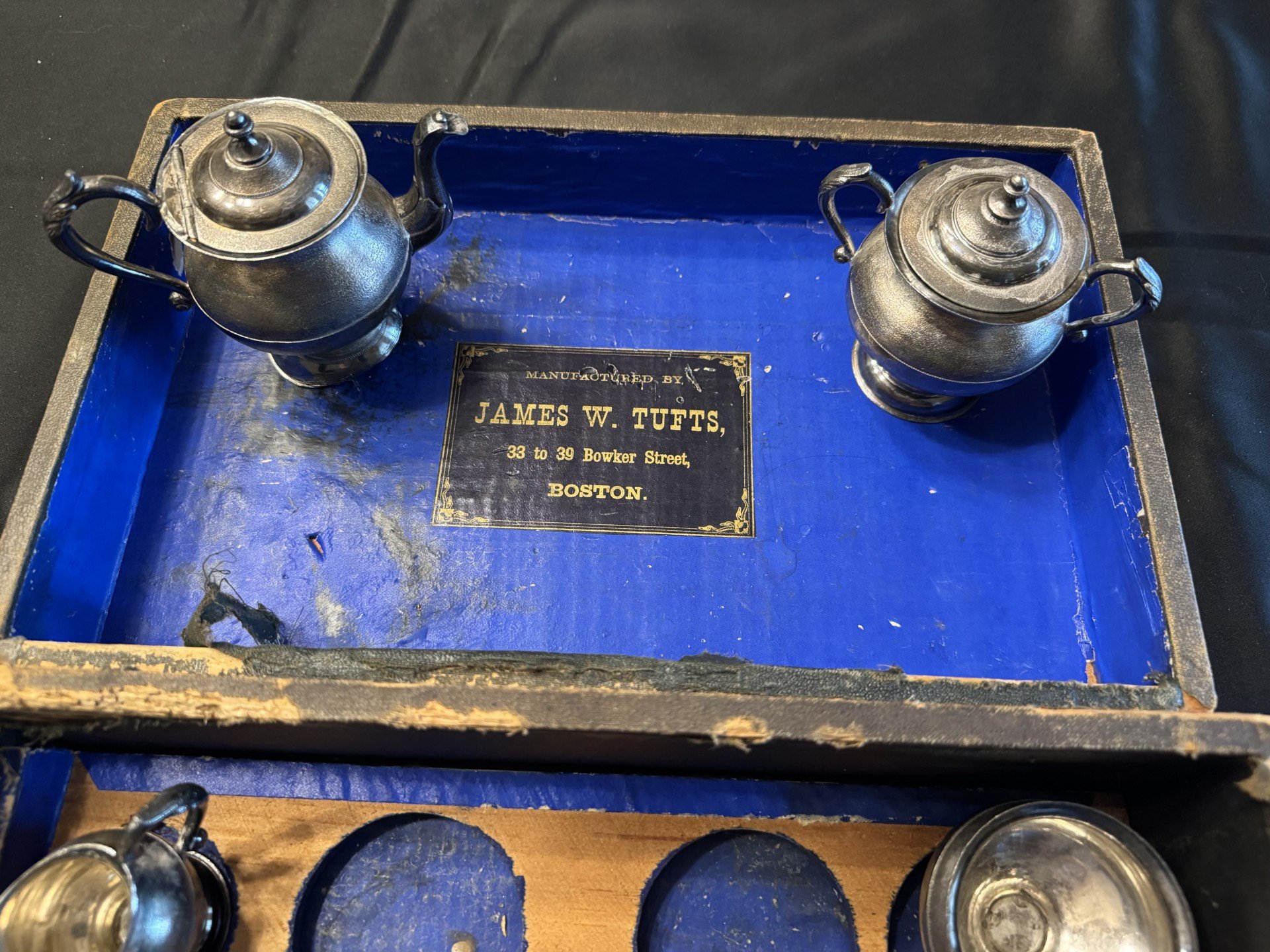
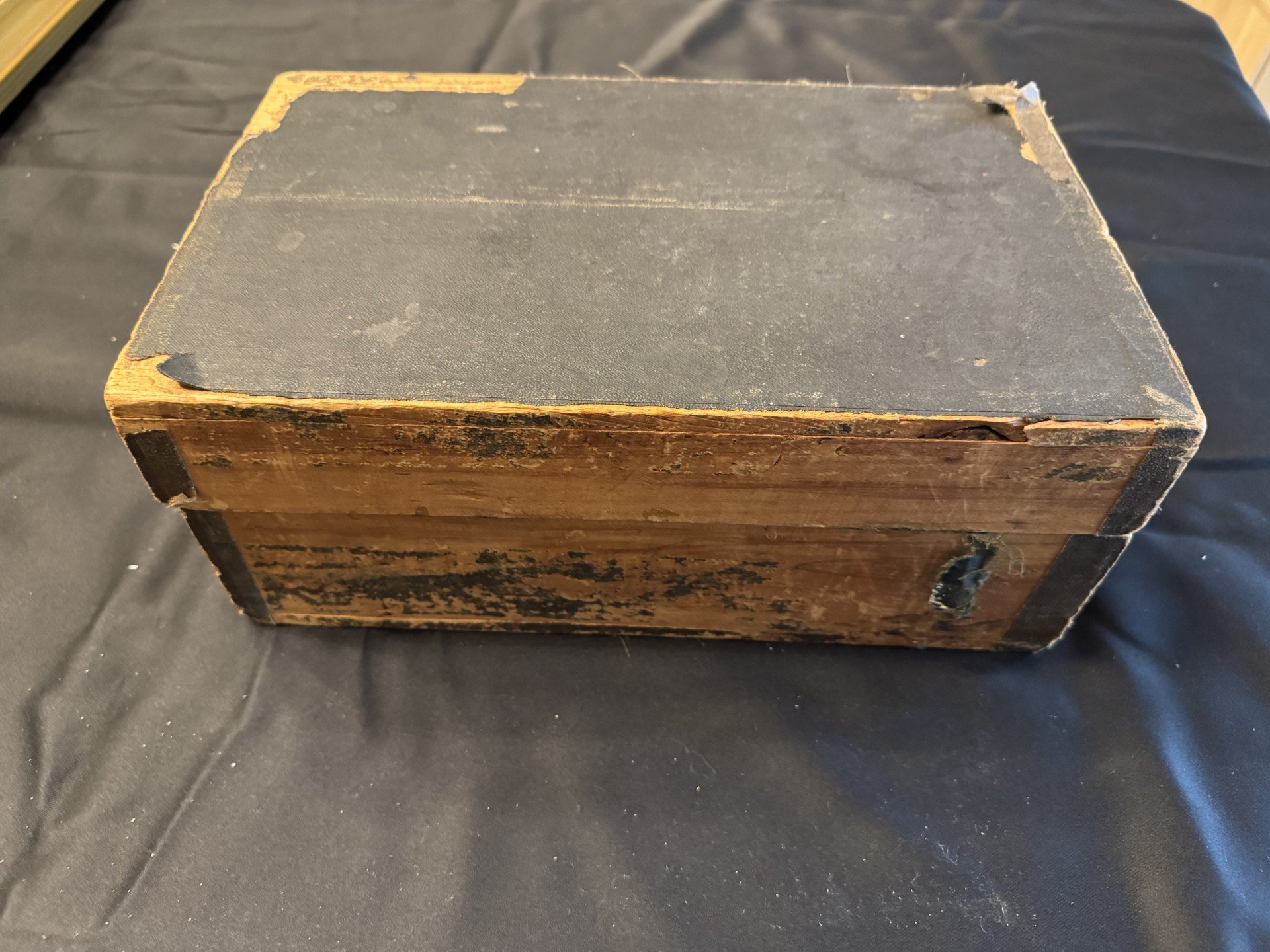
Shown here is a child-sized tea service manufactured in Boston by James W. Tufts and preserved in its fitted case. The label inside the lid reads, “Manufactured by James W. Tufts, 33 to 39 Bowker Street, Boston.” The miniature pieces reproduce the familiar forms of an adult tea table, including teapots, cups, saucers, a milk pitcher, sugar bowl, and other serving pieces.
A surviving James W. Tufts catalogue printed in the spring of 1876 advertised a “Children’s Tea Service” remarkably similar to this example. Tufts emphasized that these were not cheaply cast pewter toys. His catalogue described the pieces as being made from high-quality Britannia metal, formed by hand, heavily silver-plated, and finished with the care given to household wares. The milk pitcher, sugar and slop bowls, cups, and saucers were advertised with gold-lined interiors, and the entire service was fitted into a substantial presentation case. (Nederlandse Tinvereniging)
The price was $6.00. Using historical consumer-price estimates maintained by the Federal Reserve Bank of Minneapolis, that would equal approximately $188 in 2026 purchasing power — or roughly $190 today. Because U.S. consumer-price figures before 1913 are reconstructed historical estimates, the modern equivalent should be understood as approximate. (Federal Reserve Bank of Minneapolis)
The catalogue also documents the service’s popularity. Tufts wrote that it had first been introduced shortly before Christmas of the previous year and that demand was so great that he had initially been unable to supply everyone who wanted one. (Nederlandse Tinvereniging)
The object therefore offers more than a glimpse of nineteenth-century childhood. Children could use such sets to imitate one of the most recognizable rituals of adult domestic and social life. Tea was not merely something to drink; the table, service pieces, pouring, serving, and visiting surrounding it formed part of a larger social ritual that children could reenact through play.
A Mayflower Descendant and Boston Manufacturer
James Walker Tufts (1835–1902) was himself a Mayflower descendant. A biographical history of Massachusetts traces his ancestry to Mayflower passengers Elder William Brewster and his wife, Mary Brewster. The General Society of Mayflower Descendants confirms that William and Mary traveled together aboard the Mayflower in 1620 and left descendants through their family. (Wikimedia Commons)
Tufts’s connection with the American table extended far beyond this miniature service. Beginning his career as a teenage apprentice in the drug business, he eventually developed and patented his Arctic Soda Apparatus and built a highly successful Boston manufacturing enterprise. The elaborate soda fountains his company produced incorporated marble and silver-plated fixtures, and the firm expanded into a wide assortment of silver-plated household and decorative wares. (NCPedia)
Surviving Tufts objects demonstrate just how broad that production became. The company manufactured numerous forms of tableware, including full-sized tea services, pitchers, dishes, serving pieces, and other silver-plated objects. A James W. Tufts three-piece tea service dating to about 1885, for example, is decorated with birds, bamboo, hanging baskets, and textile-inspired patterns; Christie’s notes that another service of the same pattern is in the collection of the Wadsworth Atheneum. (Christie's) The Smithsonian Libraries and Archives has also digitized the company’s 1900 catalogue, Fine Silverplated Ware, preserving evidence of the range of objects the firm offered. (Smithsonian Libraries)
Tufts eventually became one of the leading figures in the American soda-fountain industry. In 1891, his company joined three other major manufacturers to form the American Soda Fountain Company, and Tufts served as its president. (NCPedia)
Tufts’s career later expanded in a different direction.
In 1895, Tufts purchased thousands of acres in the Sandhills of North Carolina with the intention of creating a health-oriented resort community accessible to people of more modest means. That community became Pinehurst. Landscape planning was undertaken by the firm of Frederick Law Olmsted, and Pinehurst subsequently developed into one of the most significant centers in the history of American golf. (Pinehurst Resort)
The Tufts family remained closely associated with Pinehurst for generations, and the Tufts Archives there now preserves records relating to the family and the community he founded. (Vopnc)
Tea Across Three Centuries
This child’s service provides a fitting conclusion to the Museum’s three-part exploration of tea.
In Preview 1, tea appears at the center of political resistance in the Boston Tea Party of 1773, an event that included Mayflower descendants among its participants.
In Preview 2, Mayflower descendant Charles Dana Gibson places tea within the social world of the Gibson Girl, where tea tables become settings for conversation, friendship, courtship, gossip, and changing expectations for women.
In Preview 3, through the work of fellow Mayflower descendant James W. Tufts, the ritual has reached childhood itself. By the 1870s, tea culture was so familiar that its vessels and rituals could be reproduced in miniature for children — manufactured in Boston, silver-plated like adult tableware, and presented in an elaborate fitted case.
From protest, to social ritual, to childhood play, these three objects reveal very different chapters in the American history of tea.
Holdings of the Mayflower Descendants Museum
Sources and Further Reading
James W. Tufts, Children’s Tea Service advertisement, spring 1876
A reproduction of the original catalogue page describing the Britannia-metal, silver-plated and gold-lined child’s tea service, its $6 price, fitted case, and its popularity following its introduction. View the 1876 Tufts catalogue page and discussion
Federal Reserve Bank of Minneapolis — Historical Consumer Price Index
Historical price-index estimates used to place the $6 purchase price in modern purchasing-power context. Explore the historical CPI data
NCpedia — James Walker Tufts
Biographical history covering Tufts’s Boston business career, soda fountains, silver-plated wares, Pinehurst, and descent from William Brewster. Read the James Walker Tufts biography
General Society of Mayflower Descendants — The Brewster Family
Passenger history of William and Mary Brewster and their family aboard the Mayflower. Read the Brewster family profile
Smithsonian Libraries and Archives — Fine Silverplated Ware, 1900
Digitized James W. Tufts Company trade catalogue documenting the firm’s silver-plated production. View the Tufts catalogue
Christie’s — James W. Tufts Three-Piece Tea Service, circa 1885
An example of Tufts’s full-sized silver-plated tea wares, with reference to a related service in the Wadsworth Atheneum. View the Tufts tea service
Village of Pinehurst — Pinehurst History and the Tufts Archives
Historical resources concerning the community founded by James Walker Tufts and the surviving Tufts family archives. Explore Pinehurst history