
Stamped and Annotated Encyclopédie de la Plante Plates
The Mayflower Descendants Museum Holds the Largest Known Publicly Documented Collection of Over 70 Tiffany Studios
Louis Comfort Tiffany (1848–1933) was one of America’s leading artists and decorative designers of the late nineteenth and early twentieth centuries. The son of Tiffany & Co. founder Charles Lewis Tiffany (1812–1902), he established and directed a succession of decorative-arts firms that ultimately included Tiffany Studios, producing celebrated stained glass, lamps, mosaics, pottery, metalwork, enamels, jewelry, and interiors.
Tiffany was also a Mayflower descendant, tracing his ancestry to passengers Isaac Allerton, Francis Cooke, Stephen Hopkins, and Richard Warren. Together with the talented artists and designers he employed, Tiffany helped define the naturalistic aesthetic that became synonymous with American Art Nouveau and earned international acclaim. France, one of the principal centers in the emergence of the Art Nouveau movement, formally recognized Tiffany’s artistic contributions by naming him a Chevalier of the Legion of Honor, the nation’s highest order of merit. His artistic achievements were also recognized in the United States, where he was elected a National Academician, the highest level of membership in the National Academy of Design.
The Collection
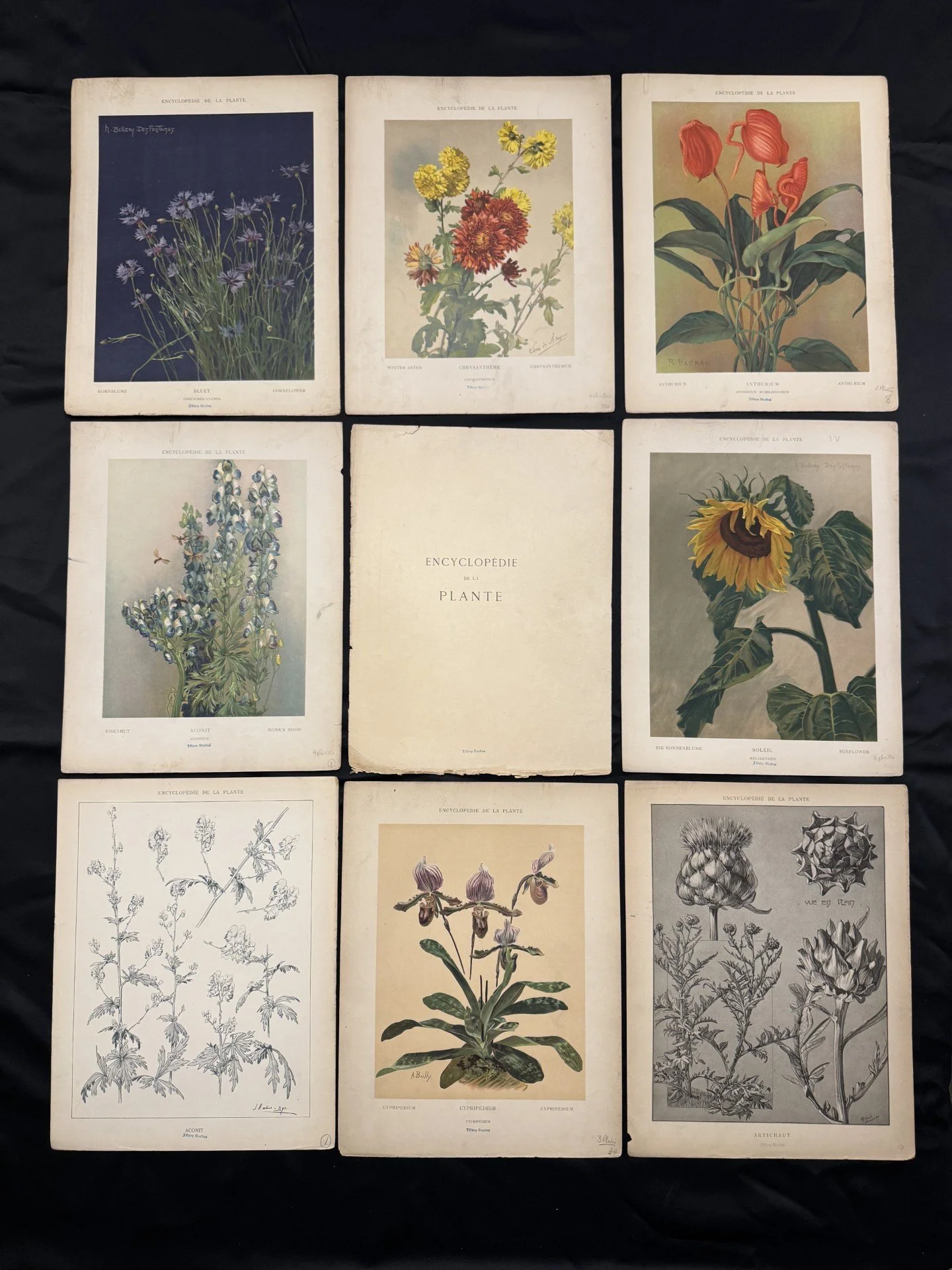
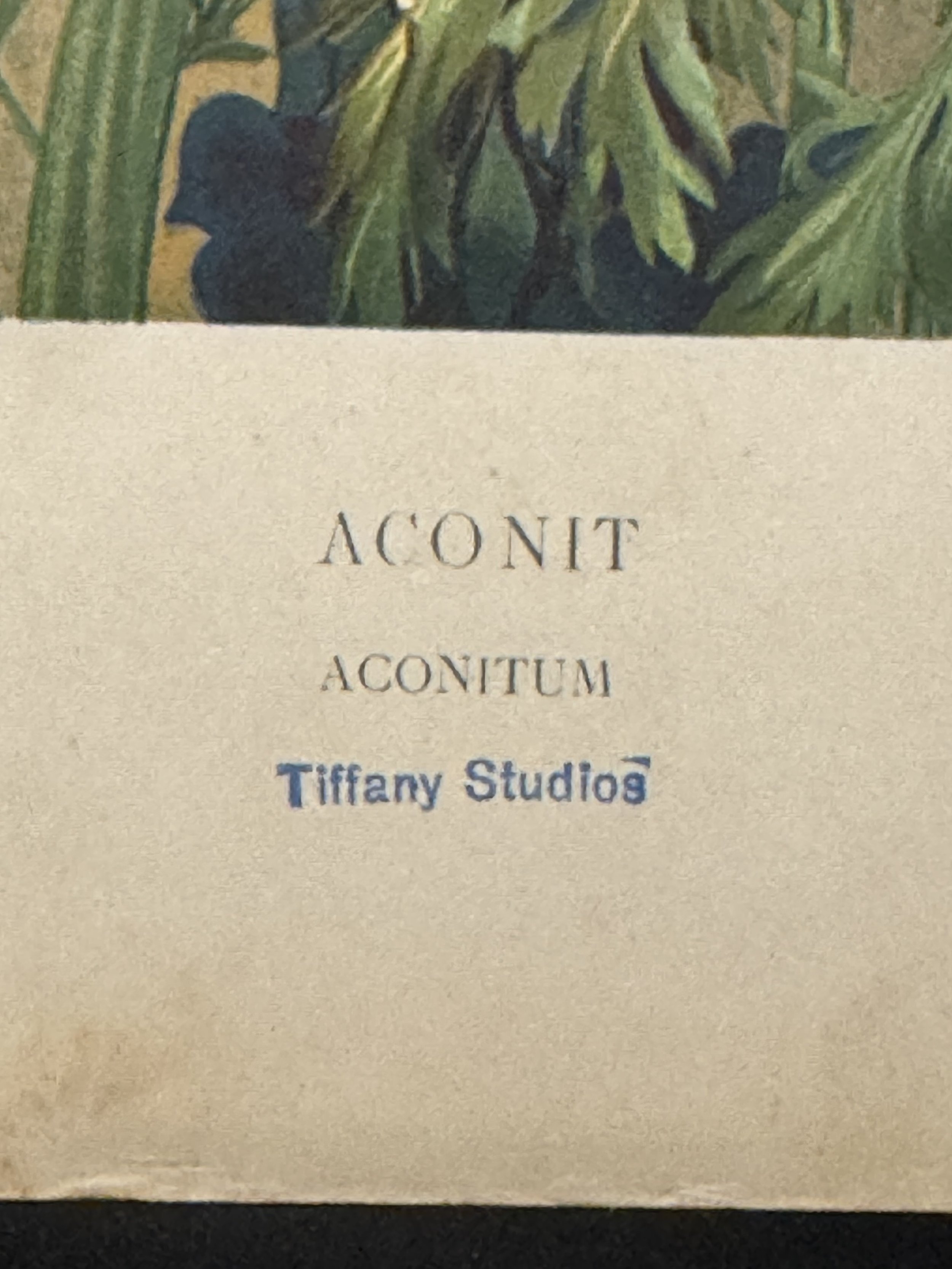
From the world of Tiffany Studios, the Mayflower Descendants Museum holds an extraordinary group of more than 70 botanical plates from Tome I of the early-twentieth-century French publication Encyclopédie Artistique et Documentaire de la Plante. The Museum’s holdings comprise 72 individual botanical plates together with the title page. The plates bear Tiffany Studios stamps, and many retain handwritten pencil annotations.
Based on the Museum’s research into publicly accessible museum, library, exhibition, auction, and institutional records reviewed to date, we have not identified another publicly documented institutional collection of Tiffany Studios–stamped Encyclopédie de la Plante plates approaching this size.
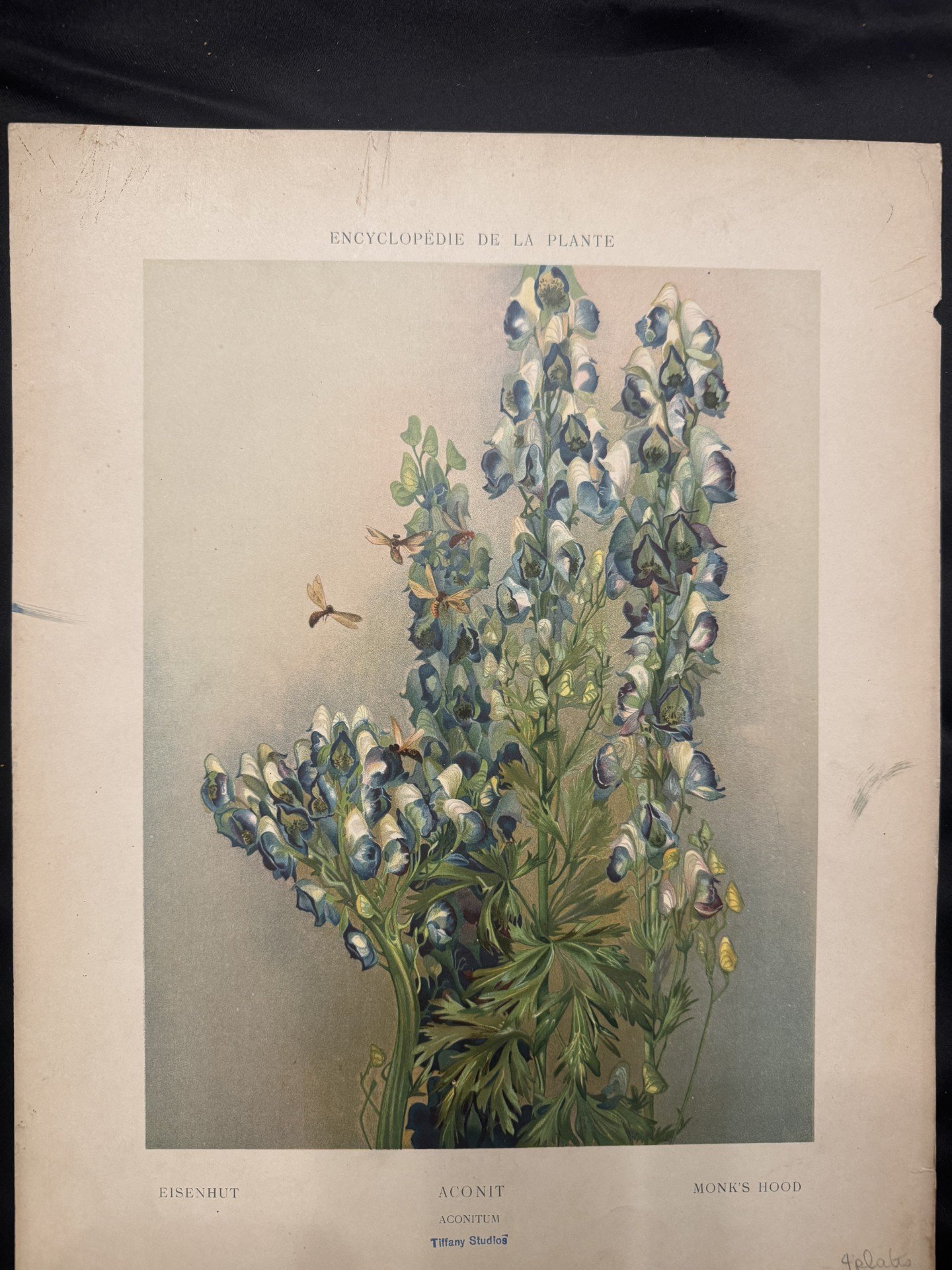
Pictured is a fraction of the total collection. The dragonflies flying around Monk’s Hood have been enlarged for closer viewing. Dragonflies became iconically associated with Tiffany Studios, including the celebrated Dragonfly design created by Clara Driscoll before the publication of this volume.
The Book
The plates come from Encyclopédie Artistique et Documentaire de la Plante, an ambitious four-volume French publication issued in Paris from 1904 to 1908 under the direction of artist and designer Maurice Pillard Verneuil (1869–1942).
Created specifically for the decorative arts, the encyclopedia brought together watercolors, drawings, and photographs examining the forms of the natural world as inspiration for artists and designers. Its contributors included Alphonse Mucha, Mathurin Méheut, Alice Bailly, Louis-Marie de Schryver, Habert-Dys, Védy, Barberis, and photographer Pierre Plauszewski. The complete publication contained 384 plates.
The Museum’s examples come from Tome I.
Their presence within Tiffany Studios offers a glimpse into the working world of the firm—its use of botanical reference material, its fascination with nature, and the artists and designers who transformed flowers, leaves, vines, insects, and other natural forms into some of the most recognizable works in American decorative art.
Clara Driscoll and the Tiffany Girls
At the center of Tiffany Studios’ nature-inspired glasswork was Clara Driscoll (1861–1944) and the women of the Women’s Glass Cutting Department, now widely known as the “Tiffany Girls.”
Driscoll joined Tiffany’s company in 1888 and later supervised a department of approximately 35 women glasscutters. Her importance—and that of the women she supervised—was largely obscured for decades because the objects they created were produced under the Tiffany name.
Research by the New-York Historical Society has helped restore their role to the story of Tiffany Studios. The Historical Society explains that the women’s department, run by Driscoll, oversaw the design and production of all of Tiffany Studios’ nature-inspired leaded-glass lampshades. It also identifies Driscoll and the Tiffany Girls as creators of some of the studio’s most famous works.
Driscoll herself designed the celebrated Dragonfly lamp, while one of the Tiffany Girls selected its glass. In 1900, a version of the design received a prize at the Paris World’s Fair.
This makes the natural imagery found throughout the Museum’s Tiffany Studios–stamped botanical plates particularly intriguing. Flowers, leaves, vines, insects, and other elements of the natural world were not peripheral to the work of the women at Tiffany Studios—they were central to the designs for which the firm became famous.
The surviving handwritten annotations add another layer of interest. Their authorship has not yet been established, and the Museum does not attribute them to Driscoll or another Tiffany Studios artist without supporting evidence. Studied across more than 70 plates, however, recurring handwriting, numbering, markings, stamp placement, botanical subjects, and signs of handling may eventually provide further clues about how these sheets were organized and used.
The Mayflower Descendants Museum will explore these plates, the publication from which they came, Clara Driscoll and the Tiffany Girls, the surviving annotations, individual botanical subjects, and their connections to Tiffany Studios design in greater depth through future social-media features.
Holdings of the Mayflower Descendants Museum.
Sources & Further Reading
New-York Historical — “Clara Driscoll and the Tiffany Girls”
Documents Clara Driscoll’s leadership of the Women’s Glass Cutting Department, the approximately 35 women known as the Tiffany Girls, their role in the artistic and commercial success of Tiffany Studios, and the department’s oversight of the design and production of nature-inspired leaded-glass shades. It also discusses Driscoll’s Dragonfly design and the Tiffany Girl who selected its glass.
New-York Historical: Clara Driscoll and the Tiffany Girls
Charles Hosmer Morse Museum of American Art — “Tiffany Studios Designers”
Provides extensive information about Clara Driscoll, the Women’s Glass Cutting Department, Tiffany’s employment of women artists and craftspeople, the labor history surrounding the department, and Driscoll’s Dragonfly & Water lampshade.
Morse Museum: Tiffany Studios Designers
Charles Hosmer Morse Museum of American Art — “Louis Comfort Tiffany and Tiffany Studios”
Discusses the development of Tiffany’s companies, the artists and designers who worked for him, Tiffany’s design philosophy, and the visual reference files maintained to provide inspiration for designers within the Studios.
Morse Museum: Louis Comfort Tiffany and Tiffany Studios
Bibliothèque nationale de France — Encyclopédie artistique et documentaire de la plante
The BnF catalog record documents the publication under the direction of Maurice Pillard Verneuil, its Paris publication from 1904–1908, four-volume format, 384 plates, chromolithography and phototype, and contributors including Alphonse Mucha, Mathurin Méheut, Alice Bailly, Louis-Marie de Schryver, Habert-Dys, Védy, Barberis, and Pierre Plauszewski. It classifies the publication under plant motifs for the decorative arts.
Bibliothèque nationale de France catalog record
General Society of Mayflower Descendants — Louis Comfort Tiffany and the Mayflower Connection
The Mayflower Society identifies Louis Comfort Tiffany as a Mayflower descendant through Francis Cooke, Richard Warren, Isaac Allerton, and Stephen Hopkins and discusses his connection to the historic Tiffany stained-glass Mayflower image at the Mayflower Meetinghouse in Plymouth.
Mayflower Society Quarterly: Louis Comfort Tiffany and the Mayflower connection
National Academy of Design — Louis Comfort Tiffany
The National Academy’s official artist record documents Tiffany’s election as an Associate National Academician in 1871 and a full National Academician in 1880, along with his career as a painter and decorative artist.
National Academy of Design: Louis Comfort Tiffany
Charles Hosmer Morse Museum of American Art — Louis Comfort Tiffany’s Life and Art
The Museum’s guide documents Tiffany’s receipt of the French Legion of Honor following his exhibition at the 1900 Exposition Universelle in Paris and includes examples of his work and the Dragonfly & Water design attributed to Clara Driscoll.
Morse Museum: Louis Comfort Tiffany’s Life and Art
Marie Selby Botanical Gardens — Tiffany: The Pursuit of Beauty in Nature
Selby Gardens’ 2023 exhibition examined Tiffany’s lifelong use of nature as a source for art and design and provides additional context for the botanical imagery that became central to Tiffany Studios’ aesthetic.
Selby Gardens: Tiffany — The Pursuit of Beauty in Nature
Mayflower Descendants Museum Research Files
The Museum’s continuing research documents its 72 Tiffany Studios–stamped and annotated Encyclopédie de la Plante plates, their physical characteristics and annotations, and comparative research into other publicly documented Tiffany Studios–stamped examples.