
Massasoit/Ousamequin Monument in Plymouth
A 1933 Award-Winning Photographic Enlargement
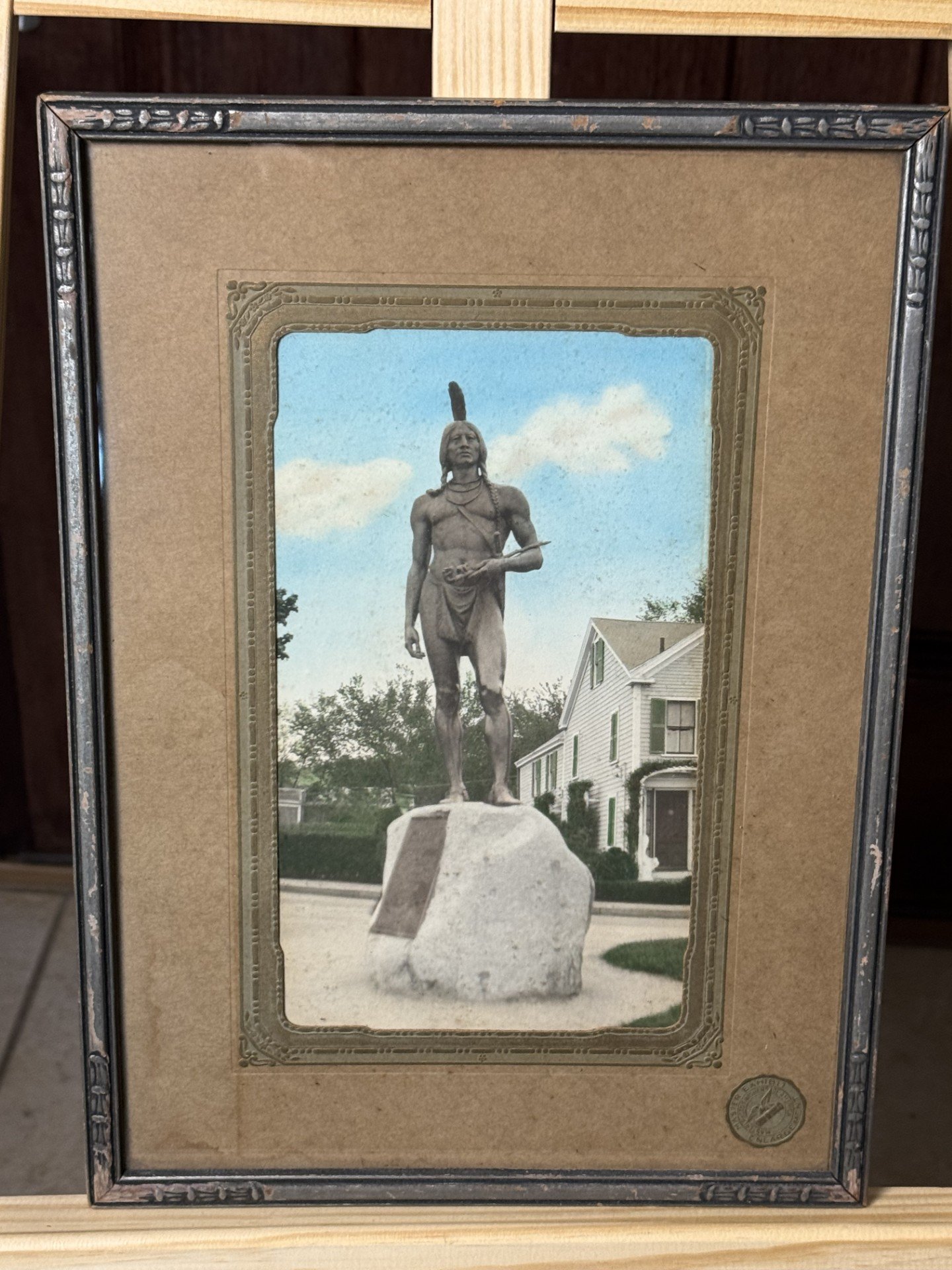
This framed photographic enlargement depicts Cyrus E. Dallin’s monumental bronze sculpture of Ousamequin, commonly known by the title Massasoit, on Cole’s Hill in Plymouth, Massachusetts.
American sculptor Cyrus E. Dallin (1861–1944) had deep artistic connections to the commemoration of Mayflower and Plymouth history. In addition to creating the monumental bronze Massasoit Ousamequin, installed on Cole’s Hill during the 1921 Pilgrim Tercentenary, Dallin designed the 1920–1921 Pilgrim Tercentenary half dollar, featuring Governor William Bradford and the Mayflower, and created the monumental Signing of the Mayflower Compact relief at the Pilgrim Monument in Provincetown. He also designed a statue of Governor William Bradford for Plymouth and was entrusted with supervising work to reunite the separated sections of Plymouth Rock.
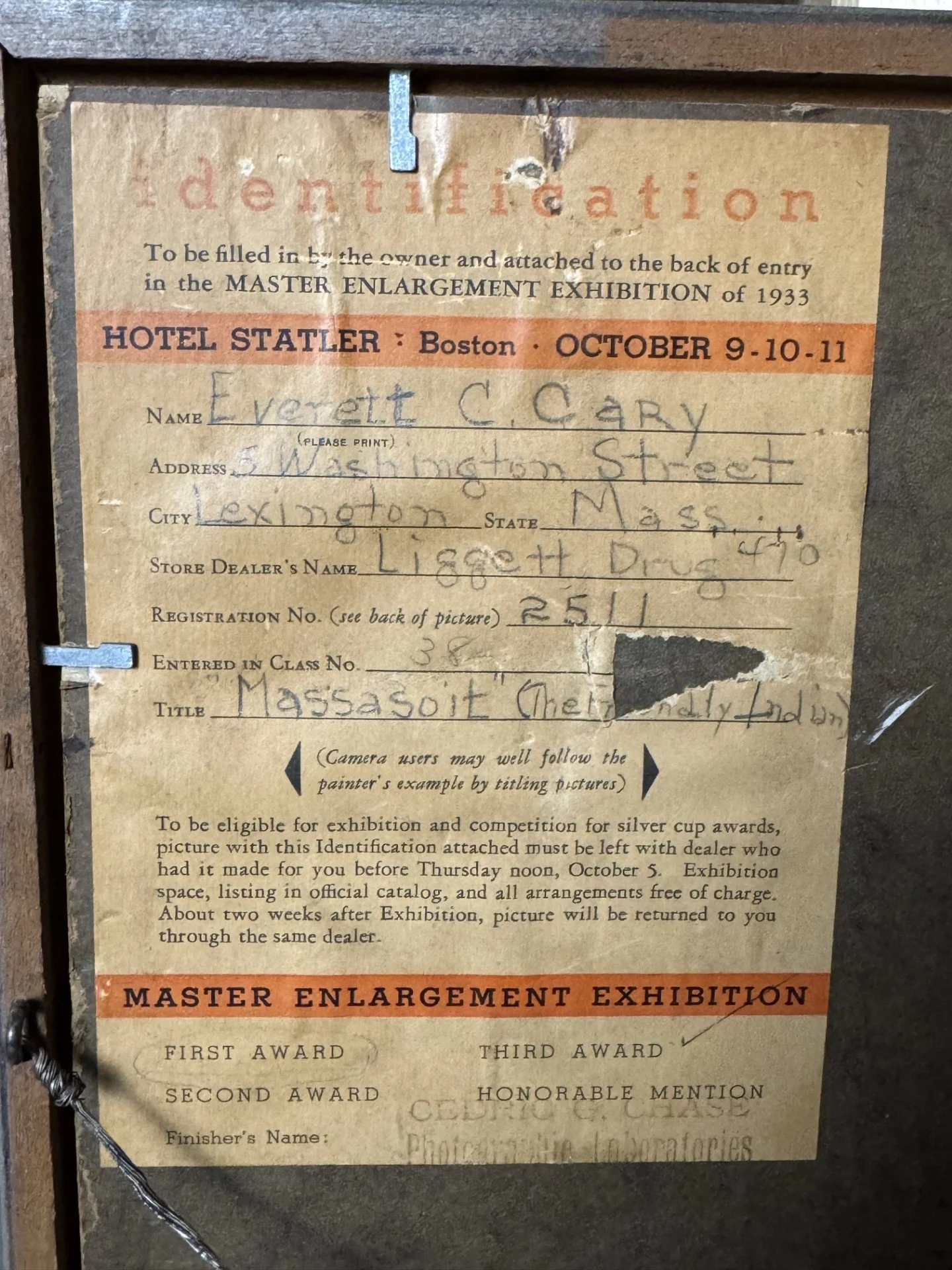
What makes the photograph particularly unusual is that much of its original exhibition history remains attached to the object.
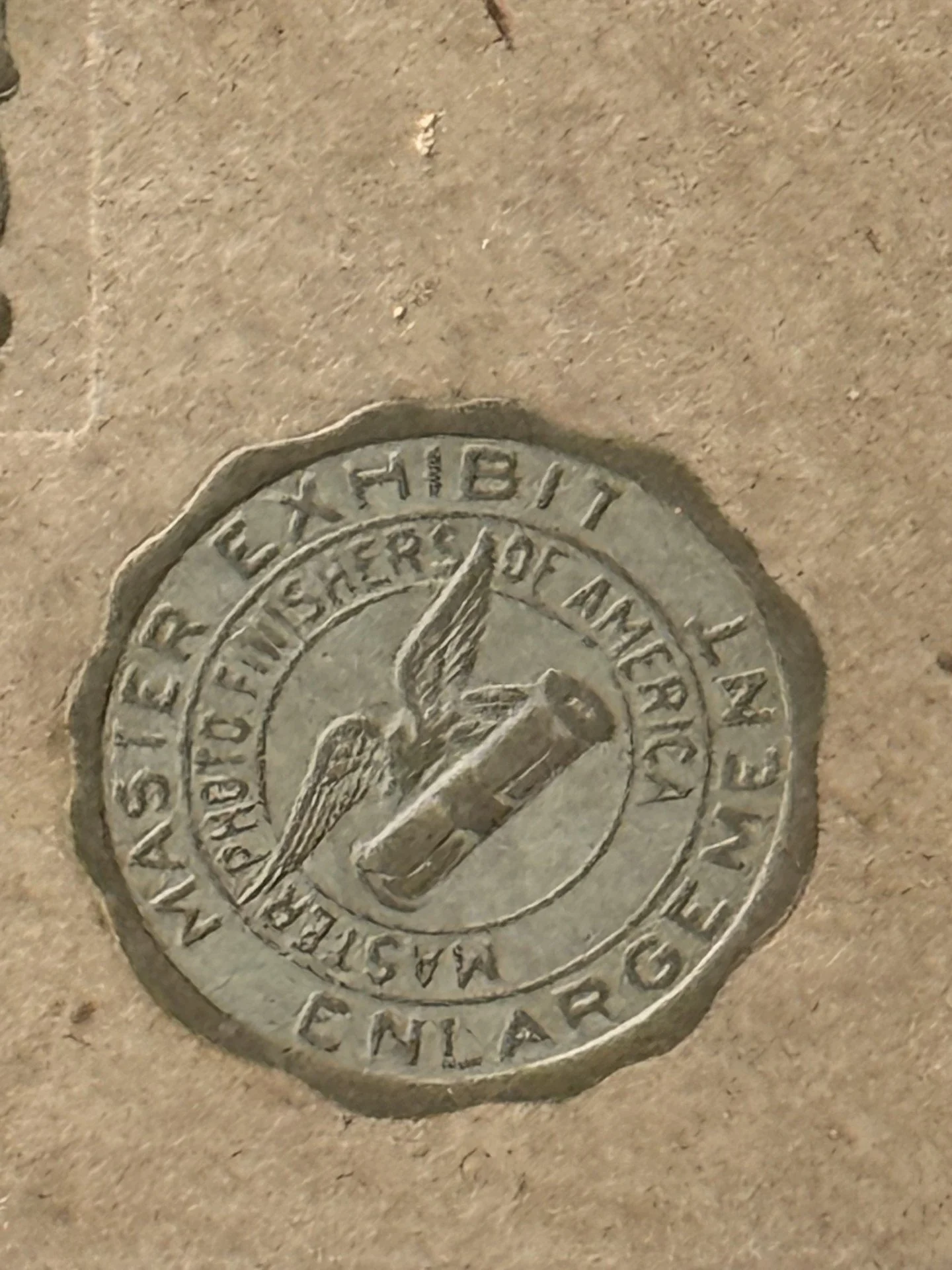
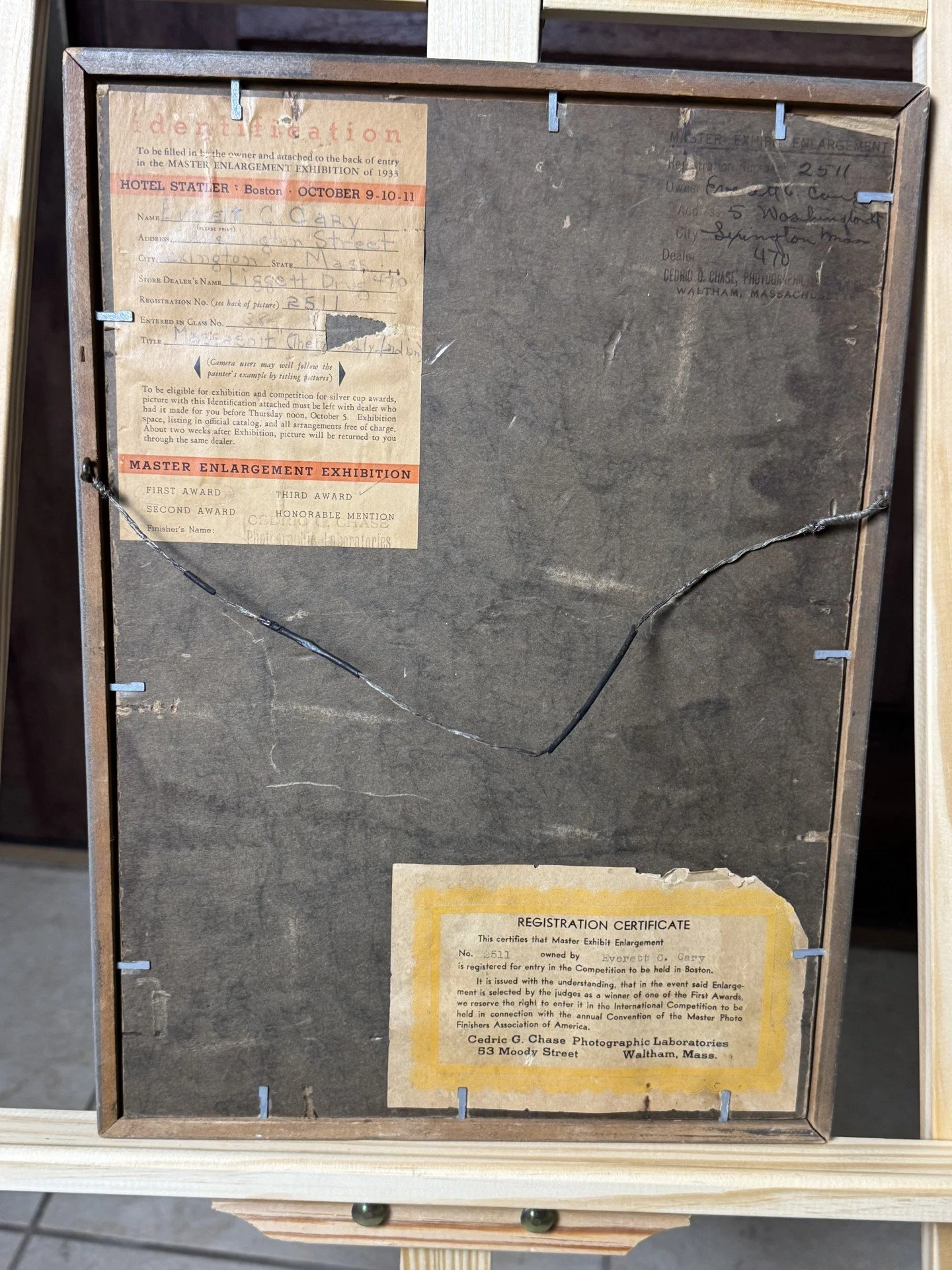
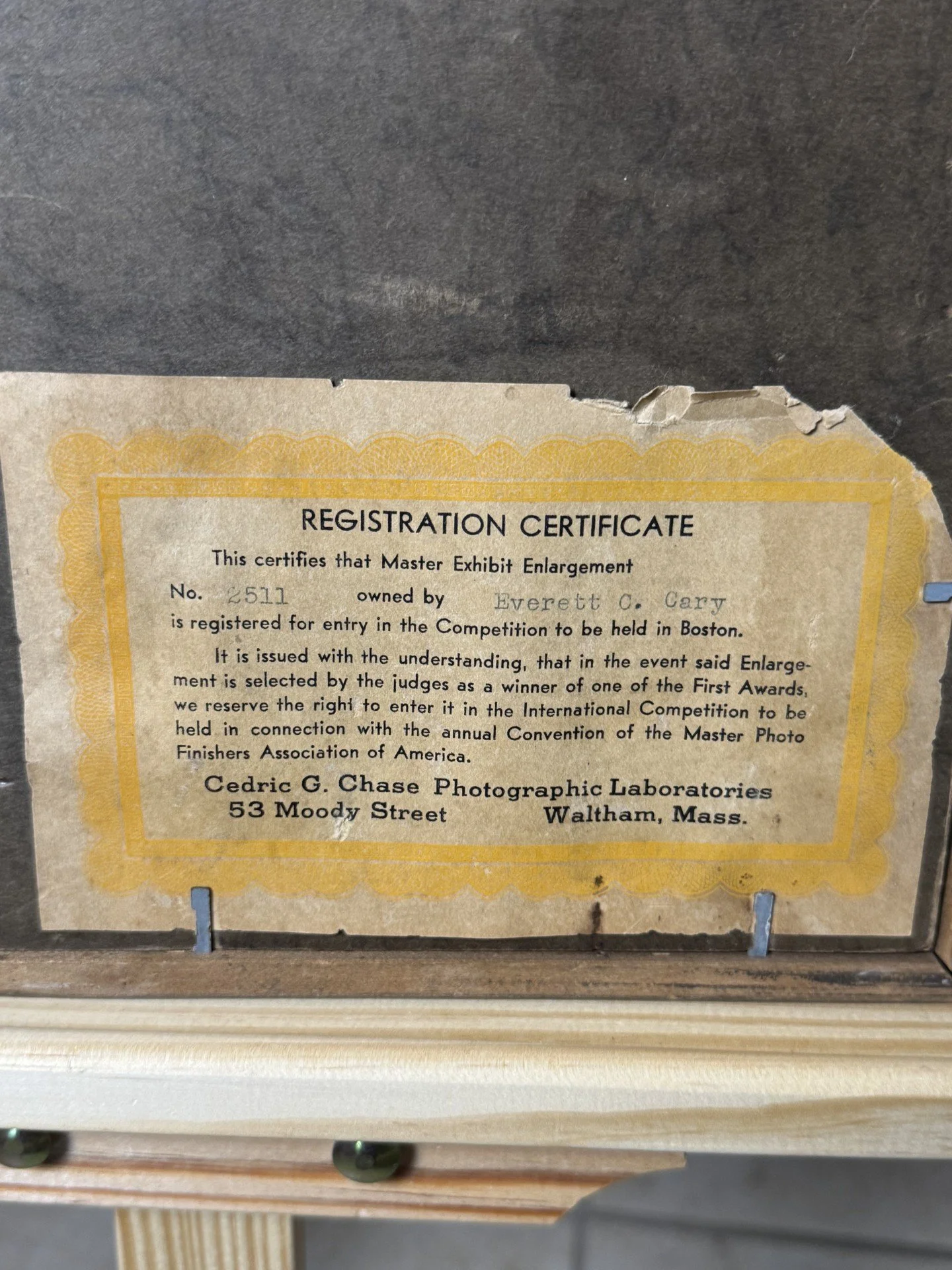
Labels preserved on the reverse identify the work as entry no. 2511 in the 1933 Master Enlargement Exhibition, held at the Hotel Statler in Boston on October 9, 10, and 11. The entry was owned and submitted by Everett C. Cary of Lexington, Massachusetts, and was processed through Cedric G. Chase Photographic Laboratories of Waltham.
Most significantly, the original exhibition identification label bears a check beside “Third Award,” documenting the enlargement’s recognition in the 1933 competition.
Together, the photograph, historic frame, exhibition labels, and registration certificate preserve much more than an image of a Plymouth monument. They document a moment in the history of photography, public commemoration, Wampanoag history, and the evolving ways Americans have interpreted the relationship between the Wampanoag and the Mayflower colonists.
Photography, Enlargement, and the 1933 Competition
The photograph was entered specifically in a “Master Enlargement Exhibition.”
Today, an image can be enlarged digitally almost instantly. In 1933, producing a successful photographic enlargement required specialized darkroom and photofinishing work involving exposure, printing, contrast, enlargement, finishing, and presentation.
Cedric G. Chase Photographic Laboratories operated at 53 Moody Street in Waltham, Massachusetts. Later city directories continue to identify the company at that address as a photographic laboratory and photo-finishing business.
The professional organization represented on the surviving exhibition paperwork was part of a substantial national industry. A 1933 federal report described the Master Photo Finishers as one of the two truly national associations serving the American photographic industry and reported approximately 1,721 members.
The surviving paperwork therefore places Cary’s photograph within a specific moment when camera ownership, commercial laboratories, photographic enlargements, and competitions were broadening the ways photographs could be transformed from small personal images into objects intended for public exhibition.
The Monument in the Photograph
The sculpture is Cyrus Edwin Dallin’s Massasoit, representing Ousamequin, the Pokanoket/Wampanoag leader whose diplomacy became central to the early history of Plymouth Colony.
The Smithsonian records Dallin’s monumental bronze on Cole’s Hill as dedicated on September 5, 1921. Massachusetts documentation identifies the approximately ten-foot bronze as a central feature of Cole’s Hill.
The timing of Cary’s photograph is therefore notable:
1921 — Dallin’s monumental representation of Ousamequin is installed in Plymouth.
1933 — Everett C. Cary’s photographic enlargement of the monument is exhibited in Boston and receives a Third Award.
Cary photographed the monument only about twelve years after it became part of Plymouth’s commemorative landscape.
Who Was Ousamequin, or Massasoit?
“Massasoit” was not his personal name but a title meaning “Great Sachem.” Ousamequin was a principal leader of the Wampanoag at the time the Mayflower colonists established Plymouth on Wampanoag homelands. The National Park Service notes that his people had recently suffered enormous population losses from epidemic disease and that the weakened Wampanoag also faced pressure from the Narragansett. Ousamequin’s decision to establish an alliance with Plymouth therefore occurred within a complicated Native political landscape.
In the spring of 1621, Ousamequin and Plymouth governor John Carver entered into an agreement of mutual aid. Surviving seventeenth-century accounts record promises that neither group would harm the other, stolen property would be restored, and each side would aid the other if attacked.
The relationship should therefore not be reduced simply to a story of friendship. It was diplomacy—a strategic agreement between two communities facing very different but serious challenges.
How Communication Became Possible—and Why the Alliance Mattered
Ousamequin did not need to speak English himself for diplomacy with Plymouth to take place. Communication depended heavily on Native intermediaries, especially Samoset and Tisquantum, also known as Squanto.
Samoset, an Abenaki sagamore who had learned English through contact with European fishermen and traders, made the first English-language approach to the Plymouth settlers in March 1621. Pilgrim Hall Museum identifies him as an emissary acting on behalf of Ousamequin. He subsequently introduced the colonists to Tisquantum.
Tisquantum’s ability to speak English resulted from a traumatic history that began years before the Mayflower arrived.
In 1614, English captain Thomas Hunt kidnapped Tisquantum and other Wampanoag men and boys and transported them to Europe to be sold into slavery in Spain. Tisquantum was eventually freed and made his way to England, where he lived in the household of London merchant John Slany and learned English. When he finally returned to his homeland in 1619, he discovered that epidemic disease had killed nearly everyone in his home community of Patuxet.
The Mayflower colonists subsequently established Plymouth on the site of Patuxet.
Tisquantum’s extraordinary and painful experiences therefore gave him a linguistic ability that became crucial after the colonists arrived. He served as an interpreter and guide between the Wampanoag and the English, although his later relationship with Ousamequin and the Plymouth leadership became politically complicated.
The assistance came at a moment when Plymouth’s survival was already precarious. The Smithsonian’s National Museum of the American Indian explains that approximately half of the Mayflower colonists died during their first several months and states directly that the English colonists needed help to survive.
Through the alliance, Native advisers such as Tisquantum and Hobbamock provided access to trade networks and knowledge concerning hunting, fishing, gathering, and the surrounding environment. The Smithsonian notes that Plymouth leaders themselves recognized an alliance with the Wampanoag as advantageous for both security and survival.
It would go beyond the historical evidence to claim with certainty that every remaining Plymouth colonist would have died without Ousamequin and the Wampanoag. What the evidence does support is that the settlement had already lost approximately half its people and remained highly vulnerable, and that Ousamequin’s decision to establish diplomatic relations—combined with the knowledge, interpretation, trade, and assistance provided by Wampanoag people—substantially improved Plymouth’s prospects for survival.
That is an important part of understanding why Ousamequin occupies such a central place in the intertwined histories of the Wampanoag and Plymouth Colony.
Native Presence—and Absence—in the Monument’s Early Ceremonies
At the monument’s 1921 unveiling, Charlotte Mitchell, also known as Wootonekanuske and identified as a descendant of Ousamequin, participated in the ceremony. Contemporary newspaper indexing records that she was selected to unveil the memorial to her ancestor.
Historians Lisa Blee and Jean M. O’Brien have documented that while Mitchell occupied a prominent ceremonial role, non-Native participants largely controlled the spoken interpretation of the monument. Mitchell later recalled that she had attended only after considerable urging and expressed resentment toward celebrations that commemorated English colonization while overlooking what Native peoples had lost.
The following year, the Massasoit Memorial Association held what organizers called the monument’s “real dedication.” Blee and O’Brien report that Mitchell apparently was not invited to return and that no Native people participated in the 1922 ceremony. The surviving evidence does not establish exactly why, so the Museum does not assign a motive that cannot be documented.
Together, these ceremonies raise important questions about public memory: Who creates monuments? Who participates in their interpretation? And whose voices are heard when history is commemorated?
A Monument About Historical Memory
Cary’s photograph records not Ousamequin himself, but a twentieth-century representation of him.
That distinction matters.
Dallin’s sculpture was created approximately three centuries after the events it commemorated. Scholars Lisa Blee and Jean M. O’Brien describe the monument as part of a commemorative narrative that emphasized Ousamequin as a welcoming diplomat and participant in the traditional story of Plymouth’s beginnings.
The monument therefore tells us about two historical moments simultaneously: seventeenth-century encounters between the Wampanoag and Plymouth colonists, and early twentieth-century American ideas about how those encounters should be remembered.
That interpretation has continued to change.
Today, Cole’s Hill is also associated with the National Day of Mourning. Massachusetts documentation notes that Native people gather there annually and that a modern National Day of Mourning memorial plaque provides another perspective on the consequences of European colonization.
The same physical landscape therefore contains multiple layers of historical memory: Plymouth’s Mayflower history, the monument to Ousamequin, and contemporary Indigenous perspectives on colonization and survival.
Three Moments in One Object
This photograph brings together several layers of history:
1621 — Ousamequin and the Wampanoag establish an alliance with the newly arrived Plymouth colonists at a moment when the English settlement is struggling to survive.
1921–1922 — Cyrus Dallin’s monumental representation of Ousamequin is unveiled and formally dedicated during the era of Plymouth’s tercentenary commemorations, revealing both the inclusion and the limitations of Native participation in early twentieth-century public memory.
1933 — Everett C. Cary photographs the monument, and his enlargement is exhibited in Boston and receives a Third Award.
For the Mayflower Descendants Museum, those layers are precisely what make the object meaningful. The photograph connects Wampanoag history, Mayflower history, survival and diplomacy, Native interpretation, public monuments, photographic technology, and the changing ways later generations have chosen to remember the events surrounding Plymouth Colony.
Object Information
Photographic enlargement
Subject: Cyrus E. Dallin’s Massasoit/Ousamequin Monument, Cole’s Hill, Plymouth, Massachusetts
Entrant/Owner: Everett C. Cary, Lexington, Massachusetts
Date of exhibition: October 9–11, 1933
Exhibition: Master Enlargement Exhibition, Hotel Statler, Boston
Registration no. 2511
Award: Third Award, as marked on the surviving exhibition label
Photographic finisher: Cedric G. Chase Photographic Laboratories, 53 Moody Street, Waltham, Massachusetts
Historic frame with surviving exhibition labels and registration documentation
Holdings of the Mayflower Descendants Museum
Sources & Further Reading
Pilgrim Hall Museum, “Treaty With Massasoit.” Presents the surviving seventeenth-century accounts of the 1621 mutual-aid agreement between Ousamequin and the Plymouth colonists.
Pilgrim Hall Museum — Treaty With Massasoit
Pilgrim Hall Museum, “Tisquantum / Squanto.” Explains Tisquantum’s kidnapping by Thomas Hunt, attempted enslavement in Spain, years in England, acquisition of English, return to Patuxet, and later role as interpreter.
Pilgrim Hall Museum — Tisquantum / Squanto
Pilgrim Hall Museum, “Samoset.” Discusses Samoset’s knowledge of English, his role as Ousamequin’s emissary, and his introduction of Tisquantum to the Plymouth colonists.
Pilgrim Hall Museum — Samoset
Smithsonian National Museum of the American Indian, Native Knowledge 360°, “Arrival of English Settlers.” Discusses the catastrophic first winter at Plymouth and the colonists’ need for assistance.
Smithsonian NMAI — Arrival of English Settlers
Smithsonian National Museum of the American Indian, “Threats to Relationships.” Discusses the strategic value of the Wampanoag alliance and the knowledge supplied by Native advisers including Hobbamock and Tisquantum.
Smithsonian NMAI — Threats to Relationships
U.S. National Park Service, “The Wampanoag.” Provides historical context for Ousamequin’s leadership, epidemic population loss, relations with the Narragansett, and the alliance with Plymouth.
National Park Service — The Wampanoag
Smithsonian Institution, “Massasoit,” Cyrus Edwin Dallin. Documents Dallin’s monumental bronze and its 1921 Plymouth dedication.
Smithsonian — Dallin’s Massasoit
Lisa Blee and Jean M. O’Brien, Monumental Mobility: The Memory Work of Massasoit, University of North Carolina Press, 2019. Examines the creation, unveiling, dedication, movement, and changing interpretation of Dallin’s monument, including Native participation and absence from its early ceremonies.
Oxford Academic — Monumental Mobility
Massachusetts Department of Conservation and Recreation, Pilgrim Memorial State Park documentation. Discusses the Massasoit statue on Cole’s Hill and the later National Day of Mourning memorial and observances.
Massachusetts DCR — Pilgrim Memorial State Park documentation
U.S. National Recovery Administration, Code of Fair Competition for the Photographic and Photo Finishing Industry, 1933. Provides contemporary information on the Master Photo Finishers and the scale of the American photo-finishing industry at the time Cary’s enlargement was exhibited.
1933 federal photographic-industry report